
THE CONTROL OF SWISS POCKET WATCH CASES (1880-1907): OFFICIAL HALLMARKS
SECTION I: THE FEDERAL LAW OF DECEMBER 23, 1880
Source: Basic texts of the Federal Control of gold and silver articles.
In Switzerland, control is compulsory for all watch cases bearing, in any language, an indication of fineness in milliemes or carats. However, an exception is made for low-fineness cases (below 14k [0.583] for gold and 0.800 for silver), which are not officially hallmarked; on the other hand, they must bear the maker’s mark if they feature an indication of fineness. All gold and silver articles bearing a designation of fineness cannot be of a lower standard than that indicated, subject to the legal testing tolerance (3 milliemes for gold and 5 milliemes for silver). No part of these articles may be of a lower fineness than that hallmarked or indicated. Exceptions are made only for the hinges of silver cases (under the manufacturer’s responsibility) and the push-piece tubes, for which the manufacturer did not request verification when presenting the cases for control.
“Galonné” (gold-rimmed) and “plaqué” (gold-plated) finishes on silver cases are admitted for control if the gold used in their manufacture resists the action of nitric acid at 32º on the Baumé hydrometer, which means that the gold used must be approximately 12 carats. Furthermore, it is forbidden to place any layer of copper between the gold and silver materials. Gold appliques (ornamental drops, thumbpieces, etc.) and inlays on silver cases must also have a minimum fineness of 12 carats (0.500).
For jewelry and silverware articles, control is optional. These articles must bear the maker’s mark to be admitted for hallmarking. Those articles that are of higher fineness (18k and above for gold and 0.875 and above for silver) may be hallmarked even if they do not contain an indication of fineness. As with watch cases, officially uncontrolled jewelry and silverware articles cannot bear any other indication regarding their composition or alloy than that of their actual fineness. If they bear this indication, they must furthermore feature the maker’s mark or sign registered in a control office (Art. 2, 1st paragraph of the Federal Law on Control of December 23, 1880). For all gold and silver articles, the indication of fineness is affixed by the manufacturer, and the hallmark of guarantee by the control offices. Designations tending to deceive the buyer are prohibited.
Characteristics and Dimensions of Official Hallmarks
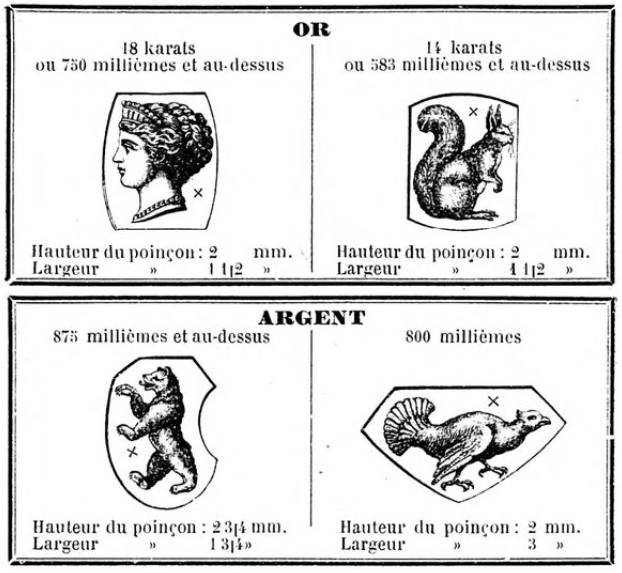
The control hallmarks for the different standards of fineness are as follows:
GOLD
18 carats or 750 milliemes and above: Bust of Helvetia in left profile framed in a shield with a rounded base. Height of the hallmark: 2 mm. Width of the hallmark: 1 ½ mm.
14 carats or 583 milliemes and above: Squirrel in profile facing right with an upper ‘X’. Height of the hallmark: 2 mm. Width of the hallmark: 1 ½ mm.
SILVER
875 milliemes and above: Bear rampant in profile facing left, with a lower ‘X’. Height of the hallmark: 2 ¾ mm. Width of the hallmark: 1 ¾ mm.
800 milliemes: Capercaillie (Tetras) in profile facing right framed in an elongated hexagon, with an upper ‘X’. Height of the hallmark: 2 mm. Width of the hallmark: 3 mm.
(The letter x indicates the position on the hallmark where the distinctive mark is located, allowing identification of the specific control office where the articles were hallmarked.)
Identification of the Control Offices (The Distinctive Mark « x »): The small « x » featured on the official hallmark designs is replaced by the specific identification letter of the Swiss assay office where the case was tested and stamped:
- Basel (*) / Berne (+) / Bienne (B) / Chaux-de-Fonds (C) / Delémont (D) / Fleurier (F) / Geneva (G) / Grenchen (g) / Locle (L) / Madretsch (L) / Neuchâtel (N) / Noirmont (n) / Porrentruy (P) / Saint-Imier (I) / Schaffhausen (S) / Tramelan (T) / Zurich (Z).
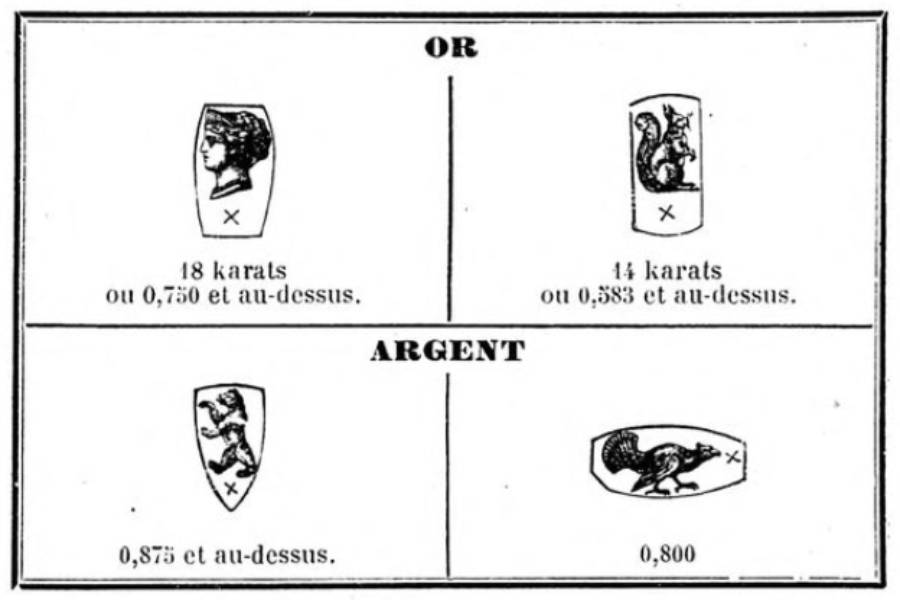
The dimensions of the hallmarks used to control the casebands (middle cases) and pendants of watch cases, jewelry, and small wares are more restricted than those indicated above. Furthermore, the framing of these small hallmarks is as follows:
GOLD (Small hallmarks)
18 carats or 0.750 and above: Tiny bust of Helvetia in a stylized three-pointed shield.
14 carats or 0.583 and above: Tiny squirrel framed in a vertical rectangle.
SILVER (Small hallmarks)
0.875 and above: Tiny bear rampant framed in a pointed shield.
0.800: Tiny capercaillie framed in a horizontally elongated oval.
For watchmaking, the hallmark is affixed to the inside of the case backs, on the cuvettes, on the case bands, and on the pendant (exceptionally, it is stamped twice on the case band if the pendant is too weak to receive an insculped mark). If requested, the hallmark may also be affixed to the bow, provided that the latter is solid and bears the maker’s mark. Jewelry is hallmarked on the essential parts of the body of the article, taking into account, as far as possible, the fragility of the objects.
SECTION II: IMPLEMENTATION REGULATIONS
Source: JSH, Fifth Year, No. 4, Official Acts.
ART. 2. Articles sent to the control office to be tested and hallmarked must be classified and separated by fineness standard. Each lot must be accompanied by a signed declaration from the producer, indicating the number and nature of the objects, the fineness, and the serial numbers. Jewelry, silverware, watch cases, and any pieces without serial numbers must, in order to be hallmarked, bear the maker’s mark or a distinctive mark known to the office.
ART. 3. Gold or silver articles presented for hallmarking will be tested in all their parts. To prevent them from being damaged by the taking of the assay sample, they must be brought fully assembled, unfinished, but sufficiently advanced in their manufacture so that during finishing, neither the insculped marks nor the articles themselves can undergo any change or alteration. Special instructions from the Federal Department of Commerce and Agriculture may further specify this provision, taking into account the different categories of articles.
ART. 4. No part composing a gold or silver article may be of a lower fineness than that of the article as a whole, regardless of the color of the alloys used in its manufacture or decoration. Exceptions are made for platinum or silver appliques and ornaments placed externally, as well as hinges on silver cases, subject however to the provisions of Article 8.
ART. 5. The hallmark will be applied to all essential parts of the article, namely: For watch cases: a) On the casebacks; b) On the cuvette; c) On the caseband; d) On the pendant. At the request of the manufacturer, the hallmark may also be affixed to the bow. Hallmarks with the same design as those mentioned above, but smaller, will be used to hallmark jewelry, silverware, casebands, pendants, etc. If the cuvette is made of a metal other than the one hallmarked, it must bear the exact indication of that metal written out in full. Additions to the indication of the standards of 18k for gold or 875 milliemes for silver of the first standard (first silver, first gold, erster Feingehalt, and identical translations in other languages) will be admitted for federal hallmarking.
ART. 6. If gold or silver articles contain, externally or internally, parts of a lower fineness than that stated in the declaration or the insculped mark, these parts will be cut by the sworn assayer in the presence of a member of the administration, without prejudice to the penalties provided by law.
ART. 7. Gold or silver articles containing inner parts of lower fineness, an excess of solder, or metals, alloys, or foreign substances foreign to those composing the body of the article are declared “filled” (fourrés). Objects found to be filled will be cut by the sworn assayer in the presence of a member of the administration, without prejudice to the penalties provided by law.
ART. 8. When articles submitted for hallmarking are intended for a country that requires full standards or standards slightly higher than those fixed by federal law, or which does not admit the exceptions provided for in Article 4, it is up to the producer to take the necessary precautions in this regard. The Swiss control office incurs no responsibility if, having affixed the federal hallmark while taking into account the legal tolerance or the exceptions provided for in Article 4, the articles in question were subsequently cut or refused by a foreign control office.
Primitive Hallmarking Tariff (Art. 9)
- a) For an open-face gold case: Fr. 0.15
- b) For a hunting-case gold case: Fr. 0.20
- c) For an open-face silver case: Fr. 0.05
- d) For a hunting-case silver case: Fr. 0.10
- e) For a gold bow: Fr. 0.05 (subsequent adjustment)
- f) For a silver bow: Fr. 0.02 (subsequent adjustment)
For jewelry: e) Per piece up to 10 grams: Fr. 0.05; f) From 10 grams and above: Fr. 0.15. For silverware: g) Per piece up to 150 grams: Fr. 0.05; h) From 150 to 300 grams: Fr. 0.15; i) From 300 grams and above: Fr. 0.50. These fees must be strictly observed. However, the Federal Council may authorize a slight increase in favor of offices that do not cover their annual expenses. For articles presented to the office that cannot be hallmarked, the testing fee will be doubled as a fine.
Administrative Provisions and Organization of the Offices
ART. 10. Each hallmark will have a distinctive mark, which will reveal in which control office the articles were hallmarked.
ART. 11. The cantons determine matters relating to the administrative organization of the control offices. There shall be a supervisory commission for each office. The cantons must ensure that suitable premises are made available to the offices, so that employees can work comfortably and the public does not have access to the laboratories and assayers’ offices.
ART. 12. The cantons must grant authorization to open a control office to any municipality or association of municipalities that provides proof that it is able to strictly comply with the law and regulations on the matter, and that undertakes to bear any eventual deficit that the office might incur. The federal authority may object to the opening or order the closure of an office that is not organized under conditions offering sufficient guarantees.
ART. 16. In accordance with Article 4 of the law on the control and guarantee of the fineness of gold and silver articles, a federal control office will be established. Its purpose shall be: 1) To train assayers possessing the necessary theoretical and practical knowledge; 2) To administer examinations to obtain the federal certificate; 3) To verify, in the event of a dispute, the testing performed by the cantonal offices.
ART. 17. In the event of a dispute, the verification of tests at the federal control office shall be final and without appeal. The articles will therefore be either hallmarked or cut. For the revision, four times the tariff fixed by the cantons shall be paid. The costs will be paid by the party that made the error.
ART. 21. Assayers and control employees may under no circumstances engage in the trade of either finished articles or gold and silver raw materials. The Federal Department of Commerce and Agriculture may demand the suspension or dismissal of an assayer or employee who does not perform their duties properly. In the case of gross negligence on the part of a sworn assayer, the Department has the right to revoke their diploma, subject to appeal to the Federal Council.
ART. 22. It is expressly forbidden for assayers, employees, and members of supervisory commissions to take or give tracings, verbal or written indications, or to copy or allow the copying of models, designs, and decorations of articles sent to the office to be either simply tested, or tested and hallmarked.
ART. 23. In each control office, two metal registry plates are deposited, intended to receive, according to a serial number, the impression of the maker’s marks or distinctive signs of the producers of gold or silver articles falling under the jurisdiction of that office (Art. 2 of the law). Any producer required to deposit their mark is bound to declare at the same time their domicile and industry.

Special Transitional Ordinance: The Bee Hallmark
ART. 1. As of September 1, 1881, the cantonal control offices may admit gold and silver articles for ad hoc hallmarking or lead sealing with the hallmark described below, in accordance with the following provisions: [Hallmark: A worker bee, back view with wings spread].
ART. 2. Watch cases bearing one or the other of the indications mentioned in Article 1, letter a, of the Federal Law, and which are not marked with the control stamp of a Swiss canton or any other State whose hallmark is recognized as equivalent, may receive either the hallmark corresponding to the indicated fineness or, if this insculped mark is not possible, an ad hoc lead sealing, according to the instructions that will be given to the offices.
ART. 3. Articles bearing the indication of other standards of fineness without being accompanied by the maker’s mark or sign will be admitted to receive an ad hoc hallmark or to be lead-sealed, so as to establish proof that they were manufactured prior to the entry into force of the Federal Law. The official assay must demonstrate that the indication of fineness is real.
Foreign Language Inscriptions and Export Equivalencies (Decree of December 1881):
- For Gold: Authorized terms included « premier or », « or fin », or the Russian zolotnik numbers « 72 » (for 18k / 0.750 full) and « 56 » or « 58 » (for 14k / 0.583). In March 1882, offices were instructed that cases marked « 58 » had to test at a true fineness of 0.604 (14½ k).
- For Silver: Authorized terms included « premier argent », « argent de pièce », « argent pur », or « 84 » (Russian zolotnik 0.875). Cases marked « argent fin » or « argent à pièces » were required to meet a 0.900 standard.
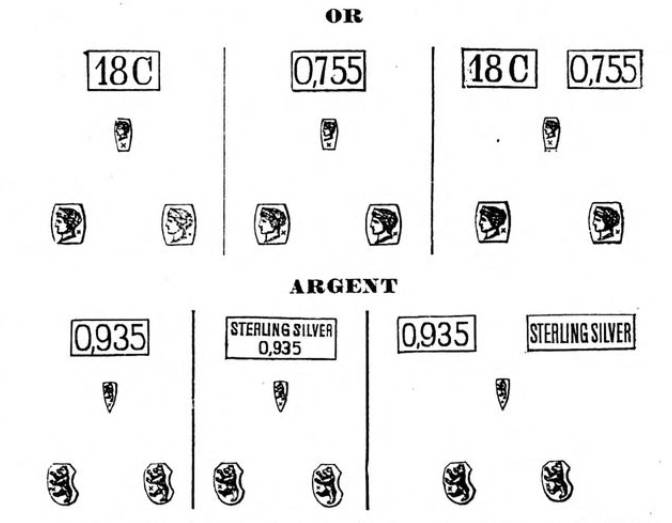
- The Sterling Silver Conundrum (0.935 Standard): For cases destined for the British market, Switzerland established a 0.935 minimum fineness under the Bear hallmark. This elevated standard stemmed from the long-standing continental assumption that English sterling was equivalent to “935 millièmes” (as documented in the Paris Revue Contemporaine of 1866). It also provided a crucial safety margin (remède); while Swiss law allowed a 5/1000 tolerance, British assay offices permitted none. Any imported case testing below 0.925 in Britain was legally smashed.
- Ounce-Based Fineness (Argent T13 and T14): Inscriptions tracking the ounces of fine silver per pound of alloy. « Argent T14 » equaled 14 ounces (0.875 fineness without tolerance), whereas « Argent T13 » equaled 13 ounces (theoretically 0.813, which adjusted through the allowed statutory tolerance to match the 0.800 minimum required by the Capercaillie hallmark).
Integrity of the Bow: The pendant bow (the ring from which the watch is suspended) was strictly required to be made of the exact same fineness and material as the outer case.
SECTION III: STATISTICAL DATA AND GEOGRAPHY OF CONTROL (1882-1886)
Source: Comparative table of hallmarking, lead sealing, and assaying (Swiss control offices)
The industrial fabric of Swiss watchmaking following the implementation of the 1880 law is characterized by the geographical concentration of the volumes of cases presented and the varying severity of the assays..
Volume Distribution and National Hallmarking Average (1882-1886)
La Chaux-de-Fonds (Canton of Neuchâtel): Average of 27.2% of the total Swiss volume. Stable annual volumes fluctuating between 286,539 (1882) and 304,107 (1886) pieces.
Bienne (Canton of Bern): Average of 15.2%. Marked expansion in 1886 with 232,356 cases hallmarked.
St-Imier (Canton of Bern): Average of 11.1%. Progression from 99,369 (1882) to 154,743 (1886) pieces.
Le Locle (Canton of Neuchâtel): Average of 10.7%. Constant production reaching 131,749 cases in 1886.
Madretsch (Canton of Bern): Average of 10.7%. Massive integration starting from 1883 with 143,415 pieces.
Tramelan (Canton of Bern): Average of 6.9%. Activity fluctuating around 82,189 pieces in 1886.
Fleurier (Canton of Neuchâtel): Average of 4.5%. Volume rising to 54,040 cases in 1886.
Geneva: Average of 4.3%. Downward trend, decreasing from 52,848 (1882) to 37,252 (1886) pieces, but characterized by higher weight cases.
Schaffhausen: Average of 4.0%. Progression from 34,879 to 50,639 pieces in 1886.
Noirmont (Canton of Bern): Average of 3.5%. Office opened in 1884 with 48,005 pieces, climbing to 89,293 in 1886.
Neuchâtel: Average of 1.9%. Residual volume on the decline, ending at 11,416 pieces in 1886.
Zurich: No activity recorded over the period.
Volume of Rejected and Destroyed Cases (Example of the 1885 Severity Peak)
In direct application of Articles 6 and 7 of the regulation, the volume of cases intercepted and destroyed by physical cutting reached a national total of 7,177 pieces in 1885, distributed among the offices as follows:
La Chaux-de-Fonds: 3,134 cases cut.
Le Locle: 941 cases cut.
Bienne: 697 cases cut.
St-Imier: 567 cases cut.
Madretsch: 561 cases cut.
Fleurier: 396 cases cut.
Tramelan: 272 cases cut.
Geneva: 219 cases cut.
Neuchâtel: 126 cases cut.
Schaffhausen and Noirmont: No rejected cases recorded during this fiscal year.
SECTION III BIS: THE LIBERALIZATION OF 1886 AND THE OPENING TO PRIVATE ASSAYERS
Source: Execution of the federal law of June 17, 1886 on the trade of gold and silver scrap (Federal Department of Commerce and Agriculture, Berne, December 24, 1886).
Faced with a massive increase in watch production and the subsequent bottlenecking of official State laboratories, the federal law of June 17, 1886 introduced a major historical turning point: opening the system of control and treatment of precious metals to private companies and industrial entities, duly accredited and sworn in by the Confederation.
This regime brought an end to the State’s execution monopoly while maintaining strict federal oversight. From this point forward, commercial manufacturers were authorized to act directly under highly regulated professional categories:
The Hallmarking and Guarantee of Fineness: Unlike the official State offices, which continued to stamp the national hallmarks of guarantee (Helvetia, Squirrel, Bear, Capercaillie), these authorized commercial assayers and melters marked the ingots, materials, or pieces with their own registered maker’s mark or commercial assayer’s punch. By doing so, they legally guaranteed the fineness of the metal under their own civil and criminal liability toward the federal authority.
Register of the First Appointed Industrials (Decree of December 24, 1886)
In execution of Article 1 of the law, the Federal Department issued the first official authorizations to the key players of the Jura and Geneva industrial sectors, categorized as follows:
1º Buyers, Melters, and Assayers (Acheteurs, fondeurs et essayeurs):
Bienne: H. Carrel, P. F. Courvoisier.
Le Locle: L. E. Renaud.
La Chaux-de-Fonds: A. Michaud, A. Défer & Cie., Larrivée & Cie..
Geneva: Usine de dégrossissage, L. Hoffmann, L. and M. Frutiger, Francisque Fontaine.
2º Buyers and Melters (Acheteurs et fondeurs): An extensive group of trusted manufacturers, heavily concentrated in Fleurier (W. Stædele, Ferd. Ghirardi, Jos. Musa, D. Ghirardi and J. Musa, Emile Perret), Le Locle (F. Lobrot, Justin Quartier, Augustin Musa, Jacquet frères), La Chaux-de-Fonds (François Farine, P. F. Courvoisier, O. Mandonnet, Vve A. Courvoisier, J. Laubscher, David Calame, Oscar Seclier, Ch. Perrochet), and St-Imier (Jean Santschi, Paul Musa).
3º Buyers and Assayers (Acheteurs et essayeurs):
Zurich: M. Jacques Heer.
4º Buyers (Acheteurs): A select list of reputable commercial and banking houses including the Banque du Locle (Le Locle), Pury & Cie. and Fritz Chatelain (Neuchâtel), or Th. Sandoz-Gendre alongside B. Pantillon (La Chaux-de-Fonds).
5º Melters and Assayers (Fondeurs et essayeurs): This status was granted directly to the laboratories of the Control Offices of Noirmont, Madretsch, Bienne, Neuchâtel, Locle, and Chaux-de-Fonds.
6º Assayers (Essayeurs): Attributed specifically to the localized operations of the Control Offices of Fleurier and Tramelan.
SECTION IV: MARKET MATURITY AND EVOLUTION AT THE TURN OF THE CENTURY (1899 EDITION)
Source: Official guide compiled by Charles Savoie, Director of the Federal Office, Bern, August 1899.
Control in Switzerland does not pursue a fiscal purpose; it is the subject of an industrial and commercial regulation law. The tariff revised at the end of the century maintains the double fee for watch cases presented in a finished state. Metal cuvettes (copper, etc.) in watch cases are admitted provided they bear the clearly legible insculped mark “metal” (“copper”, etc.). There are currently 13 control offices in Switzerland, namely: Bienne, Chaux-de-Fonds, Delémont, Fleurier, Geneva, Grenchen (Solothurn), Le Locle, Neuchâtel, Noirmont, Porrentruy, St-Imier, Schaffhausen, and Tramelan.
Last year, they hallmarked 3,570,229 watch cases, consisting of 577,237 gold cases and 2,992,992 silver cases, 40,866 jewelry and silverware articles, and performed 17,787 assays on gold and silver ingots. The technical directors receive directives from the federal authority, whereas from an administrative and financial standpoint, they fall under the jurisdiction of the cantons or municipalities (or associations of interested parties). In addition to hallmarking, these offices are responsible for supervising the trade in scrap gold and silver (Federal Law of June 17, 1886). The volume of scrap transactions in 1898 amounted to the sum of Fr. 3,701,118.
The Export Regime and Foreign Regulations in 1899
FRANCE
Control is mandatory and forms part of the indirect taxation service (service des contributions indirectes). Hallmarking (guarantee duty) is paid by weight; for gold, Fr. 0.37 ½ per gram, plus Fr. 0.02 ½ per gram for assaying, making a total of Fr. 0.40 per gram; and for silver, Fr. 2.00 per hectogram, plus the assaying fee of 5 centimes per fraction of 25 grams. Imported articles found not to be of the legal standard of fineness are re-exported at the owner’s expense, who pays the assaying fees; otherwise, these articles are smashed.
“Weevil” Hallmark (Poinçon « Charançon »): Used for the control of articles imported from Switzerland (within a horizontal oval for gold, and within a horizontal rectangle for silver). The guarantee duty is refunded for re-exported unsold articles after the hallmark has been canceled (obliterated).
Foreign Provenance Hallmarks: For gold, watch cases receive the “Owl” (hibou) hallmark within a vertical oval, and for silver, the “Swan” (cygne) hallmark within a horizontal oval.
The offices at the Swiss border are Bellegarde, Pontarlier, and Montbéliard. The legal fineness standards for gold are: 0.920, 0.840, and 0.750 (the most frequently used); plus 0.583, for export only. This special 4th standard is marked with the “Egyptian Head” hallmark and the insculped mark EXP / 583 M within an ellipsoidal frame inside the watch casebacks. For silver, the standards are: 0.950 and 0.800. Gold appliques on silver cases (hinges, olivettes / oval thumb-pieces, pipes) cannot be of a lower standard than 0.750 (18k), as is also required for the gold leaf used for the crowns (rims).
GERMANY
State control (a special state hallmark) does not exist. The law of July 16, 1884, concerns the fineness standard of articles, which for watch cases cannot be lower than 0.585 for gold and 0.800 for silver (tolerance for the article melted as a whole: 5 thousandths for gold, 8 for silver). Gold and silver jewelry may be marked with any standard in thousandths, but the German Imperial Crown cannot be applied to jewelry. For watch cases, the most frequently used standards are 0.750 and 0.585 for gold, and 0.800 for silver. The indication of fineness must be expressed in thousandths, accompanied by the maker’s mark (registered at the Commercial Court in Leipzig) and the German Imperial Crown applied by the maker:
Within the sun symbol for gold: Imperial crown inside a circular sun.
Within the moon symbol for silver: Imperial crown next to a crescent moon.

Swiss control is recognized in Germany as substituting for the required marks. Following the entry into force of the German law (1887-88), these cases must be of the full indicated standard of fineness, specially hallmarked in Switzerland with two impressions of the control hallmark (to the left and to the right of the fineness indication in thousandths) along with the German Imperial Crown.
ENGLAND
For watch cases destined for ENGLAND, analogous requirements exist in Switzerland to those mentioned above, with this difference, however, that instead of two insculped marks of the federal hallmark, there are three, which are applied below the indication of the fineness standard, as follows:
The fineness standards are therefore given slightly higher than for articles destined for Germany. The hallmarking of watch bows (rings) is mandatory. Since control is optional in England, the trade prefers the Swiss hallmark, which is applied at the factory, that is to say, before the importation of the articles into England.
The standards are higher than for Germany. The hallmarking of watch bows is mandatory. Since control is optional in England, the trade prefers the Swiss hallmark affixed at the factory.
AUSTRIA-HUNGARY
Control is mandatory in thousandths. Fineness standards: 0.920; 0.840; 0.750 and 0.580 for gold, and 0.950; 0.900; 0.800 and 0.750 for silver. Imported articles must be at least of the lowest domestic standard (0.580 for gold, 0.750 for silver). These articles are delivered by customs to the control offices and hallmarked using the « Ausland » mark:
For gold: Escudo con doble “X” y aspas stylisées.
For silver: Escudo con letras “A” y “V” entrelacées.

Marking applied to the pendants (bow necks). Gilded or gold-plated crowns and watch bows (rings) are not permitted. Gold appliques on silver cases must be at least 0.580. Metal cuvettes (inner lids) are permitted; they must bear the indication “metal” (Metall) visible on the outside of the cuvette (Austrian ordinance of February 22, 1889).
ITALY
Does not have mandatory control in 1899; a draft law is under study. Articles bearing the Swiss hallmark are introduced without difficulty.
RUSSIA
According to the regulation that came into force on July 1, 1896, watch cases are subject to mandatory control. The articles are hallmarked in figures giving the number of zolotniks contained in one pound of alloy (the Russian pound weighs 409 gr. 496, divided into 96 zolotniks; 1 zolotnik = 4.26559 gr.). Frequently used standards for gold: 56 and 72 (equivalent to 0.583 [14 k.] and 0.750 [18 k.]); for silver: 84 (corresponding to 0.875). Watch bows (rings) and crowns cannot be of a lower standard than the case.
In view of Article 25 of the Russian regulation of 1896 (the average fineness, including solder, must not exceed the tolerance of 3 thousandths for gold and 5 for silver), the Swiss Federal Council, on June 8, 1896, issued a decree prescribing that for cases bearing Russian indications, federal control is mandatory and must show the full indicated standard, without tolerance (full 0.750 for 72; full 0.585 for 56; full 0.875 for 84). Gold appliques on silver cases must be at a minimum standard of 0.585 (56).
OTHER COUNTRIES (Spain, Portugal, Belgium, Netherlands, Denmark, Sweden, Turkey, United States, etc.)
Control is optional or does not exist at all; manufacturing and trade are free. The special laws of certain countries have become a dead letter (as in the case of Portugal and Sweden in 1899). Most watch cases sold in Denmark and Scandinavian countries are hallmarked in Switzerland as for Germany (standard in thousandths, Swiss hallmark, imperial crown within the sun symbol for gold and moon symbol for silver).
SECTION V: THE EXPORT MUTATION OF WATCHMAKING (1907 DOCUMENT)
Source: Technical Update Report by Charles Savoie, Director of the Federal Bureau, Berne, September 1907.
Legislative Developments by Country as of September 1, 1907
ROMANIA
Articles bearing the official Swiss hallmark benefit from facilities. The fiscal hallmarking taxes are, for gold watches, 4.10 Lei (francs) per piece and, for silver watches, 1.10 Lei. The maker’s mark is mandatory. Gold watch cases with 14 k. gold-plated steel watch bows (rings) are permitted.
BULGARIA
Law of 1907 (entered into force in 1908). Control is mandatory for all articles. The fineness standards are, for gold: 0.920; 0.840; 0.750; 0.583; 0.500, and 0.333; for silver: 0.950; 0.900; 0.850; 0.750, and 0.500. Articles must bear the maker’s mark. Gold watches pay 4 fr. per piece, silver ones 1 fr.
CANADA
A law of July 13, 1906, which entered into force on July 13, 1907, prescribes a minimum fineness standard of 10 karats (0.417) for gold articles, and additionally the official standards of 14 karats (0.583) and 18 karats (0.750). The degree of fineness for “sterling silver” is equivalent to 0.925. Official Swiss standards, guaranteed by the application of the federal control hallmark, are recognized in Canada.
UNITED STATES OF NORTH AMERICA
Law of June 13, 1906, which entered into force on June 13, 1907, for the suppression of false indications of fineness. System based on a punitive regime upon complaint by a third party. Main provisions: Complete freedom of standards; obligation for any silver article bearing the mark “sterling” to be at the standard of 0.925, and for those bearing the mark “coin” to be at 0.900. Obligation for every watch case to be in all its parts at the indicated standard, subject to a tolerance of 3 thousandths for the constituent gold; 4 thousandths for silver. Gilded, plated, or silvered metal cuvettes (inner lids) must legibly bear one of the insculped marks: « gold plated » or « silver plated ».
AUSTRALIA
Provisions of the “Commerce Act” of 1907. Every indication must conform to the exact composition of the gold or silver used. Cases bearing the official hallmark of federal control, without any addition, are admitted without any other indication of origin. On the other hand, when Swiss-made watches bear English words, or fineness indications in the English language, or names of merchants established in Australia, the designation « Swiss made » or « made in Switzerland » is required. The same applies to gold-plated watch cases, in which it is permissible to insculpe the indication « Rolled Gold » or « Gold plated », provided they bear the designation “Swiss made” in legible characters and near the mark. Regarding jewelry, every article must be provided with a label bearing the designation of the nature of the metal and its country of origin.
SITUATION OF OTHER COUNTRIES IN 1907
In other countries (Spain, Portugal, Belgium, Denmark, Turkey, Republics of South and Central America, Egypt, China, Japan, etc.), control is optional or does not exist at all. Some of them have introduced mandatory control through special laws, but these laws have fallen into disuse (reaffirmed case of Portugal). Gold and silver articles manufactured in Switzerland and bearing the federal control hallmark are sold there without any other formality than the payment of customs duties.
