In the mid-19th century, a time when the Neuchâtel Jura was shaping the future of timekeeping, James-Emile Favre-Fallet emerged as a prominent figure in the watchmaking industry of Saint-Imier. Born Favre-Bulle and married to Ida Fallet, he belonged to a lineage tracing its origins back to pioneers such as Daniel JeanRichard, successfully transforming a technical family heritage into an organized and respected manufacture.
Industrial Structure and a Strong Brand Identity
Far from the image of the simple artisan, period archives and press announcements reveal that James-Emile directed a true watch manufacture (Fabrique d’horlogerie). By hiring specialized craftsmen—jewel setters, escapement pivoters, and finishing watchmakers (horlogers-acheveurs)—he demonstrated a modern approach to the production of movements, dials, and watch cases.
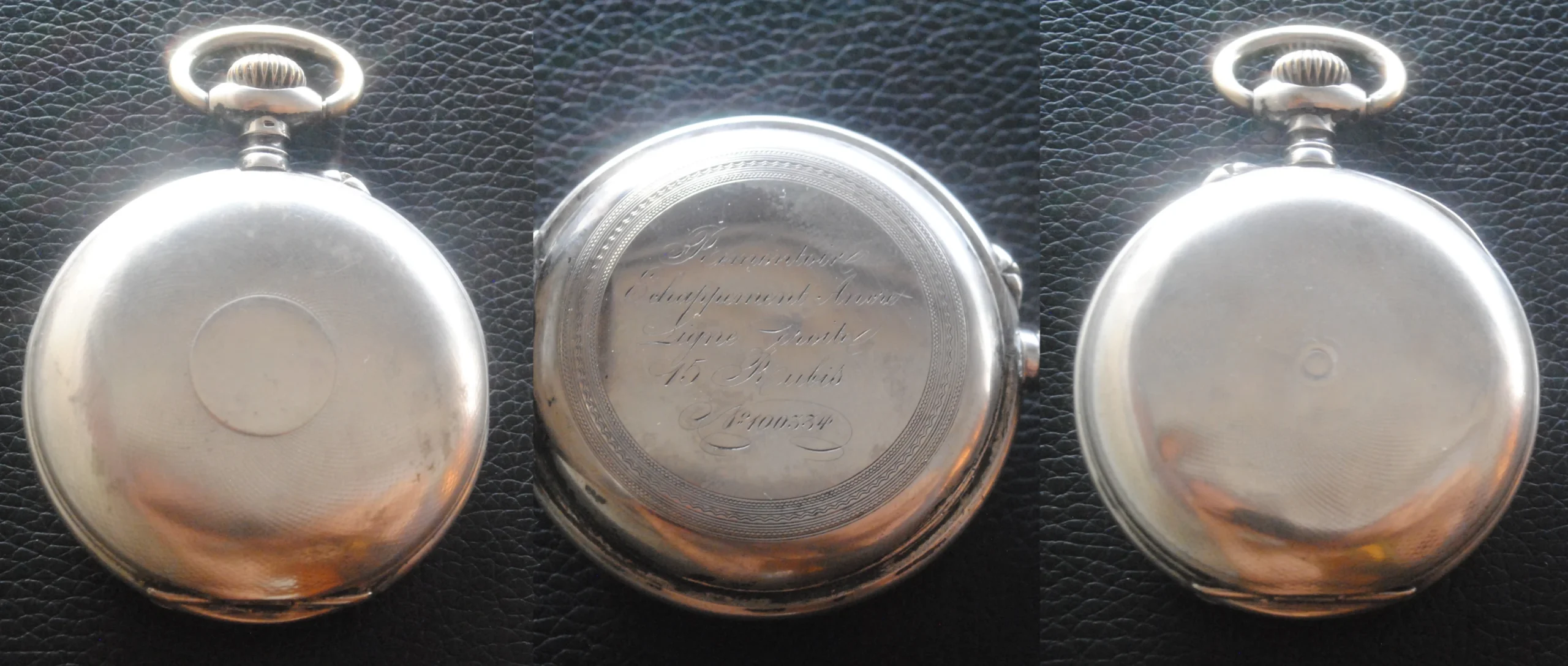
James Favre-Fallet hunter case pocket watch, circa 1891, engraved and guilloché with tight waves in 800 silver, bearing the «coq de bruyère» assay mark from the Bienne Assay Office. The cuvette is engraved: "Remontoir - Echappement à ancre - Ligne droite - 15 rubis - Nº 100334". Author's collection.
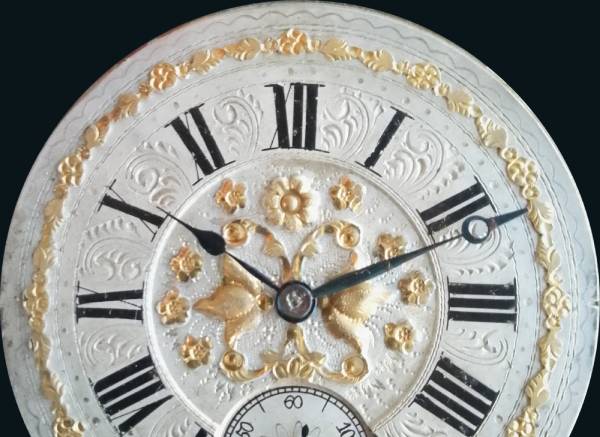
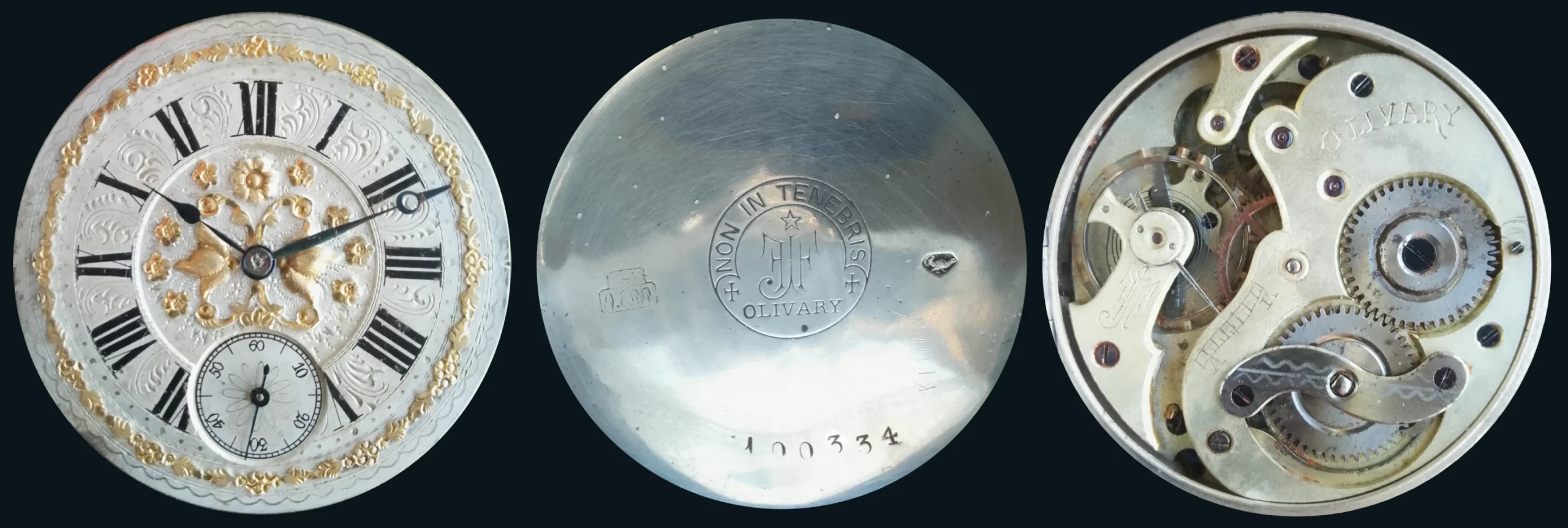
James Favre-Fallet pocket watch, circa 1891, featuring a silvered Victorian-period dial in the «Genre Espagne» style. The center of the composition is decorated with multi-toned gilt elements stamped in low relief, forming a floral motif set against a finely stippled, hand-engraved silver ground. The circular chapter ring carries hand-painted Roman numerals in lampblack, separated by hand-engraved palm-like motifs in the inter-hour spaces. The perimeter is enclosed by a floral garland of multi-toned gilt forms, with radial flutes stamped along the outer rim and regular concave dots marking the minutes. The small seconds sub-dial displays a starburst guilloché centered on the hand arbor. The dial is fitted with a blackened steel hour hand in the «Poire Stuart» style and a minute hand in the «Breguet Empire» style. The 19-ligne, ½-plate movement features stem winding via the pendant and hand-setting via a push-piece on the caseband at 4 o'clock. Its layout includes a robust ratchet wheel bridge ensuring optimal stability for the barrel arbor. The train and escapement pivot on pierced jewels, with cap jewels on the balance staff. The movement utilizes a straight-line escapement with steel pallets, an uncut bimetallic-style balance wheel with timing screws, a flat blued steel balance spring, and a standard regulator index. The silver cuvette is stamped with the James Favre-Fallet trademark ("NON IN TENEBRIS - OLIVARY" with the JFF monogram), bearing the serial number 100334 and the official «coq de bruyère» 800 silver assay mark.
This industrial ambition manifested in the registration of several iconic trademarks, reflecting the diversity and quality of their production:
OLIVARY: Marketed alongside their distinctive motto, “Non in Tenebris” (Not in Darkness). This motto, engraved on their timepieces, symbolized a quest for absolute precision—a light brought to mechanics to ensure the reliability of their watches, particularly those in the «Genre Espagne» style.
HÉLICE (registered February 15, 1889): A trademark illustrating the technical precision of their movements.
FAVORY (registered September 17, 1890): Identified by a stylized dial emblem.
JFF (registered September 25, 1890): The classic monogram of the manufacture.
LA PERLE (registered September 4, 1891): Symbolizing the refinement of their craft. Judging from surviving examples, James-Emile Favre-Fallet appears to have dedicated this specific brand to their large-format pocket watches, commonly known as “Goliath” watches.
These trademark registrations at the Saint-Imier office confirm that James-Emile managed their business with a clearly defined market strategy, protecting their technical expertise under strong, memorable brand identities.
Trademark registration entries for the manufacture James-Emile Favre-Fallet in Saint-Imier (1889–1891), illustrating the diversification of their production.
Despite a relatively short period of activity, this remarkable timepiece by James Favre-Fallet (No. 106,807) demonstrated high precision during observatory trials. With an exemplary average daily rate of -0.12 seconds and a variation of just 0.52 seconds, this chronometer bears witness to the technical expertise characterizing Saint-Imier’s production during this era.
James-Emile also held an influential position within the Syndicat des Fabricants d’horlogerie et des fabriques d’ébauches, where they specifically represented manufacturers as a delegate, illustrating their recognition and active involvement in defending local industrial interests.
The ongoing recruitment of specialized labor—jewel setters (sertisseuses), escapement pivoters (pivoteurs d’échappement), and finishing watchmakers (horlogers-acheveurs)—at the James Favre-Fallet workshop reveals an industrial vision far more demanding than it might appear. Far from settling for the passive assembly of standardized rough movements (ébauches), this systematic search for experts attests to an assertive manufacturing strategy: that of proprietary production where the strict control of finishing and timing stages was kept in-house, ensuring that every pocket watch bore the technical signature and integrity of their manufacture.
The End of a Builder and the Passing of the Torch
The career of James-Emile was abruptly cut short by a “long and painful illness,” which claimed his life on March 3, 1895, at the age of 47. However, he had already taken steps to ensure the continuity of his work. As early as 1890, he granted power of attorney to his son, Jämes-Albert Favre-Bulle, securing an orderly transition. In 1892, the original company entry under his name was canceled, and business continued under the trade name “J. Favre Fils”, assuming both the assets and liabilities of the family enterprise.
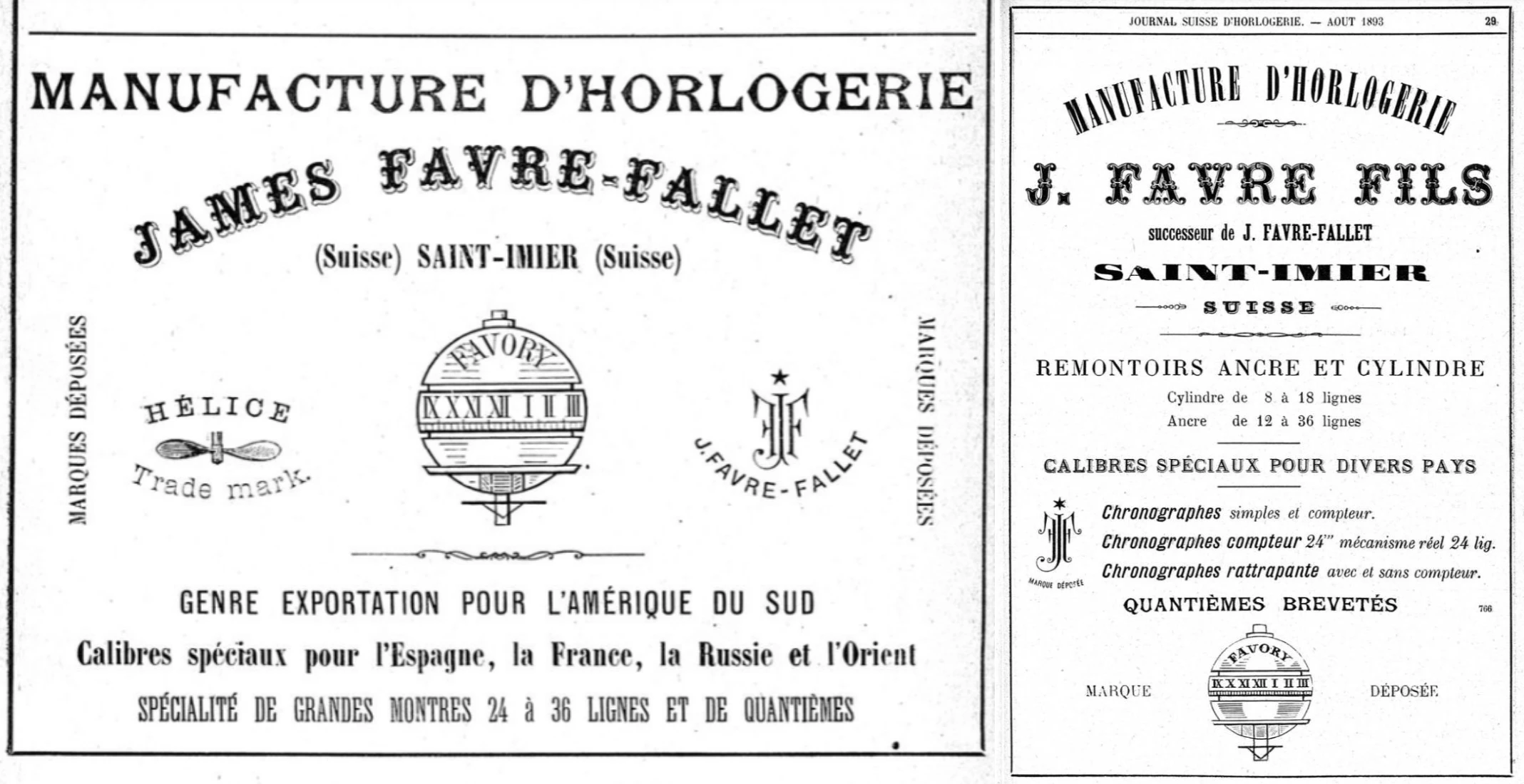
Evolution of the commercial identity of the James-Emile Favre-Fallet manufacture in Saint-Imier: on the left, an advertisement for the firm under his direct management in 1890; on the right, an advertisement for the company from 1893 onwards, following the effective power of attorney granted to his son, James-Albert.
The Legacy: Path to Zenith
The story of this lineage did not end in Saint-Imier. Jämes-Albert Favre-Bulle, already active in their father’s enterprise “J. Favre fils” following his death, soon joined the company of his paternal uncle, Georges Favre-Jacot (Zenith), in Le Locle. Well before his 1904 marriage to his first cousin Fernande-Amélie, daughter of Georges Favre, he was already established within the firm, where he emerged as a bold reformer.
With the founder’s only son, Georges-Adrien, taking no apparent part in the business activities, Jämes-Albert became the natural successor at the helm of what would become Zenith. Drawing upon the rigorous experience inherited from his father, it was he who successfully navigated financial crises—most notably the 1900 crisis in Russia—and established a global commercial vision, ranging from the creation of international agencies to the meticulous study of American manufacturing methods. The rigor of the Saint-Imier “Favre school” thus provided the foundation upon which the international stature of the famous Zenith manufacture was built.
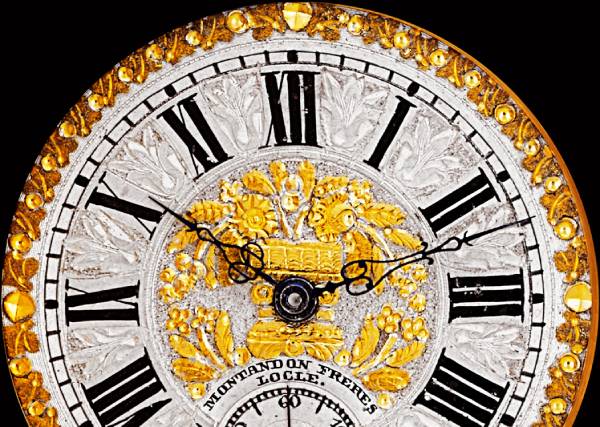
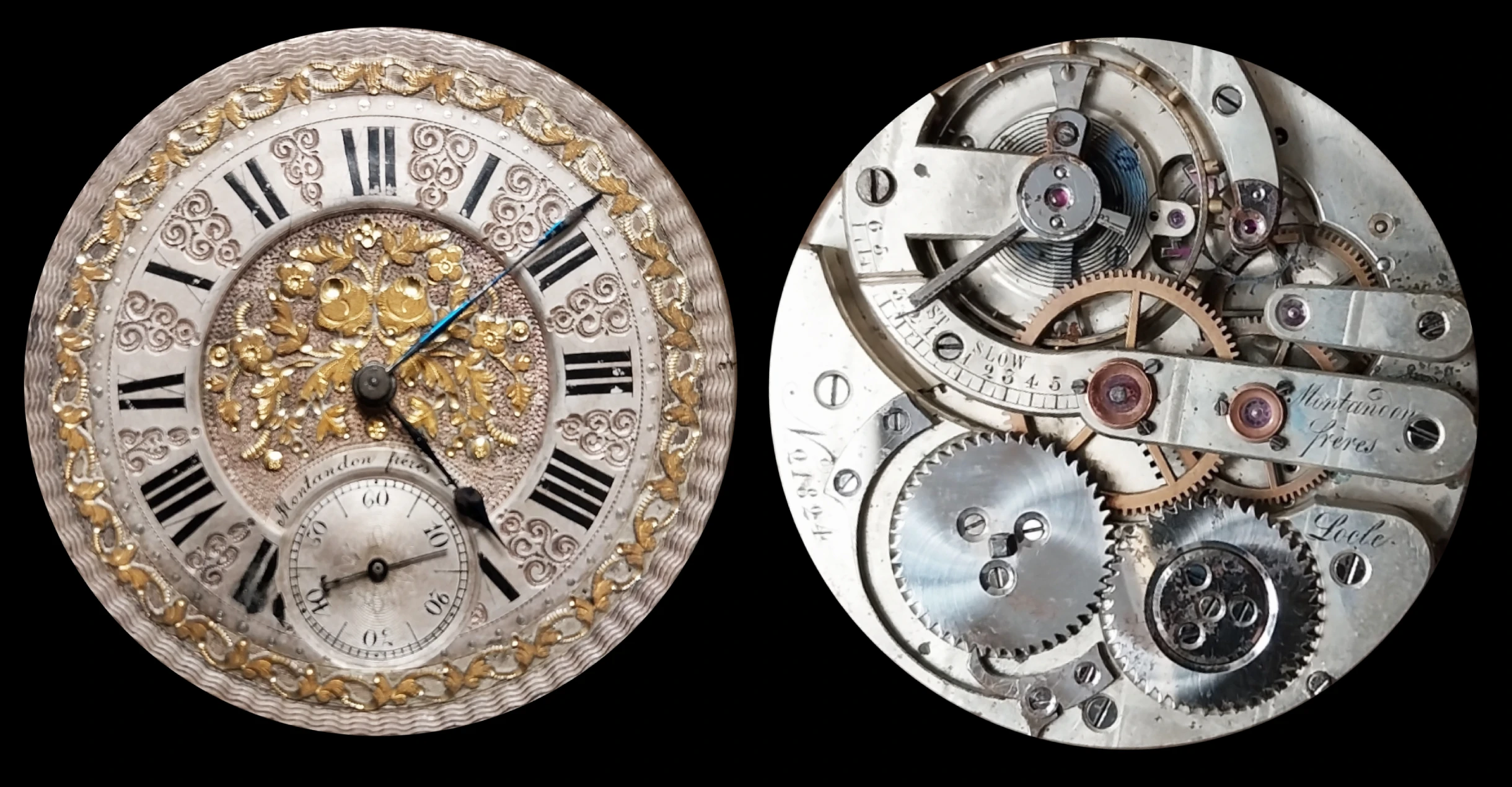
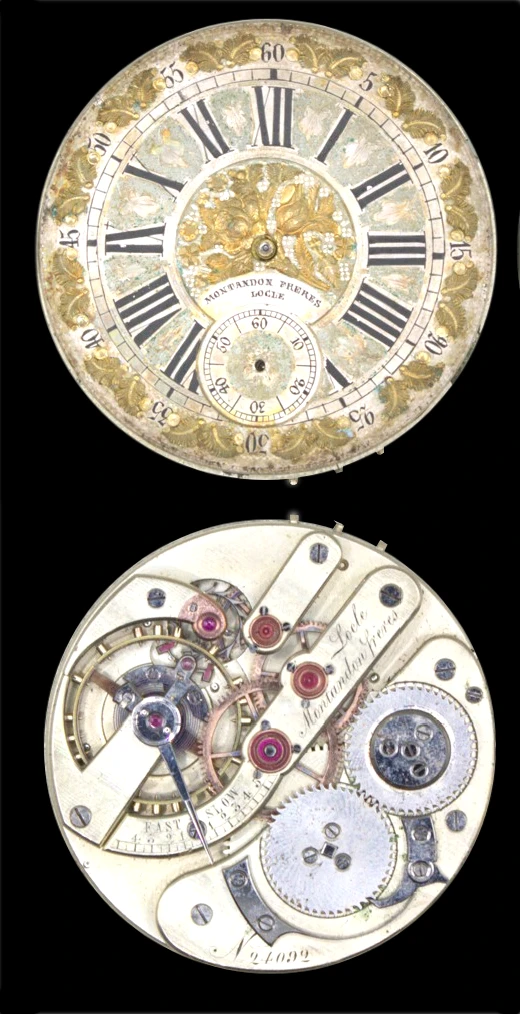
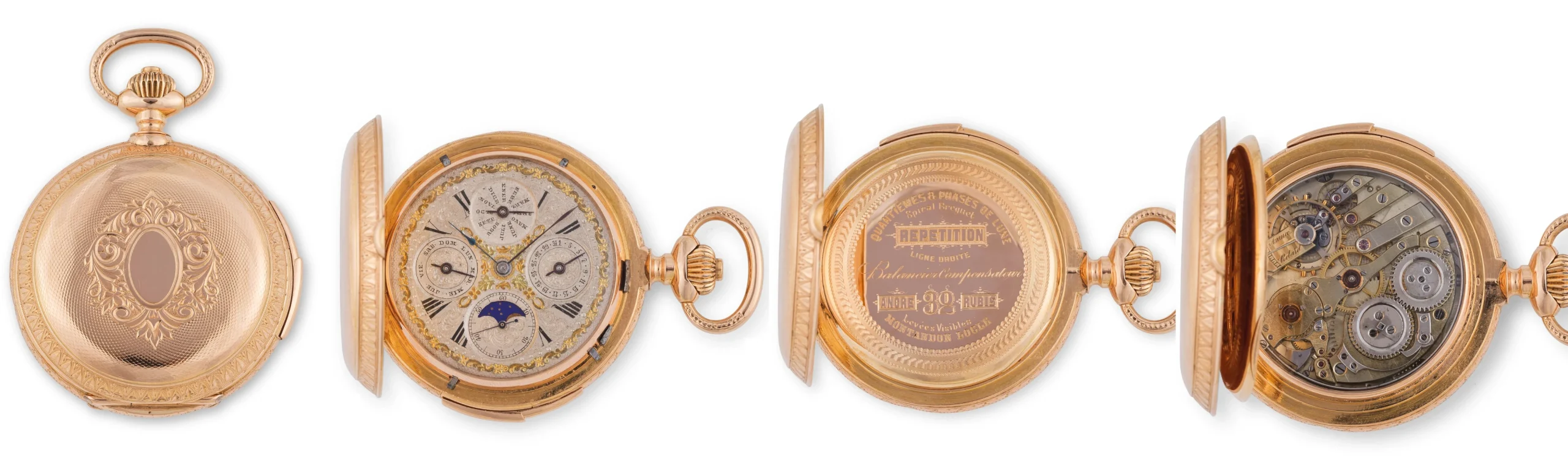
The firm Montandon Frères, stemming from the Montandon-Blaiselion branch and founded in 1790, maintained establishments in Le Locle and Paris. In 1850, Ulysse Montandon left the company, leaving sole management to Charles-Adolphe Montandon (1820–1886). In 1851, the firm transferred their Paris establishment to their local representative, François Perrenoud jeune, who subsequently operated under his own name.
Movement No. 21,824, Montandon Frères, circa 1873, separate-bridge architecture. The pendant winding system and hand-setting are operated via a push-piece located on the caseband at 4 o'clock. It features a wolf's-tooth winding wheel, ensuring smooth and robust transmission. The arbors are protected by pierced jewels set in chatons, complemented by cap jewels for the balance arbor and escape wheel. The escapement is a straight-line lever design with visible ruby pallet stones. The regulating organ features a cut bimetallic-style compensation balance, equipped with gilded adjustment screws, and a blued steel balance spring adjusted by a regulator index. The mainspring barrel click mechanism utilizes a long, curved spring click. Victorian-era silvered dial, «Genre Espagne» style. The center of the composition is adorned with gilded appliqués of varied textures, stamped in micro-relief to form a floral motif standing out against a finely stippled silver background. The circular hour chapter displays Roman numerals hand-painted in lampblack. The spaces between the hours are fully hand-engraved with opposing scrolls. A row of regular concave beads forms the minute track. The periphery is bordered by a floral garland in micro-relief, harmonizing with the central motif. Finally, the dial features a network of radial fluting stamped on its outer edge. The small seconds sub-dial, with painted numerals, presents circular engine-turning centered on the hand arbor. The ensemble is fitted with «Poire Stuart» hands in blued steel.
Economic and Social Influence in Neuchâtel
Beyond their industrial renown, members of the firm Montandon Frères held a prominent place in the economic and social life of the canton of Neuchâtel, reflecting a firmly established prestige. Their influence was particularly exerted within governing bodies, as demonstrated by their active participation on the board of directors of the Banque de Neuchâtel, alongside the region’s major watchmaking dynasties.
The firm Montandon Frères asserted its constant presence at major international exhibitions, accumulating awards for the quality of its production. At the 1855 Paris Exposition, it secured a silver medal, followed in 1862 in London by a notable display that included ladies’ watches, magic boxes, tourbillon escapements, as well as an independent dead-seconds watch marking fifths of a second, and a pocket chronometer certified by the Neuchâtel Observatory. In 1867, Charles-Adolphe Montandon exhibited a pivoting-detent tourbillon watch with a Phillips flat balance spring (No. 19,455).
International recognition continued at the 1873 Vienna Exposition with a merit medal, and later in Melbourne in 1881, where the firm achieved the maximum score of 500 points with a 19-ligne keyless pocket chronometer featuring a spring-detent escapement with double safety roller, earning a diploma in 1882 as part of the awarded Swiss horological delegation.
Innovation and Style in Watchmaking: The 1883 National Exhibition of Art and Application of Art to Industry
This event highlighted the firm’s ability to combine precision with aesthetic refinement. The exhibited timepieces showcased a mastery of relief decoration, employing varied tones of gold and silver on motifs such as winged dragons or hunting scenes. On this occasion, the diversity of production was also emphasized to meet the specific demands of international markets: restrained models tailored for the Anglo-Saxon clientele, contrasting with richly ornamented timepieces destined for Spanish and Hispanic-American markets.
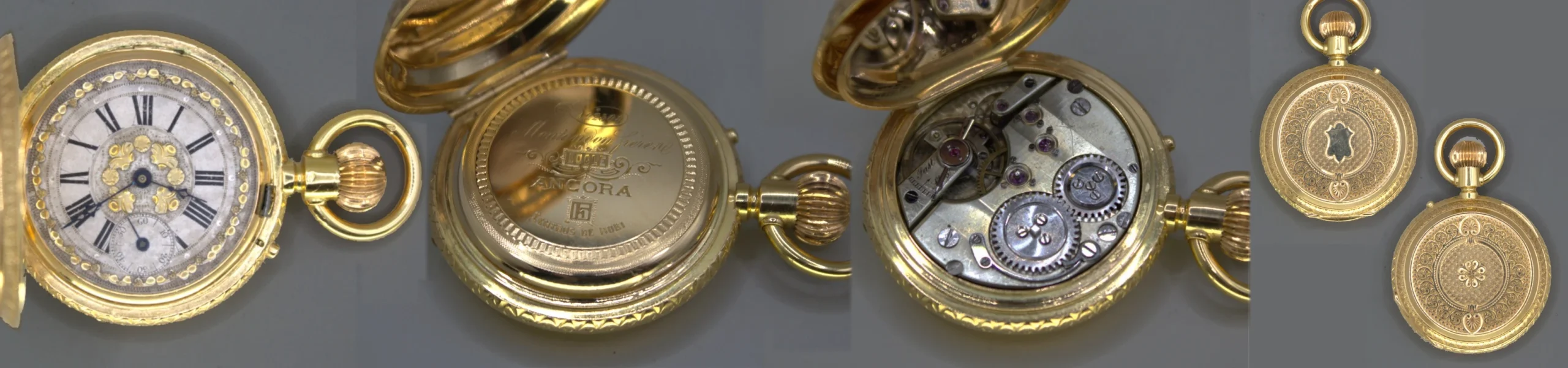
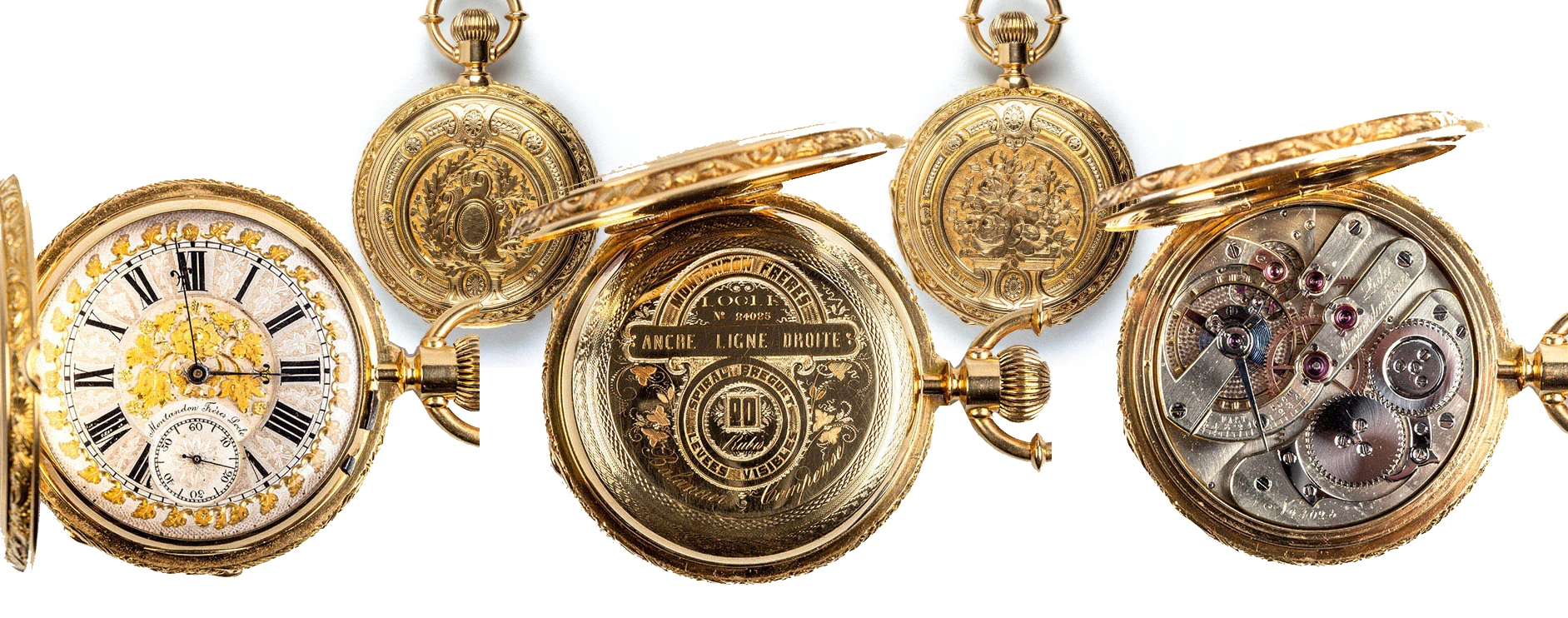
Montandon Frères – Le Locle pocket watch nº 84025, 20 jewels, fitted with a Victorian-era silvered dial in «Genre Espagne» style. The center of the composition is occupied by small gilded forms of varied colors and textures, stamped in micro-relief, composing a floral motif standing out against a finely stippled silver background engraved with a burin. The circular hour chapter displays Roman numerals hand-painted in lampblack. The inter-hour spaces between the numerals are fully hand-engraved with a burin. The minute track, also hand-painted, consists of a divided ring. The periphery is bordered by a floral garland of gilded forms in varied colors and textures in micro-relief, harmonizing with the central motif. Finally, the dial features a network of radial fluting stamped on its peripheral border. The small seconds sub-dial, with hand-painted numerals, presents a starburst engine-turning centered on the hand arbor. Original blacked steel hands in «Fleur de Lys» style. The separate-bridge movement features a pendant winding system with hand-setting operated via a slide lever (tragette) at 4 o'clock on the caseband. It is equipped with a wolf's-tooth winding wheel, ensuring smooth and robust transmission. All arbors are protected by pierced jewels, complemented by cap jewels (coquerets) for the balance arbor and escape wheel, all set in screwed chatons. The architecture—distinguished by meticulously chamfered bridge edges and a frosted-finish mainplate—features a balance bridge of slender and elegant proportions, whose robust, curved design provides enhanced protection for the regulating organ. The escapement is a straight-line lever design with visible pallets featuring ruby pallet stones. The regulating organ is paired with a cut bimetallic compensation balance equipped with fine-adjustment screws for timing and positions, while a graduated regulator index with micrometric adjustment allows precise regulation of the balance spring. The hunter case is distinguished by remarkable deep hand-engraving, combining the naturalism of a high-relief basket of roses on one side with the classical symbolism of a monogrammed cartouche enclosed by a wreath of oak leaves and acorns on the other. Every detail, from the geometric friezes to the floral motifs, demonstrates absolute mastery of goldsmithing, making this piece a true work of art where rich textures and play of volume elevate the nobility of solid gold.
The 1884 Crisis and Decline
In 1884, the firm Montandon Frères was hit hard by the major crisis that shook Swiss watchmaking during that decade. The combination of global overproduction and fierce competition from mechanized industries weakened traditional structures, plunging the firm into a critical state of insolvency. Although a composition with creditors (concordat) permitted an ephemeral continuation of activities, this episode marked the beginning of an irreversible decline for the house, whose financial stability was never truly restored.
Liquidation and Final Legacy
In 1887, the final liquidation of the firm Montandon Frères was enacted through the sale of its remaining stock. A lot of more than 6,000 movements, including keyless and key-wound calibers at various stages of completion, was entrusted to the watchmaker Albert Boss, established on Rue de la Côte in Le Locle. The latter was tasked with liquidating these stocks, ranging from standard production to complicated timepieces, while offering his services to complete these watches destined for various international markets.
After the firm’s final liquidation, Charles-Albert Montandon (1846–1903), son of Charles-Adolphe and head of the business entity C-A Montandon, successor to Montandon Frères, transferred his commercial activities to Samaná, in the Dominican Republic, where he developed a cocoa trade for the chocolate manufacturer Russ-Suchard, while maintaining a power of attorney with Albert Boss for the management of his remaining real estate and commercial interests in Le Locle. Charles-Albert Montandon passed away in 1903 at the age of 57.
«Montandon – Locle» pocket watch, 32 jewels, circa 1900. Equipped with a high-grade caliber signed by the LeCoultre manufacture, this piece attests to production carried out by a workshop of the family lineage subsequent to the activity of Montandon Frères. The separate-bridge movement features a pendant winding system and hand-setting via a slide lever (tirette) on the caseband, with transmission provided by a wolf's-tooth winding wheel. The 32-jewel mechanism, whose arbors are set in screwed chatons with cap jewels (coquerets), combines precision and durability. Its silvered dial, in «Genre Espagne» style with inscriptions in Spanish, displays a hand-painted minute track consisting of a divided ring, completing a richly ornamented aesthetic.
Historical Distinction: Montandon Frères and Montandon – Locle
The movements and technical characteristics of the hunter-case watches signed «Montandon – Locle», many of them fitted with LeCoultre calibers, postdate the period of activity of Montandon Frères Locle, which excludes any attribution to this firm.
These watches must be attributed to other members of the family who possessed the necessary workshops and technical capabilities. Although this remains a working hypothesis, this conclusion is the most consistent with the surviving timepieces and allows for a clear separation of these productions from the historical activity of the original house.
Note. The firm Montandon Frères established in Le Locle, headed by Charles-Adolphe Montandon and later by his son Charles-Albert, must under no circumstances be confused with the general partnership also named «Montandon Frères», formed by Paul Montandon and Alphonse Montandon in La Chaux-de-Fonds.
Paul Boch (1837–1896), son of the merchant Gustave-Emmanuel Boch, established himself as a watch manufacturer in La Chaux-de-Fonds. He distinguished himself through business management that combined technical production with a commercial vision focused on international markets. Although integrated into the family’s real estate and social fabric on Rue de la Balance, his personal career was defined by an independent profile: an economic actor and public figure within the community.
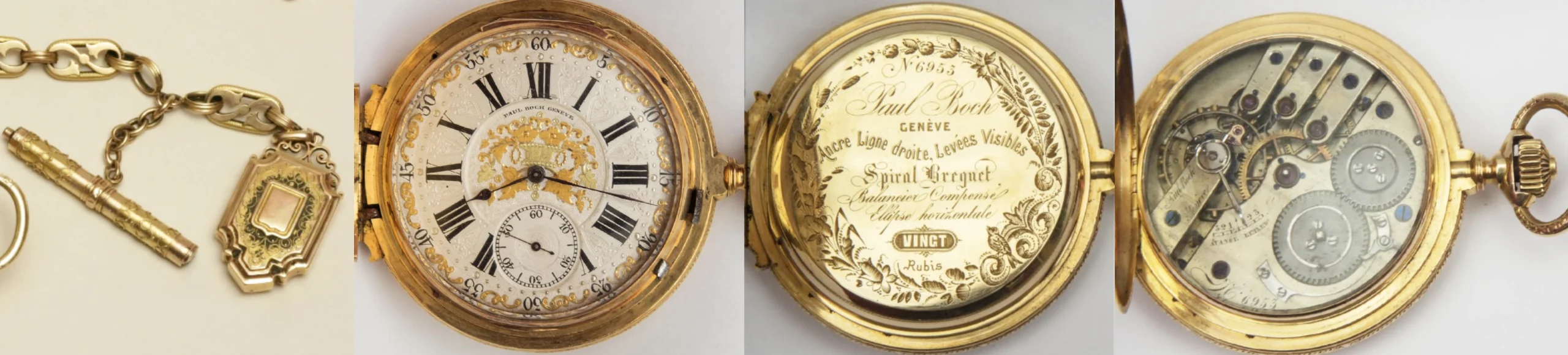
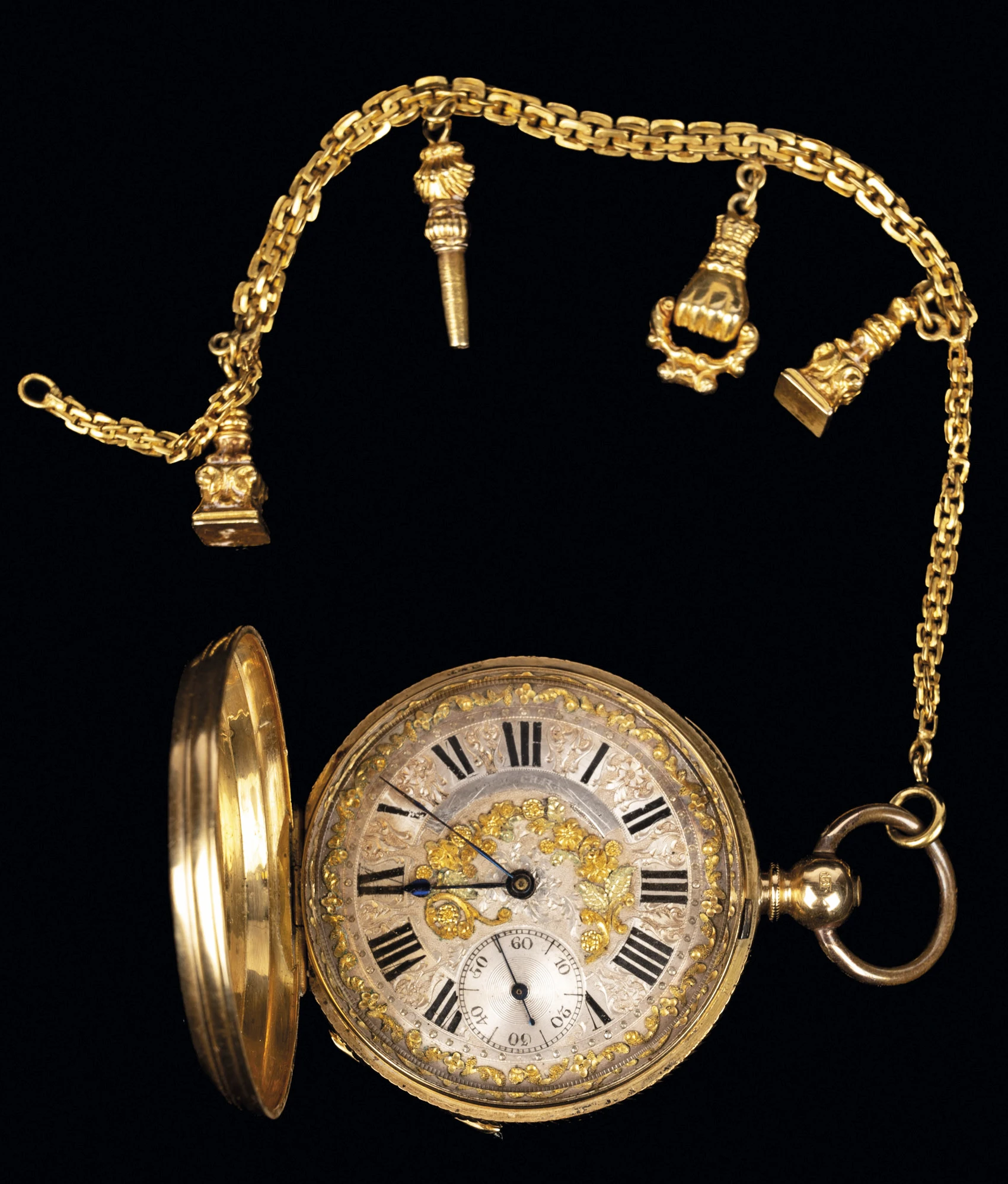
This 18-karat gold hunter-case pocket watch (No. 6,953), preserved at the Museo Nacional del Romanticismo (inv. CE2715), perfectly illustrates the technical excellence and aesthetic refinement characteristic of Paul Boch. Beyond its utilitarian function, this object bears a deeply sentimental dimension, notably through its richly worked watch chain (léontine) supporting a filigree T-bar (muletille) and a hair locket medallion—an intimate accessory evoking the memory of a loved one. The hunter case, whose caseband features engine-turned decoration, is adorned on its front cover with a central shield surrounded by meticulously chased plant motifs. The movement, signed and numbered, attests to high watchmaking precision with its 20 jewels, straight-line lever escapement, and compensation balance—features that made these timepieces symbols of dignity and prestige for the wealthy classes of the era.
Paul Boch nº 3035 pocket watch.
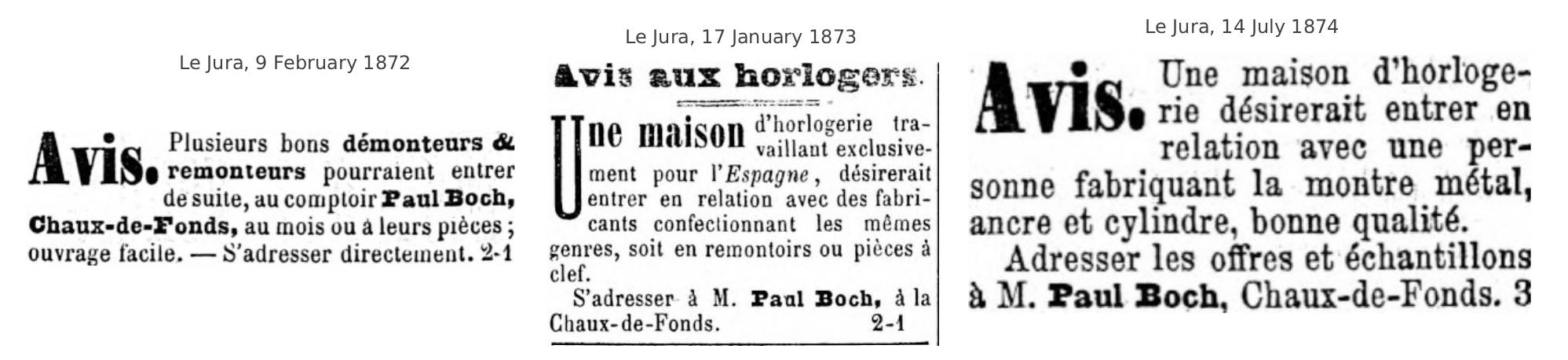
As an établisseur, Paul Boch coordinated various specialists in his workshop according to his own technical standards in order to specifically cater to the Spanish market. His commercial strategy relied on actively expanding his network of suppliers, thereby guaranteeing the consistency of his catalogue. His intent to collaborate with manufacturers producing “the same styles,” whether for keyless systems or key-wound timepieces, confirms that he imposed strict technical standards. This allowed him to ensure the homogeneity of the pieces marketed under his direction. His horological work was characterized by active intermediation and a constant pursuit of technical specialization. In the 1870s, he utilized local media to establish relationships with manufacturers mastering lever and cylinder escapements, thus managing both keyless and key-wound timepieces.
Série d'« Avis » parus dans Le Jura (1872-1874), confirmant la spécialisation de Paul Boch sur le marché espagnol et son statut d'horloger établisseur. Ses recrutements de « démonteurs et remonteurs » pour travailler au sein de son comptoir attestent de l'existence d'un véritable atelier horloger. Series of "Notices" published in Le Jura (1872–1874), confirming the specialization of Paul Boch in the Spanish market and his status as a watchmaking établisseur. His recruitment of assemblers and adjusters (démonteurs et remonteurs) to work within his workshop (comptoir) attests to the existence of a true horological establishment
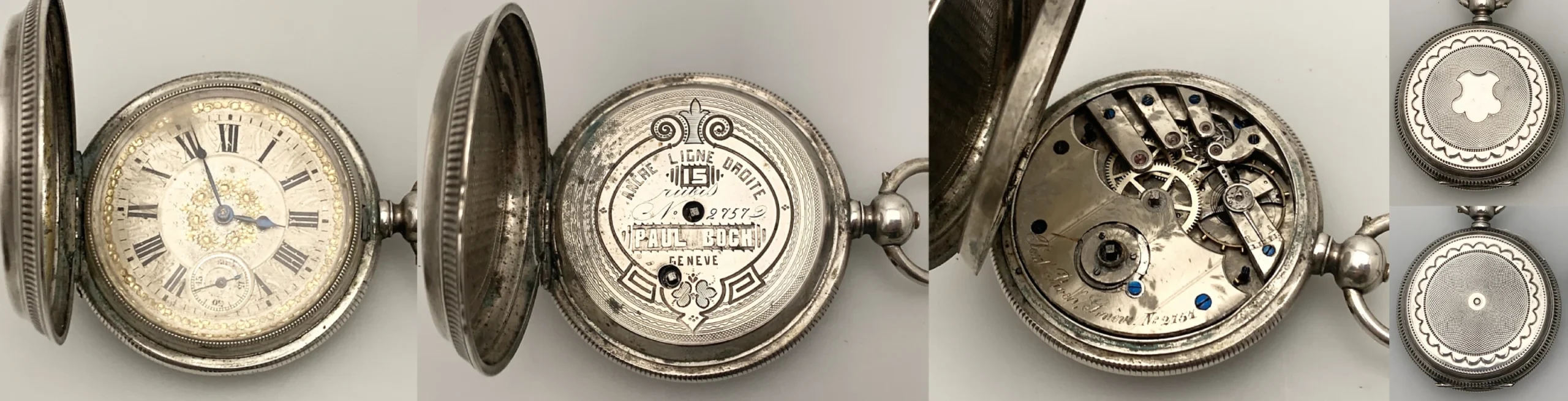
Paul Boch 0.800 silver hunter-case pocket watch No. 2,757, testifying to the firm's desire to broaden its reach beyond its gold pieces, while maintaining the same level of care and aesthetic refinement as in its gold-finished creations.
In parallel with his industrial activity, Boch played an active role in the public sphere of La Chaux-de-Fonds. His civic engagement was notably demonstrated by his membership in the Commission for Public Instruction (Commission de l’Instruction publique). Beyond his local responsibilities, his social and professional standing allowed him to move within the town’s watchmaking elite, as evidenced by his presence alongside major figures such as Constant Girard-Perregaux, Ch.-Ad. Juvet, Ch.-Aimé Grosjean, Louis Rozat, Georges Grandjean, and members of the Perregaux and Imer-Guinand families in the city’s decision-making bodies. This deep integration into the heart of La Chaux-de-Fonds‘ networks of influence was also reflected in his contributions to international humanitarian causes, such as his support for wounded soldiers of the American Army in 1864.
The excellence and quality of Paul Boch‘s production were officially recognized on the international stage at the Barcelona Exhibition of 1889, where he was awarded an honorable mention.
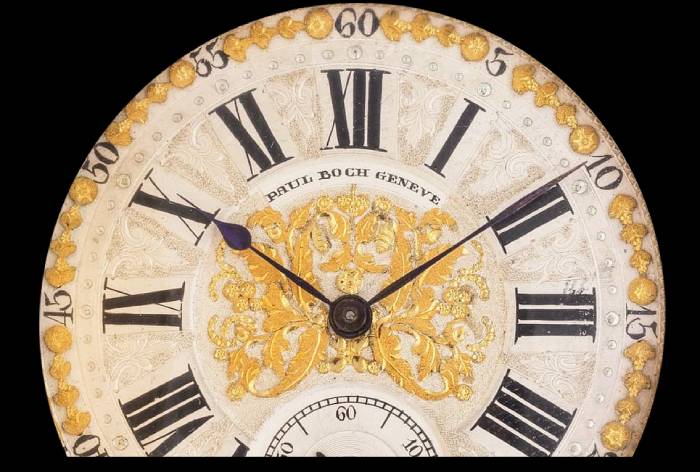
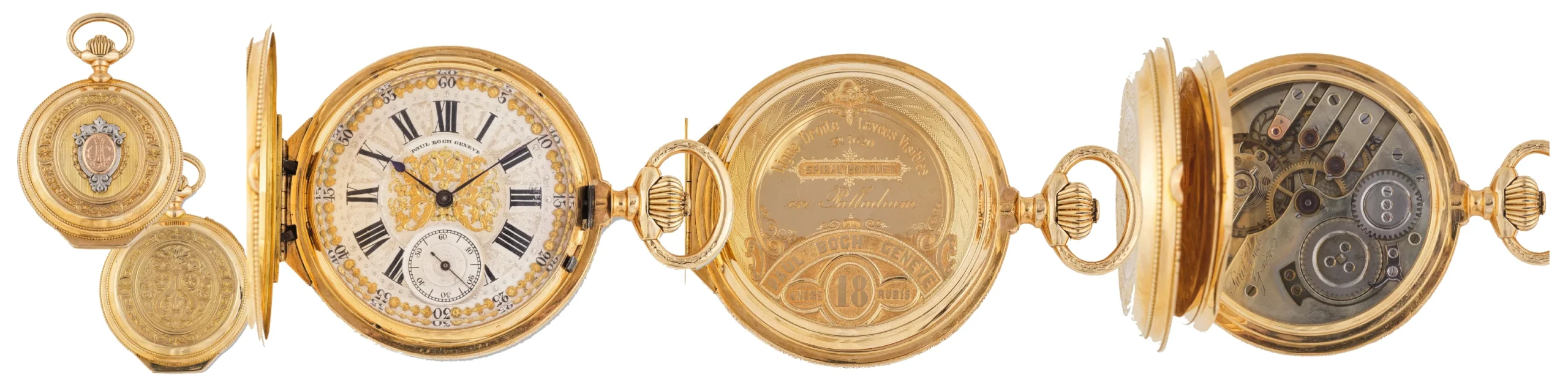
Paul Boch pocket watch No. 7,620, circa 1892. The 18-karat gold hunter case is structured around diversified goldsmithing techniques. One side features hand-engraving with a burin showing plant motifs arranged symmetrically along a vertical axis, set within a circular engine-turned frieze. The opposite side incorporates a central two-tone gold shield surrounded by a white metal decorative applique with baroque lines. The entire surface features radial engine-turning, complemented by beaded borders as well as engraved elements on the pendant and bow. Silvered dial, typical of the «Genre Espagne» style. The center of the composition is occupied by small gilded forms of varied colors and textures, stamped in micro-relief, composing a floral motif standing out against a finely stippled silver background engraved with a burin. The circular hour chapter displays Roman numerals hand-painted in lampblack. The inter-hour spaces between the numerals are fully hand-engraved with a burin depicting opposing scrollwork motifs. Regular concave beads represent the minute track. The periphery is bordered by a floral garland of gilded forms in varied colors and textures in micro-relief, with open spaces to mark the 5-minute intervals, harmonizing with the central motif. Finally, the dial features a network of radial fluting stamped on its peripheral border. The small seconds sub-dial, with hand-painted numerals, displays circular engine-turning centered on the hand arbor. Blued steel hands in «Poire Stuart» style mark the time. The movement is of classic Jura construction with separate bridges. Winding is performed by the crown, and hand-setting is operated via a slide lever (tirette) on the caseband. The wheel train pivots on pierced jewels, while the most heavily stressed arbors of the balance wheel, lever, and escape wheel are equipped with cap jewels (coquerets), all secured by chatons. The escapement is a straight-line lever design with visible pallets featuring ruby pallet stones. The regulating organ is paired with a cut bimetallic compensation balance with timing and compensation screws, oscillating with a palladium Breguet balance spring and adjusted by a regulator index system.
The excellence of these pocket watches by Paul Boch transcends mere mechanical precision, revealing a decorative sophistication that accords perfectly with the refined taste of the Spanish Isabeline style then in vogue. The delicacy of his engravings—remarkable in the profusion of plant motifs and classical compositions—as well as the meticulous selection of his accessories, such as chased-link chains, hair locket medallions, and hand seals, transform the pocket watch into a true object of social distinction. Each element serves not merely a practical function, but acts as an extension of the owner’s character and elegance, consolidating the whole as a privileged witness to the material culture of the mid-19th century.
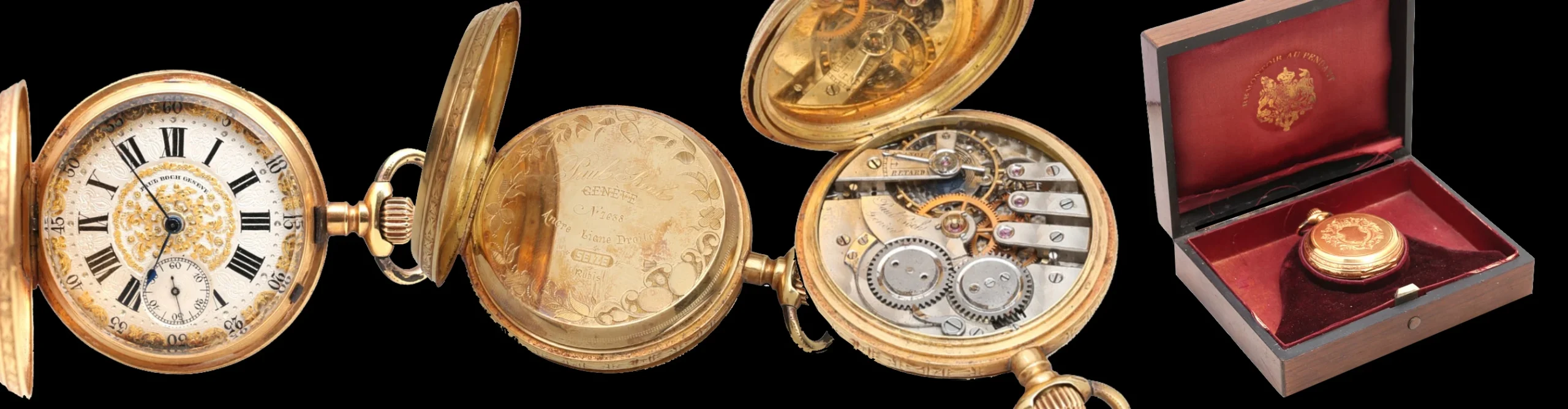
Paul Boch hunter-case pocket watch No. 7638, presented with its characteristic dial, refined movement, and original presentation box, typical of the presentation for high-quality gold watches intended for the Spanish market.
On a technical level, the perimeter garlands in micro-relief on his dials, precisely defining the spaces reserved for the numerals of the five-minute multiples, ensured exemplary legibility. By structuring the dial in this manner according to his own standards, Paul Boch imposed his visual signature. His advertising allows us to infer that Spain was the main market for Paul Boch watches.
Toward the end of his career, he diversified his economic management by participating in the administration of real estate located at strategic points in the town, such as Place-Neuve and Rue de la Balance (*). Following his death in December 1896, his legacy manifested in a considerable real estate portfolio on Rue du Manège and Rue du Grenier, bearing witness to his success during the decades of Neuchâtel industrialization.
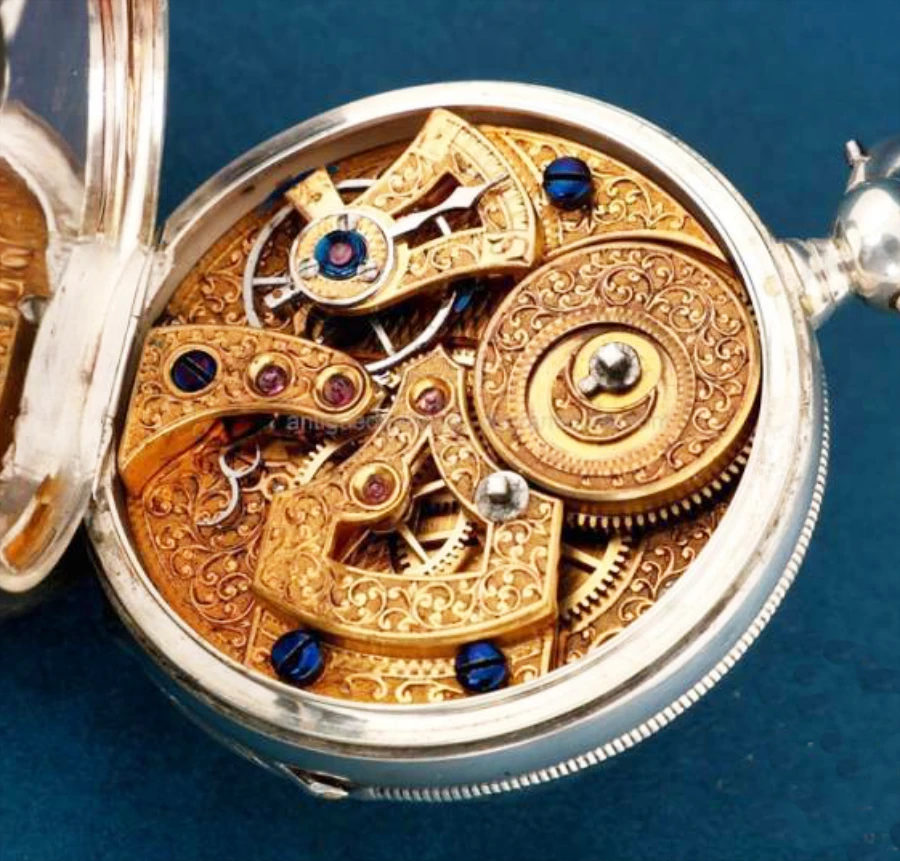
Paul Boch also developed calibers with more ostentatious decoration, characterized by chased and gilded bridges that reflect the ornamental tastes of his era.
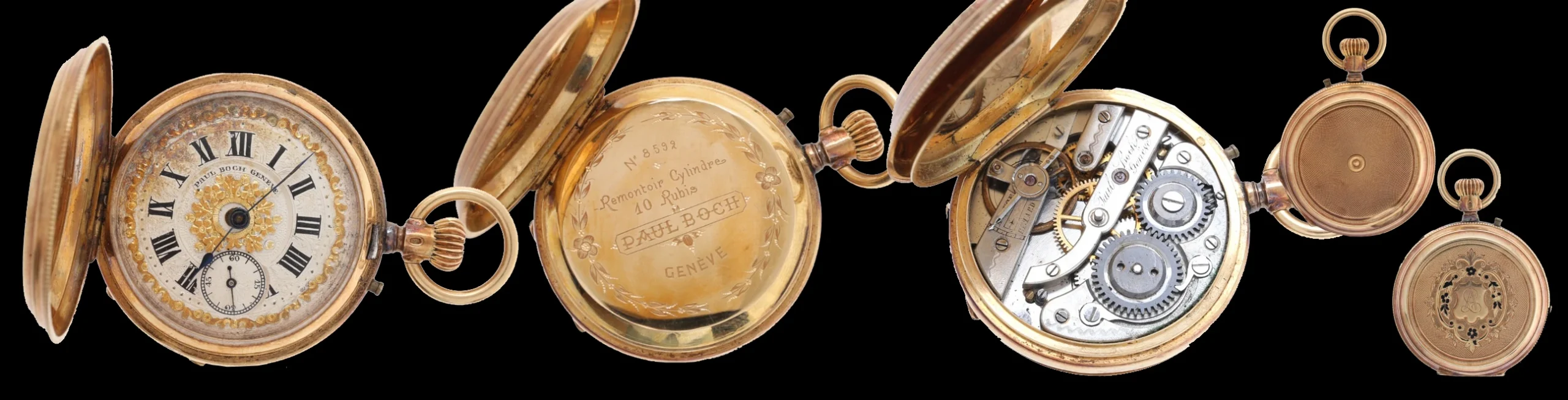
Paul Boch hunter-case pocket watch No. 8592.
(*) Enfin, l’Ancien Manège de La Chaux-de-Fonds, acquis et transformé par Gustave-Emmanuel Boch en 1864, reste l’une des réalisations emblématiques du patrimoine industriel suisse de cette époque.