HENRI GRANDJEAN

His “Genre Espagne” Pocket Watches

Pioneer of Swiss Chronometry and His Heritage in Precision Watchmaking

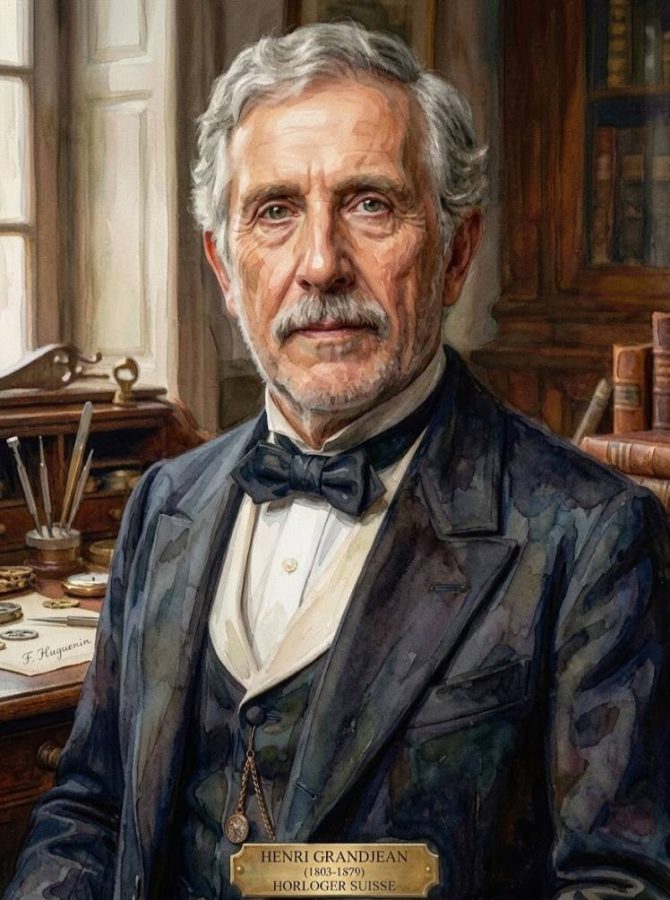
Henri Grandjean (1803-1879). Horloger.

Introduction: The Context of a Visionary

Henri Grandjean, born in Le Locle, Switzerland, in 1803, was a key figure in the transition of Swiss watchmaking toward excellence in high-precision chronometry. Son of David-Henri Grandjean—who founded his original workshop in La Chaux-de-Fonds in 1792 before transferring it to Le Locle—and a member of the prestigious Grandjean-Perrenoud-Comtesse family, his life was marked by technical innovation, industrial entrepreneurship, and a deep political commitment to his region. His legacy not only defined the manufacturing standards for marine chronometers and pocket watches, but it also laid the foundations of the modern Swiss watchmaking industry, in collaboration with legends such as Ulysse Nardin and Louis-Jean Richard.

He was awarded gold medals at the London Universal Exhibition of 1851 and those of Paris in 1855, 1878, and 1889. Henri Grandjean was one of the leaders of the Revolution of 1848 and one of the primary promoters behind the construction of the Neuchâtel Cantonal Observatory.

  1. The Beginnings: Training and Global Expansion

    1.1. Apprenticeship and First Steps Henri Grandjean methodically trained as a watchmaker in his native town of Le Locle, the neural center of Swiss high watchmaking. His father David-Henri’s heritage provided him with the perfect environment to master the manufacture of complex pieces from his youth, directing his efforts toward high-end and repeating mechanisms.

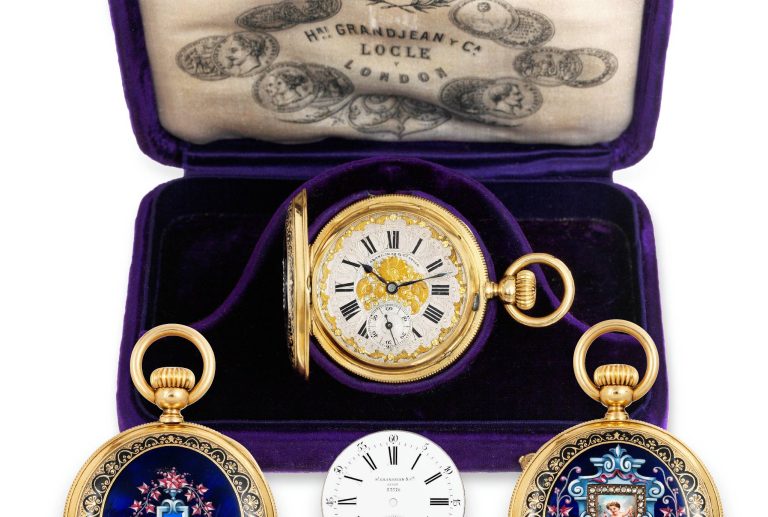
Henri Grandjean & Co. Locle & London hunter case pocket watch no. 23370, circa 1870. Manufactured for the Spanish and South American market. 18-karat yellow gold hunter case with pendant winding, lever-set hand-setting via a side lever, set with rose-cut diamonds and adorned with enamel painting. Accompanied by its fitted Henri Grandjean presentation box. Silver-ground "genre Espagne" dial with gilded micro-reliefs. The silver background is finely chisel-engraved with a graver, defining the inter-hour spaces that contrast with the central composition and the gilded peripheral garland in micro-relief. The Roman numeral hour markers, hand-painted in India ink on white enamel, are bordered by an hour track with minutes indicated by engraved concave dots, the whole complemented by "Stuart pear" (poire Stuart) style hands. Photo courtesy and © https://www.antiquorum.swiss/
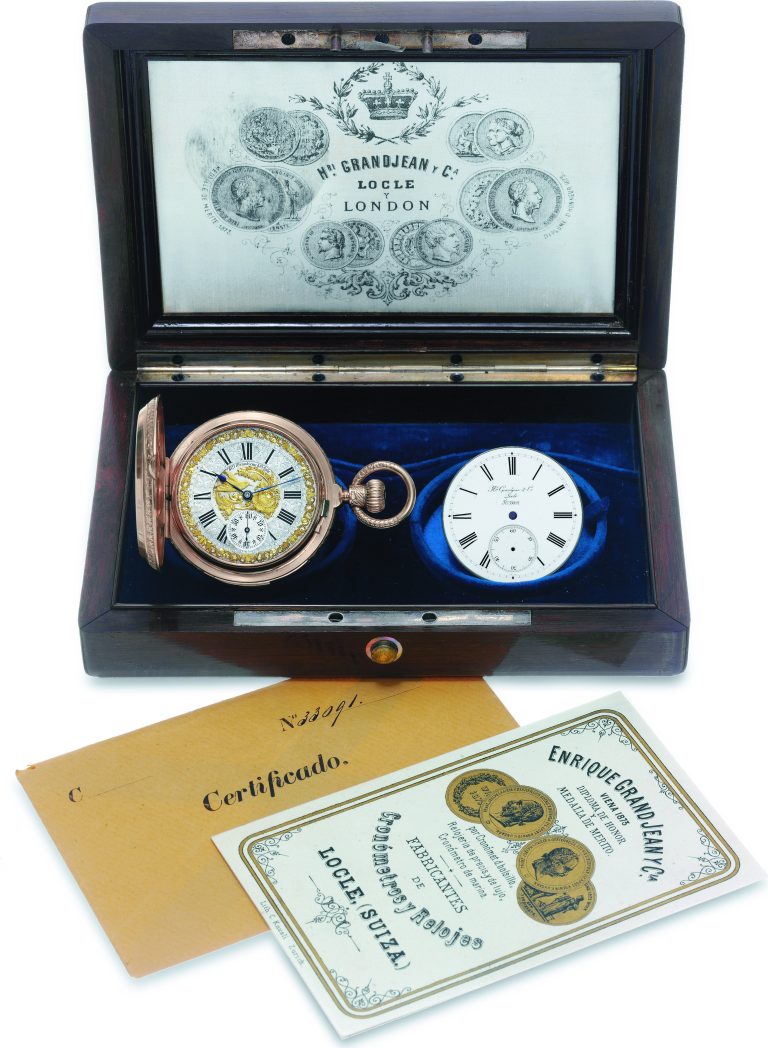
Henri Grandjean & Co. Locle & London minute-repeating pocket watch no. 33091, circa 1875. Manufactured for the Spanish-speaking market. 18-karat yellow gold hunter case with pendant winding. Accompanied by its complete original accessories: its fitted rosewood presentation box, its certificate of origin with its envelope, a second signed and numbered white enamel dial, a replacement glass crystal, and a replacement mainspring. Silver-ground "genre Espagne" dial with gilded micro-reliefs. The silver background is finely chisel-engraved with a graver, defining the inter-hour spaces that contrast with the central composition and the gilded peripheral garland in micro-relief. The Roman numeral hour markers, hand-painted in India ink on white enamel, are bordered by an hour track with minutes indicated by engraved concave dots, the whole complemented by "Stuart pear" (poire Stuart) style hands. Photo courtesy and © https://www.antiquorum.swiss

1.2. Expansion into South America (1824–1830) Between 1824 and 1830, Henri took on the task of organizing the South American branches of his father’s company, managing the watchmaking trading posts (points of sale and distribution) in Rio de Janeiro (Brazil) and Lima (Peru). This period allowed him to explore emerging markets and open key commercial routes before returning to Switzerland. In 1830, his brother Henri-Gustave Grandjean permanently emigrated to Peru to take over the management of these affairs in Lima, where he married and started his family. The Lima watchmaking establishment, located on the former Calle Espaderos (today Jirón de la Unión, cuadra 5), became an essential strategic point for the distribution of Grandjean watches on the South American continent.

The Technical Revolution and Classification of Production

2.1. The First Marine Chronometers (1830–1850) Upon his return to Le Locle, Grandjean dedicated himself to precision chronometry and began building marine chronometers inspired by renowned English models. In 1832, he completed Chronometer No. 1 with his father, which was sold in Lima, marking a milestone in long-distance navigation. In partnership with Edouard Thévenaz, and alongside Louis-Jean Richard and Ulysse Nardin, Grandjean established himself as the pioneer and founder of the Swiss marine chronometer industry.

2.2. The 1859 Catalog and the Standardization of Calibers In 1859, the manufacture had the Tableau Statistique de tous les genres d’horlogerie de la fabrication de Henri Grandjean printed in Lausanne. This catalog aimed to:

  • Standardize terminology.

  • Prevent deceptions that affected Neuchâtel’s credit.

  • Ensure that every civilian watch met a reliable rate.

Grandjean stipulated that the gold used would always be 18 karats (750 thousandths) and the silver 800 thousandths, bearing the state hallmark and the maker’s mark. His production (which numbered over 60 different calibers) was divided into three strict classes:

First Class: Chronometry (High Precision)

Pieces of absolute precision equipped with an official rating certificate (bulletin de marche) issued by a government observatory, meeting the requirements of the navies of France and England.

  • Marine Chronometers: Mounted in rosewood cases (with a double travel box). Three-quarter plate movement on suspension gimbals, auxiliary fusee, double-barrel, spring detent escapement, 8 jewels at the centers, bimetallic compensation balance, and temperature-tested spherical (cylindrical) balance spring.

  • Pocket Chronometers: Hunter or open-face models in 18k gold. Three-quarter plate or bridge movements, auxiliary fusee, spring detent escapement, jewel holes with English-style settings, compensation balance, and spherical or Breguet balance spring.

  • Tourbillon Chronometer: Pocket variant with bridge movement, spring detent escapement, compensated balance, and Breguet balance spring.

Second Class: Precision Watches

Watches designed for excellent timekeeping in civil observations, accompanied by a rating certificate signed by the manufacturer.

  • Chronometer Escapement: Hunter or open-face models, three-quarter plate, auxiliary fusee, spring detent or lever-detent (bascule) escapement, compensated balance, and helical (cylindrical coil) or spherical balance spring (19-jewel variants).

  • Lever with Complications: Bridge movement with independent seconds, or combinations of repeating and independent seconds. Straight-line lever escapement with counter-pivots, compensated balance, Breguet balance spring, and up to 29 jewels.

Third Class: Luxury and Fancy Watches

Pieces of extraordinary aesthetic or mechanical workmanship that increased their value, housed in 18k gold, silver, or heavily gilt silver cases.

  • Repeating Watches: Minute repeater, simple or with pendant winding (stem/crown wind). Bridge movements, lever escapements (several with visible pallets/lift), compensated balances, and Breguet balance springs with 29 jewels.

  • Duplex Escapement: Three-quarter plate or cartel-type movements, revolving barrel or auxiliary fusee, monometallic (uncut) compensation-type balance, and 9 to 17 jewels.

  • Commercial and Long-Duration Lever: Standard models with lever escapement, gold or uncut compensated balances, and 13 jewels. (A specific model stood out by its escape wheel, fork, and regulator made of argentan or nickel silver). Included hunter-case variants designed to run for 8 consecutive days.

  • Cylinder Escapement: Artistic models with leaf-pattern cases, enameled or guilloche backs, bridge movement, cylinder escapement, 8 jewels, and a Dardaine-type balance.

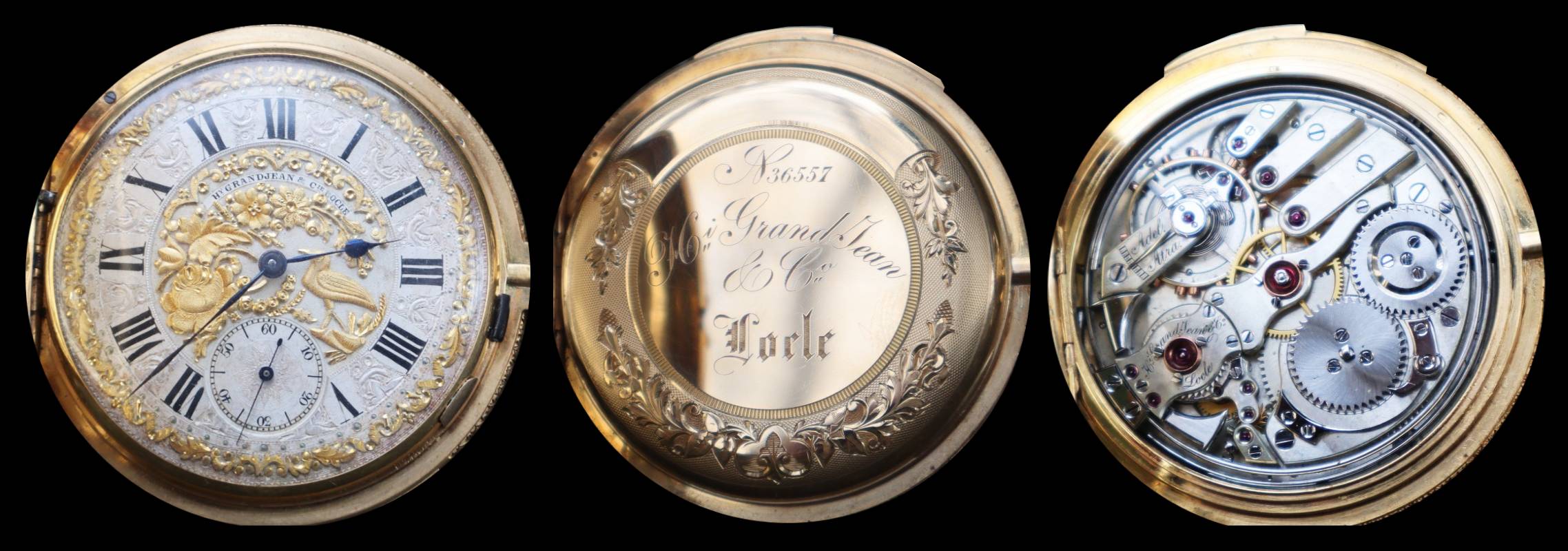
Henri Grandjean "genre Espagne" pocket chronometer No. 36557. Its movement embodies the excellence of classical Jura construction and the Neuchâtel school of the second half of the 19th century. It adopts an independent bridge architecture with finely satin-finished and grained surfaces, accentuated by meticulously angled and hand-polished bevels. This pendant-wound caliber is equipped with a straight-toothed polished steel transmission train, secured by mirror-polished screws. The gear train is mounted on high-quality rubies, with the pivoting of the main moving parts optimized by prestigious screwed gold chatons, while the balance staff benefits from ruby counter-pivots to minimize friction. The regulating organ comprises a lever escapement paired with a cut bimetallic compensation balance—equipped with gold timing and compensation screws—along with a blued-steel Breguet balance spring and a index regulator. This regulator features a fine pointer directed toward an engraved graduated sector on the balance bridge, bearing the indications "Adelante" and "Atrás" intended for the Spanish-speaking market. A prestigious piece, this caliber bears witness to the golden age of Swiss export chronometry through the rigor of its construction and the exceptional refinement of its finishes.

3. International Recognitions and Awards

Henri Grandjean & Co. amassed an exceptional record of achievements at the most prestigious international exhibitions, defending the reputation of the Swiss industry:

  • 1851 — Great Exhibition of London

    • Distinction: First Class Medal.

    • Commentary: Recognition awarded for the high precision of the presented pocket chronometers, marking the firm’s debut on the international scene.

  • 1855 — Paris Universal Exhibition

    • Distinction: 1st Class Medal.

    • Commentary: Distinction confirming the technical superiority and finesse of execution of the manufacture’s luxury watches.

  • 1857 — Bern Exhibition

    • Distinction: 1st Class Gold Medal.

    • Commentary: Awarded specifically for the exceptional performance of the marine chronometers, pillars of the house’s precision reputation.

  • 1857 — National Academy of France

    • Distinction: Medal of Honor.

    • Commentary: Prestigious tribute highlighting the technical advancements and constant innovations brought to the watchmaking industry.

  • 1867 — Paris Universal Exhibition

    • Distinction: Silver Medal.

    • Commentary: Commended for technical innovation and mastery of observational chronometry methods.

  • 1868 — Neuchâtel Observatory Competition

    • Distinction: Special Company Prize.

    • Commentary: Award dedicated to the excellence of marine chronometers during rating trials.

  • 1873 — Vienna Universal Exhibition

    • Distinction: Diploma of Honor (Gold Medal) and Medal of Merit.

    • Commentary: Global recognition of industrial excellence and the exemplary quality of the produced calibers.

  • 1878 — Paris Universal Exhibition

    • Distinction: Gold Medal.

    • Commentary: Indisputable consolidation of the firm’s position at the summit of the European watchmaking hierarchy.

  • 1889 — Paris Universal Exhibition

    • Distinction: Gold Medal.

    • Commentary: Posthumous distinction permanently ratifying the durability and historical value of the firm’s production.

Historical Note: At the Philadelphia Exhibition in 1876, the firm’s marine chronometer No. 94 achieved the absolute best result among all evaluated Swiss exhibitors.

4. Political Engagement, Scientific Contributions, and the Promotion of the Observatory

4.1. Founder of the Neuchâtel Observatory (1858) Understanding the absolute necessity of scientific control for precision watchmaking, Grandjean was the primary architect behind the creation of the Neuchâtel Cantonal Observatory. In March 1858, the government appointed a commission after consulting the astronomer Adolphe Hirsch (a student of Encke); the institution was inaugurated the same year to regulate and transmit exact time to the Jura workshops via telegraphic signals.

Starting in 1842, Henri Grandjean reconciled his manufacturing work with a prolific political career of a distinctly republican character.

  • Public Functions: Prefect of Le Locle, deputy to the Grand Council of Neuchâtel (1848–1889), and National Councilor (1858–1861 and 1867–1870).

  • The Counter-Revolution of 1856: During the royalist counter-revolution of September 1856, insurgents violently stormed his home. Thanks to the courage of his wife, Élise Montandon, who resisted the threats of the armed column, Grandjean managed to escape capture by jumping through a window onto the roof of an adjacent shed, taking refuge in the fields of the Monts du Locle. From there, acting as vice-president of the Grand Council, he drafted proclamations of resistance and assumed the presidency of the local Committee of Public Safety to defend the Republic.

  • Vision of Progress: He promoted the creation of the Quartier-Neuf (or Progress Quarter) in La Chaux-de-Fonds in 1855, designed to eliminate real estate speculation and provide dignified, affordable housing for working-class watchmaking families. He was also the leading advocate for the establishment of the industrial Jura railway line.

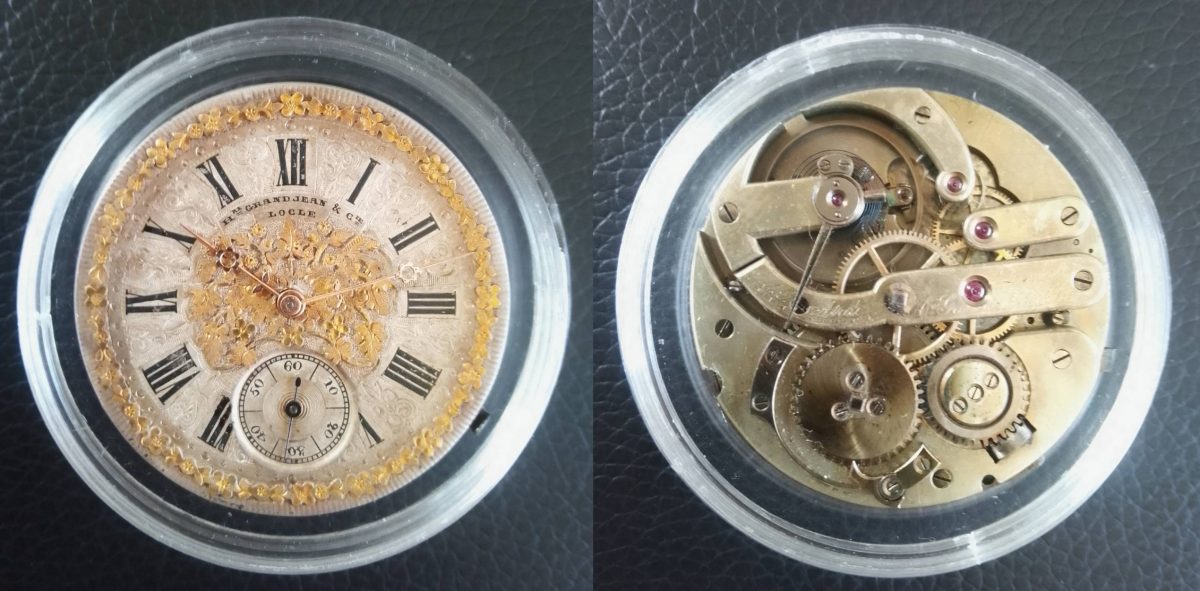
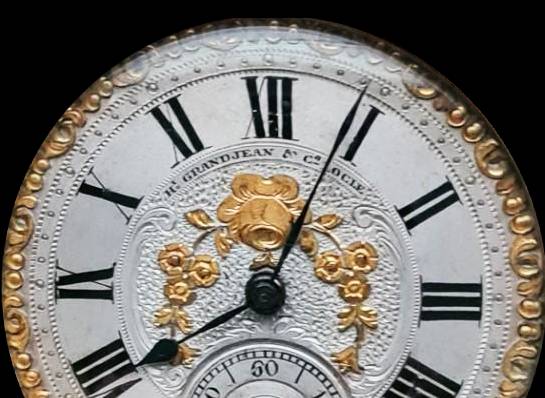
Mouvement et cadran de montre de poche Henri Grandjean & Co. (Le Locle), vers 1880, doté d'un double système de remontage — par clé ou par la couronne — et de mise à l'heure — par clé ou par la couronne en tirant sur le levier latéral —, adopte un calibre à ponts indépendants aux surfaces finement sablées, soulignées par des biseaux anglés et polis à la main. Plus sobre que les exécutions de concours, il témoigne néanmoins d'un grand rigorisme technique avec ses rubis de haute qualité chassés directement dans la masse des ponts. L'organe réglant se compose d'un échappement à ancre ligne droite associé à un balancier compensateur bimétallique coupé à vis de réglage et à un spiral Breguet en acier bleui. Le pont de balancier est surmonté d'un régulateur à raquette dont l'index en acier poli pointe vers un secteur gradué portant les indications « Adelante » et « Atrás » gravées sur le coqueret, caractéristiques des pièces destinées au marché hispanophone. Côté face, le cadran d'époque victorienne de « genre Espagne », réalisé sur fond d'argent massif, présente une remarquable richesse de textures. Le centre de la composition est occupé par un délicat composition florale et tandis que la bordure externe est rehaussée d'une riche guirlande périphérique de formas estamper en cuivre doré en microrelief, se détachant sur un fond d'argent finement gravé de rinceaux au burin, le tout surmonté de la signature rectiligne de la manufacture HRI. GRANDJEAN & Cie / LOCLE peinte en noir. Le tour d'heures à chiffres romains noirs se distingue par des espaces inter-horaires entièrement gravés de volutes et de ramages au burin. À 6 heures, le cadran de la petite seconde à décor azuré est parcouru par sa petite trotteuse en acier bleui, offrant un superbe contraste avec les aiguilles fantaisie en laiton avez pierres. Collection de l'auteur.
Movement and dial of an Henri Grandjean & Co. (Le Locle) pocket watch, circa 1880, equipped with a dual winding system—via key or crown—and hand-setting system—via key or crown by pulling the side lever—adopts an independent bridge architecture with finely frosted surfaces, accentuated by hand-angled and polished bevels. Soberer than competition executions, it nonetheless demonstrates great technical rigor with its high-quality rubies friction-fitted directly into the mass of the bridges. The regulating organ consists of a straight-line lever escapement paired with a cut bimetallic compensation balance with timing screws and a blued-steel Breguet balance spring. The balance bridge is surmounted by an index regulator whose polished steel pointer directs toward a graduated sector bearing the inscriptions "Adelante" and "Atrás" engraved on the balance cock, characteristic of pieces intended for the Spanish-speaking market. On the dial side, the Victorian-era "genre Espagne" dial, crafted on a solid silver ground, exhibits remarkable textural richness. The center of the composition is occupied by a delicate floral motif, while the outer border is enhanced by a rich peripheral garland of stamped gilt copper shapes in micro-relief, standing out against a silver background finely engraved with burin-cut scrollwork, all surmounted by the rectilinear signature of the manufacture HRI. GRANDJEAN & Cie / LOCLE painted in black. The hour track with black Roman numerals is distinguished by inter-hour spaces entirely engraved with burin-cut volutes and foliage. At 6 o'clock, the small seconds sub-dial with an azured finish features its small blued-steel seconds hand, offering a superb contrast with the fancy brass and stone hands. Author's collection.
  1. Sucesión Cronológica de la Manufactura

    Tras la muerte de Henri Grandjean el 21 de marzo de 1889, la firma prosiguió su trayectoria a través de una línea sucesoria clara que preservó sus exigencias rigurosas:

[1854] Fondation de Henri Grandjean & Cie (avec son neveu Henri et Auguste Rossel).

[1878] La direction technique et commerciale est confiée à sa nièce, Oline Rossel, née Oline GRANDJEAN-PERRENOUD-COMTESSE, veuve d’Auguste Rossel.

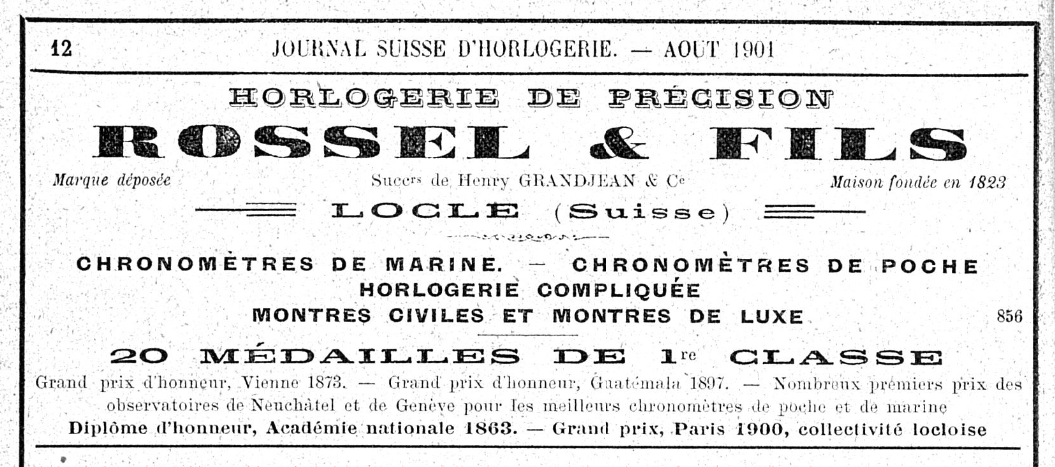
[1892] L’entreprise adopte formellement le nom de Rossel & Fils.

[1908] Formal succession and transfer of titles to Charles-Ferdinand Perret.

[1912] Reorganization under the name S.A. de la Fabrique des Montres Henry Grandjean & Cie.

[1926] The firm and its assets are acquired by industrialist Paul Cattin (founder of Oris).

[1973] Continuation of the name in the industry via a family business specializing in cases and engravings.

Epilogue: A Legacy That Endures in Modern Watchmaking

Henri Grandjean was not only a pioneer of Swiss chronometry, but a visionary who proved that Switzerland could compete with and surpass the English masters of the era. His obsession with precision, technical innovation, and uncompromising quality laid the groundwork for houses such as Patek Philippe, Breguet, and Ulysse Nardin to remain global benchmarks of high watchmaking today.

His legacy is not limited to marine chronometers or precision pocket watches; it lives on in every tourbillon, every Phillips balance spring, and every straight-line lever escapement that equips the world’s most exclusive pieces today. Henri Grandjean did not merely revive Swiss watchmaking: he brought it to its zenith and projected it into the future.

Upon his death in 1889, the director of the Neuchâtel Observatory, Dr. Adolphe Hirsch, summarized the sentiment of the industry with these words that measure his historical stature:

The country loses in him one of its best citizens; the Observatory loses in him a protector who took the initiative in its foundation and who never ceased to show it the greatest interest.”

PAUL JEANNOT & VICTOR JEANNOT

Their “Genre Espagne” Pocket Watches

Paul Jeannot, son of the watchmaker Jules-Ali Jeannot—a fervent republican who distinguished himself by ringing thetocsin in Les Brenets during the 1856 insurrection and a deputy who voted for the Address of Support to the Federal Council—and of his wife Adèle Elise Debrot, was born in Les Brenets (Neuchâtel). By the mid-1850s, he had established the representation of his father’s house in Barcelona. From the 1860s, he resided in his own tower-house on Calle San Joaquín, in the Poble-Sec neighborhood, located at the foot of Montjuïc mountain. Documents show that as early as 1868—as the successor to Baron de La Châtre—Jeannot managed a jewelry and watchmaking shop under his own name in the Catalan capital, located at Plaza National No. 1, near La Rambla.

Family and Industrial Origins (1843–1875)

The success of the enterprise rested on solid family foundations laid by his father, Ali Jeannot, a respected figure in Le Locle and Les Brenets. A committed republican, the latter took an active part in the Revolution of 1848 and represented his municipality on the Grand Council. On the industrial front, Ali had partnered in 1843 with Victor Henriet under the business name Ali Jeannot et Henriet, watchmaking manufacturers at 167 Grande Rue in Le Locle, and had opened a branch in Marseille that same year. Later, on June 30, 1854, the dissolution and liquidation of the firm Jeannot et Henriet were announced by mutual agreement. The partners continued their activities separately; it was also announced that Ali Jeannot had partnered with his son Victor, to whom he had granted powers of attorney. The headquarters of this new house was established in Les Brenets and operated under the business name Jeannot et fils.

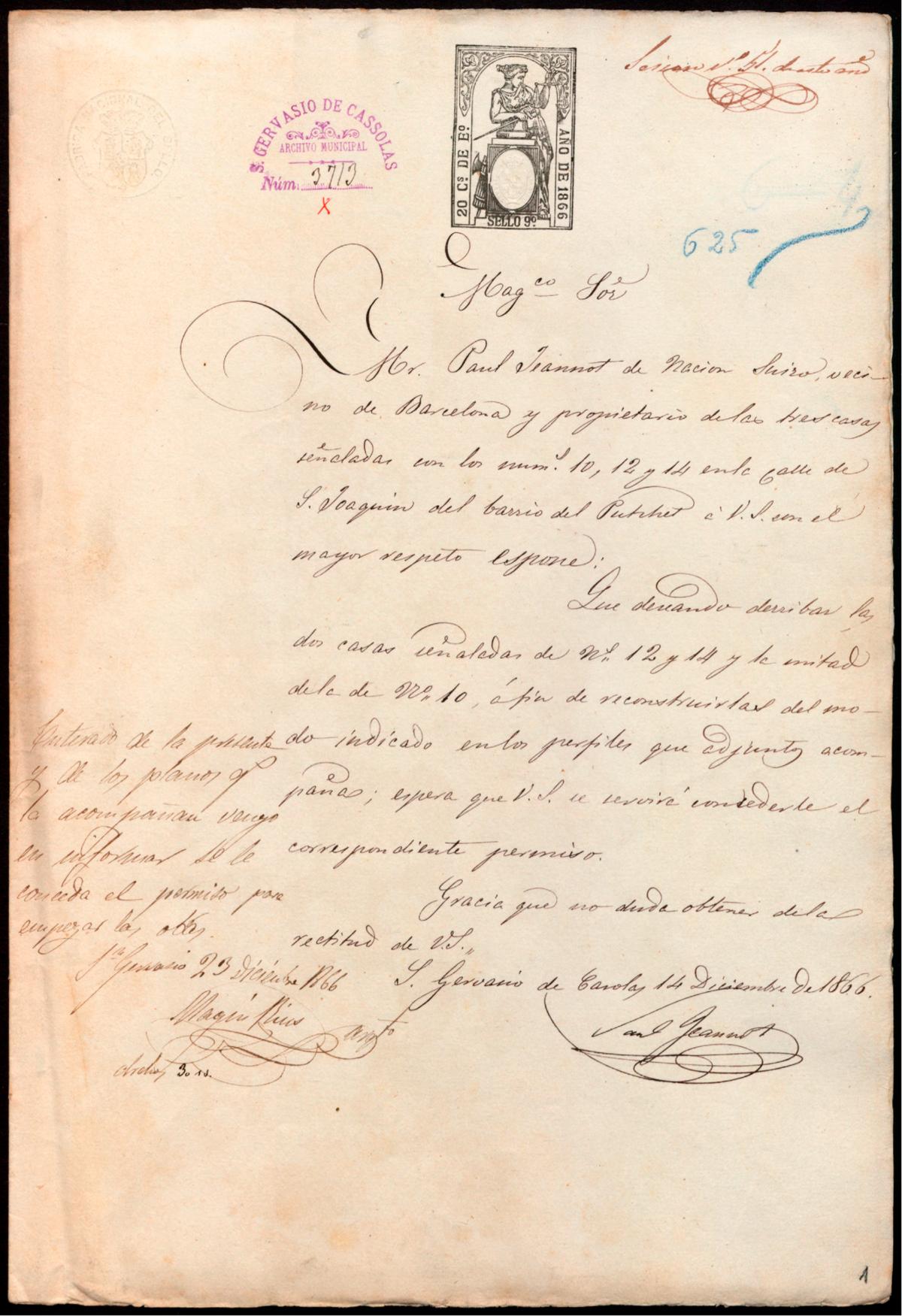
Urban planning request signed by Paul Jeannot, Barcelona (Sant Gervasi de Cassoles), December 1866. The Swiss watchmaker, mentioned as a "resident of Barcelona," requests authorization to demolish and rebuild properties belonging to him in the El Putxet neighborhood (Calle San Joaquín). This archival document confirms his physical establishment and real estate investments in Catalonia at that date, unprecedentedly documenting the foundations of his commercial network in Spain.
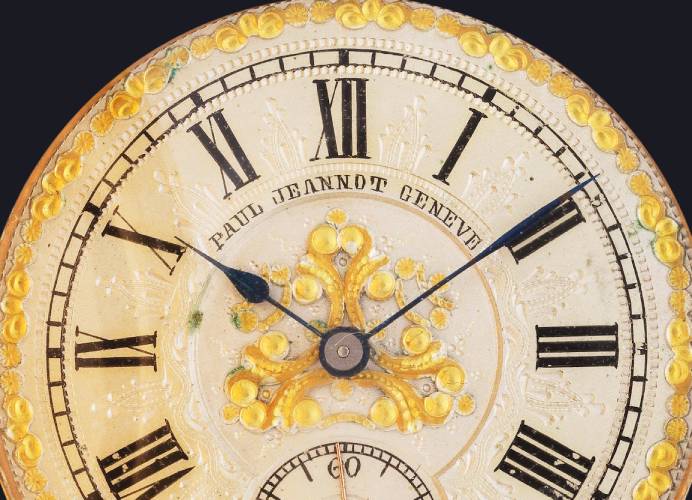
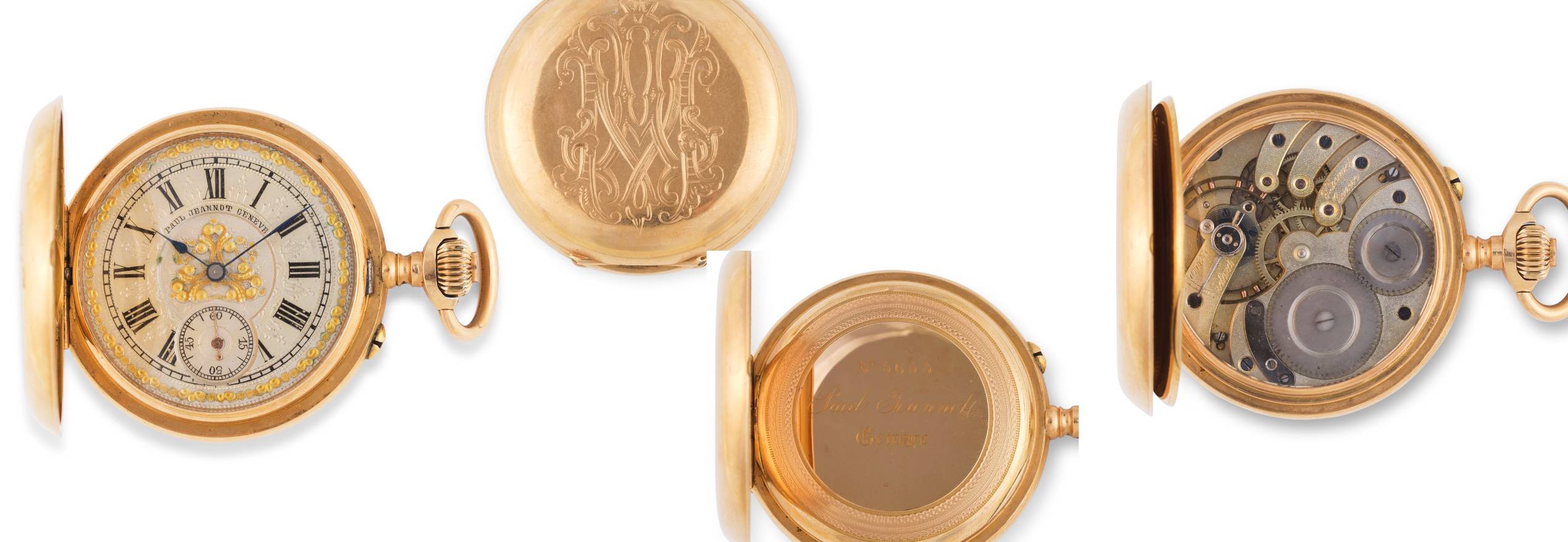
Paul Jeannot 18K yellow gold hunter-case pocket watch, Geneva, No. 5653, circa 1874. Intended for the Spanish-speaking market, this very fine 19-ligne hunter-case pocket watch features a pendant-winding system and a hand-setting mechanism via a push-piece on the band at 4 o'clock. Its 51 mm diameter case features a cover and back finely engraved with scrollwork and volutes—the upper cover centered with a rocaille-style cartouche housing an elegant monogram—and bears cantonal gold hallmarks prior to the 1880 Swiss federal law on the control and guarantee of precious metals. The hinged gold cuvette is engraved in cursive with the signature "Paul Jeannot / Geneva" above the serial number. On the dial side, the Victorian-era dial, characteristic of the prestigious "genre Espagne", is crafted on a solid silver ground and distinguished by the richness of its textures. The center of the composition is occupied by a magnificent applied and stamped gold floral motif in micro-relief, standing out against a delicately burin-engraved background, all surmounted by the manufacture's signature "PAUL JEANNOT GENÈVE" painted in black. The hour track with black Roman numerals features inter-hour spaces entirely engraved with delicate burin-cut volutes, while the outer border is enhanced by a rich matching peripheral garland of applied and stamped gold. At 6 o'clock, the small seconds sub-dial is also recessed, the whole swept by remarkable blued-steel "Stuart pear" style hands. The gilt-brass independent bridge movement features a jeweled gear train with rubies, with the balance staff benefiting from a counter-pivot to minimize friction. The regulating organ consists of an all-metal straight-line lever escapement with deadbeat pallets without rubies (metal pallets), paired with a cut bimetallic compensation balance with timing screws and a blued-steel Breguet balance spring. The latter is adjusted by a remarkable rack-and-pinion regulator system, the index of which moves over a graduated sector engraved on the balance cock. Case, cuvette, and dial signed. Photo courtesy and © https://www.bonhams.com

Beyond his international renown and commercial success in the Iberian Peninsula, Paul Jeannot was deeply rooted in the social and economic life of his region. His active involvement in the Les Brenets Railway Commission in 1888 demonstrates a firm commitment to the progress of his community. For Jeannot, the arrival of the train represented not only an essential logistical infrastructure for watchmaking, but also an indispensable engine of social development to curb rural exodus, facilitate young people’s access to the vocational schools of Le Locle, and bring medical care closer to the inhabitants of the Jura.

Bicephalous structure and production axis (Jura–Geneva–Barcelona)

Initially, manufacturing activity was directed from Les Brenets, alongside his father. Subsequently, production was transferred to 26 Rue Mont-Blanc in Geneva, where it was placed under the direction of his brother, Louis-Victor Jeannot (born June 27, 1830), a renowned watchmaker. Independent and committed, the latter distinguished himself in politics by signing, in 1856, a letter of support from 914 servicemen to the Federal Council. In 1888, he obtained the American patent US378592 for a chronograph, marking hours, minutes, and seconds, as well as fifths of a second, with an additive counter.

The Barcelona headquarters became the nerve center: receiving production and serving as the financial core supporting activities in Switzerland. Thus, a bicephalous structure was created: commercial control and capital injection from Spain directly financed the workshops, control hallmarks, and high-end testing in Geneva and La Chaux-de-Fonds.

Paul Jeannot, Geneva, No. 8229, circa 1875 women's 15-ligne hunter-case pocket watch. Featuring a pendant-winding system and a hand-setting mechanism via a push-piece on the band at 4 o'clock, this piece of extraordinary rarity and extreme refinement for a feminine watch of that era integrates calendar and moon-phase complications, housed in a sumptuous 18K yellow gold and polychrome enamel case. The upper cover is adorned with a magnificent polychrome enamel scene on a black enamel background depicting five winged cupids (or cherubins) playing among clouds, surmounting a gold floral appliqué centered with a star set with rose-cut diamonds. The back of the case is decorated with a superb design of engraved gold foliate scrollwork and a Renaissance mascaron against a black enamel background, completed in the lower part by polychrome enameled flowers on a gold background. The gold cuvette is signed, numbered, and engraved with the movement specifications: "Paul Jeannot / GENEVA / 18 JEWELS / Lever Escapement / Straight line Breguet balance spring / Nickel". On the dial side, the superb solid silver dial features a center richly adorned with two-color applied and stamped gold scrollwork and foliage in micro-relief, standing out against a delicate silvered background engraved with a burin even in the intervals between the hour markers. Below 12 o'clock, the manufacturer's signature painted in black surmounts a semi-circular aperture revealing the cobalt blue enamel moon-phase disk dotted with a golden moon and stars. At 6 o'clock, an auxiliary dial indicates the date via a hand-type calendar (1 to 31 scale). The hour track features painted black Roman numerals, the whole swept by delicate blued-steel Stuart pear hands. The half-plate type movement counts 18 jewels and testifies to great construction refinement: it features a Côtes de Genève finish, mirror-polished screws, and screwed gold chatons. This elite caliber is equipped with a counterbalanced straight-line lever escapement (moustache pallet lever), a cut bimetallic compensation balance with screws, a blued-steel Breguet balance spring, and a ruby counter-pivot mounted under a chaton for the escape wheel. The bridges bear the engraved inscription "PATENTED / Jan. 27, 1880", corresponding to the patent filed by the manufacture for its mechanism. Case, cuvette, dial, and movement signed. Photo courtesy and © https://uhren-muser.de
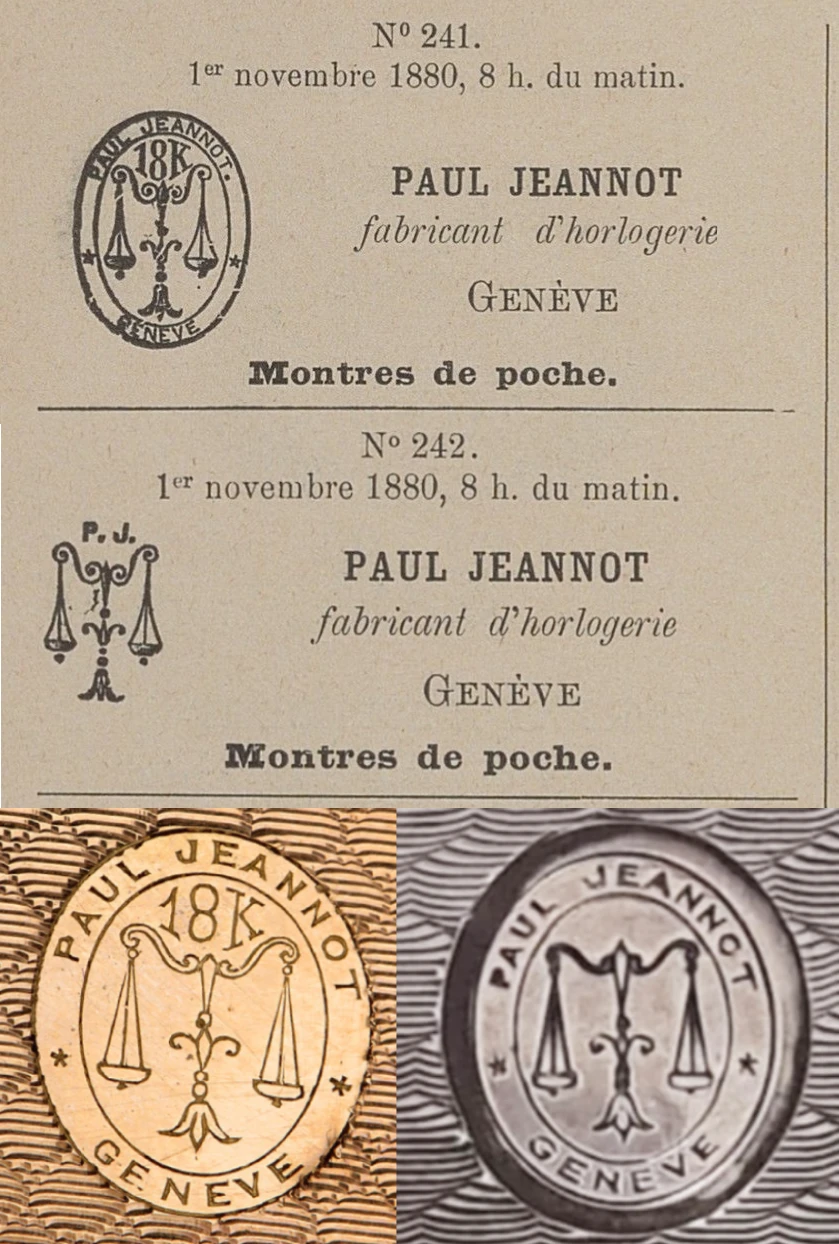
1880. First official trademark deposits by Paul Jeannot.

Consolidation and Specialization (1875–1889)

Paul Jeannot gave a new impetus to the latter, which was registered in 1876 under the name “Paul Jeannot, specialty: watchmaking manufacturer for Spain and the Colonies”. The enterprise specialized in chronometers, repeaters, and calendars developed in-house.

By mid-1879, he founded, together with François Henri Rochat (originally from Yverdon), a limited partnership under the business name Paul Jeannot, adopting a compensation balance as its logo. The house established its counters at Plaza del Real No. 2 in Barcelona, while opening branches in London and Geneva. This expansion was led by his son, Paul-Victor Jeannot (born July 11, 1860, in Les Brenets).

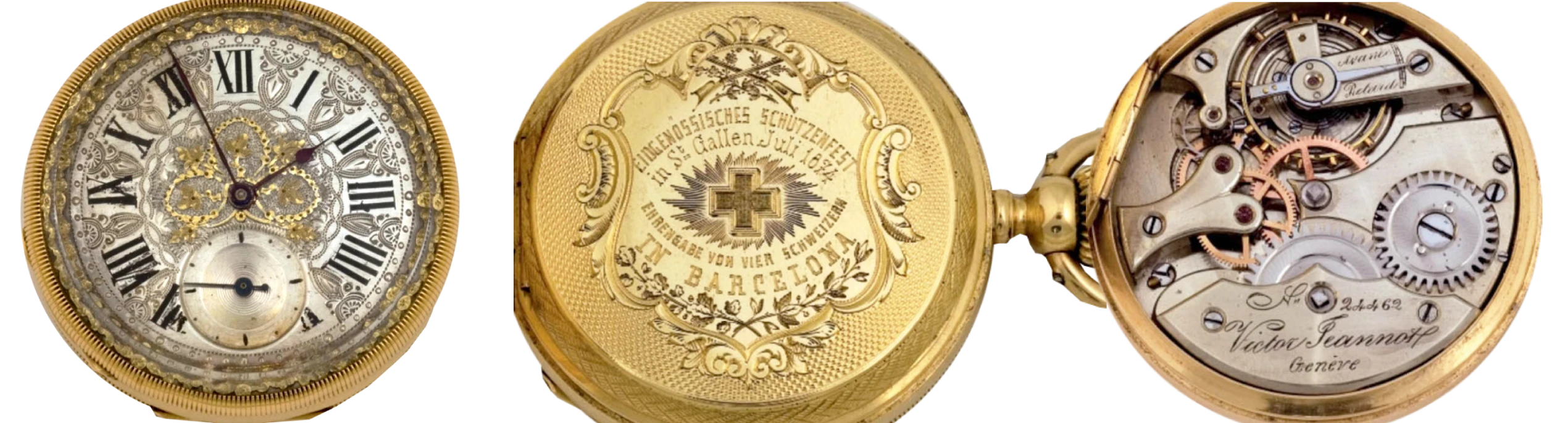
Victor Jeannot (La Chaux-de-Fonds / Geneva) 19-ligne hunter-case pocket watch, No. 24462, circa 1877. Bearing a commemorative inscription engraved on its cuvette and back case, this historical piece constitutes a Prix d'Honneur presented by a group of four Swiss residents in Barcelona on the occasion of the St. Gallen Federal Shooting Festival in July 1874. This piece attests to the presence and role of the Jeannot family, commercially established in Catalonia, serving as a bridge between Swiss manufacturing and the Iberian Peninsula market. The yellow gold hunter case features a back finely burin-engraved and guilloché, centered with a radiating Swiss cross surmounted by crossed rifles and oak branches, housing the official German dedication relating to the event and the Swiss colony of Barcelona. On the dial side, the Victorian-era "genre Espagne" dial, crafted on a silver ground, features a center occupied by an applied and stamped gold floral motif in micro-relief, standing out against a silver background delicately engraved with a burin, while the periphery is enhanced by the traditional matching garland. The hour track with painted black Roman numerals is flanked by inter-hour spaces entirely burin-engraved with intertwined scrollwork volutes and foliage, with the outer minute track marked by dots stamped in relief directly into the solid silver. At 6 o'clock, the recessed small seconds sub-dial is adorned with a concentric guilloché decoration, the whole swept by elegant blackened-steel "Stuart pear" style hands. The 19-ligne movement, of classic Jura construction with independent bridges, features a neat satin finish with angled bevels. It is equipped with a straight-line lever escapement, a bimetallic compensation balance with timing screws, a blued-steel Breguet balance spring, and an extended-index regulator pointing to the engraved graduated sector "Avance / Retard" (Fast / Slow). Case, cuvette, dial, and movement signed.

Alliance with Paul Perret, Social Conflicts, and Decline (1890–1903)

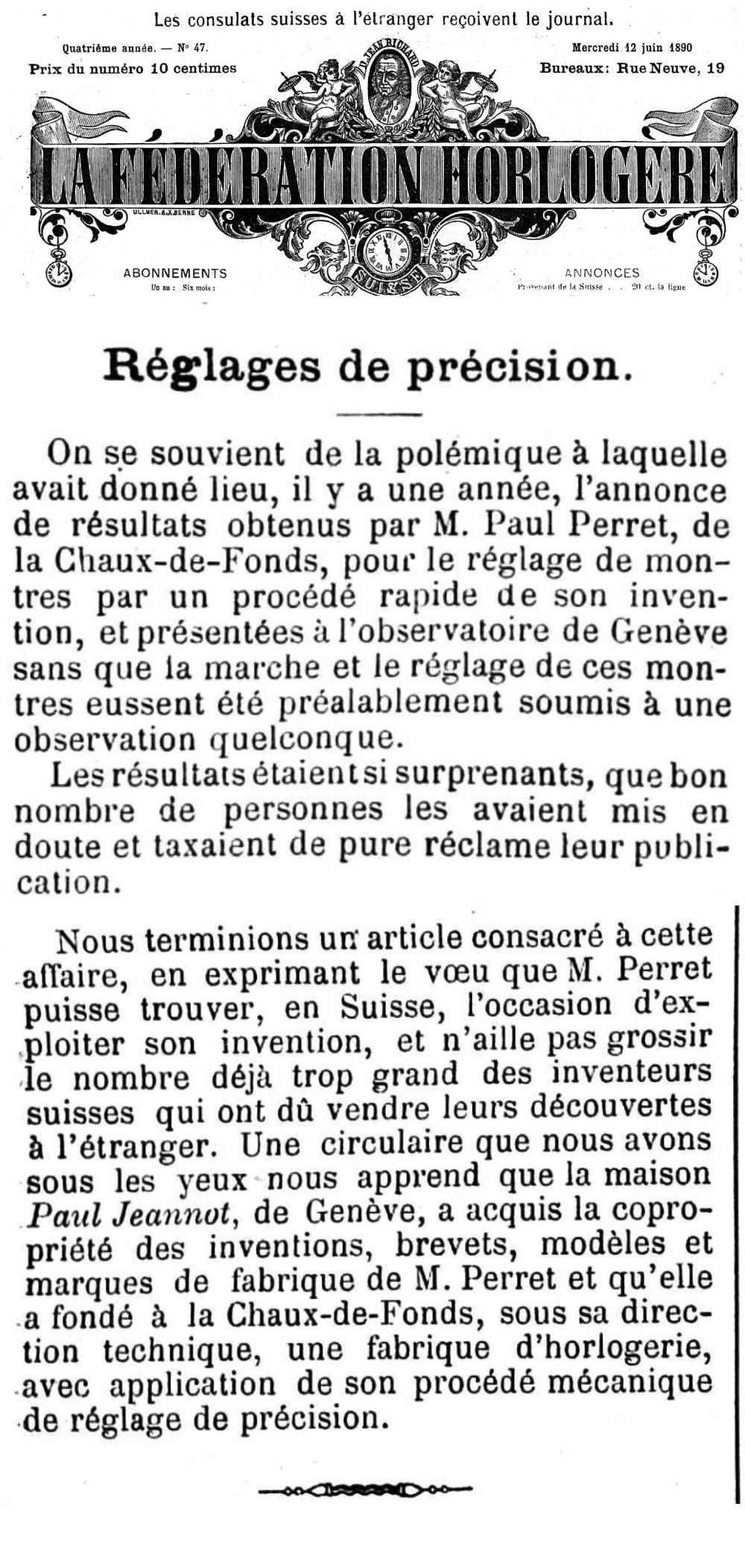
In 1890, Paul Jeannot sealed a strategic alliance by acquiring a 50 percent co-ownership of Paul Perret’s inventions, models, and trademarks. A brilliant yet controversial inventor, Perret had distinguished himself since the late 1870s through his work on chronometric precision. This partnership marked a major technological breakthrough for the manufacture, with Perret contributing three key innovations designed to resolve the inaccuracy of manual regulation:

  • The snail-cam micrometric regulator (Swiss Patent No. 21, 1890): an eccentric screw with a spiral cam allowing precise, continuous, and ultra-smooth adjustment of the regulator.

  • The segmented compensation balance (Swiss Patent No. 22, 1888): a bimetallic wheel significantly improving resistance to temperature variations.

  • The talantascope: an optical device making it possible to observe and adjust the tiny components of the movement with unparalleled precision.

Aware that this scientific rigor was an indispensable lever for conquering international markets, Jeannot integrated these technologies into his production. As early as 1892, he stamped his watches with the label “Precision Mechanical Regulation” (Réglage Mécanique de Précision), guaranteeing technical excellence for his creations destined for Spain and America.

To materialize this industrial growth, he inaugurated a branch at 65 Rue du Parc in La Chaux-de-Fonds, dedicated to these new processes, with technical management entrusted to his son, Paul Jeannot-Bersot. This collaboration was also embodied in the brand’s visual identity with the registration, that same year, of a circular logo combining the names Jeannot and Perret, centered on a compensation balance.

Furthermore, this union went beyond the strictly professional framework: much like their fathers, Paul Jeannot Jr. and Paul Perret maintained a deep friendship, reinforced by their assiduous participation in Swiss and German shooting competitions—a personal complicity that illustrates the close nature of the alliance between the two families.

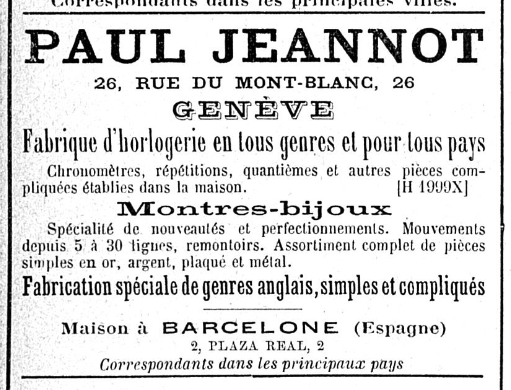
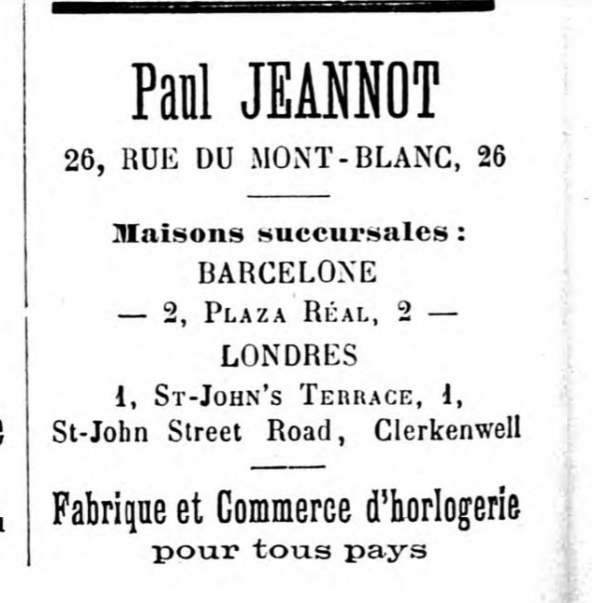
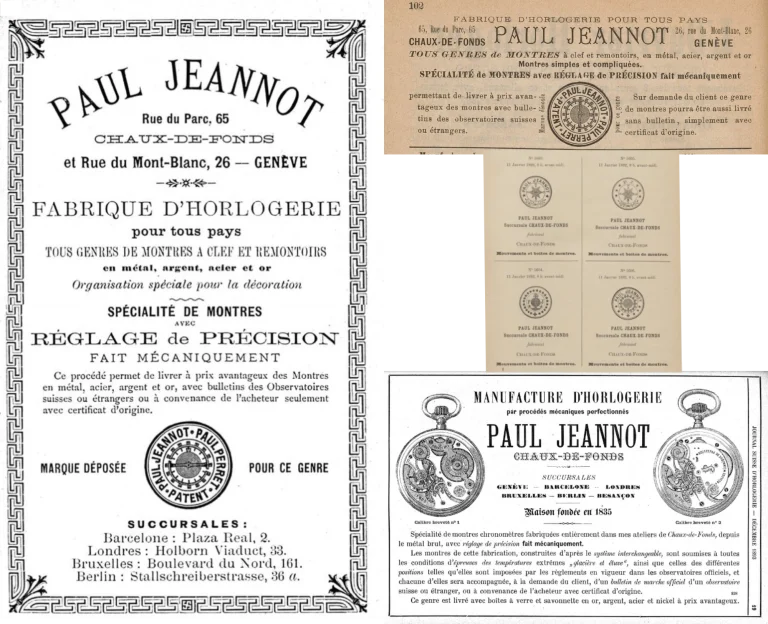
Paul Jeannot advertising inserts, 1886 and 1889.
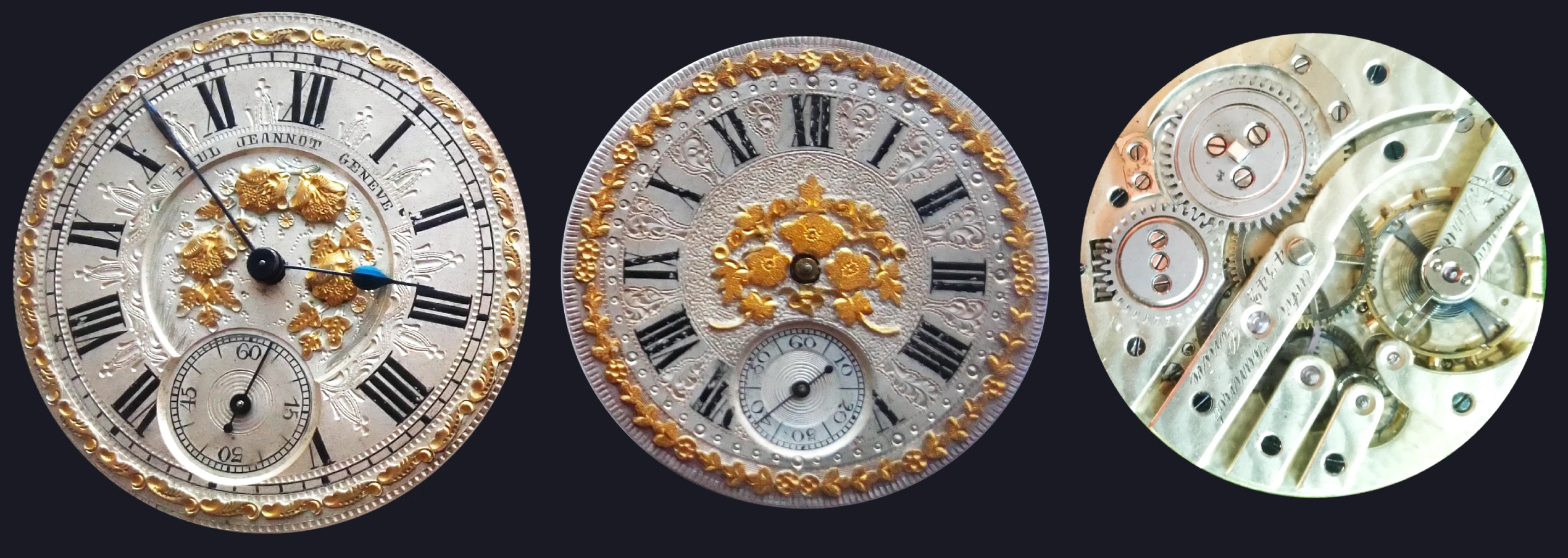
Typical "genre Espagne" dials by Paul Jeannot (19 lignes) and Victor Jeannot (15 lignes). Crafted on a silvered ground, the peripheral garland and the center are adorned with gold floral motifs featuring varied gilding shades and textures, stamped in micro-relief. A dense hand-engraved burin stippling creates a matte, granulated background that makes the central composition stand out, the whole completed by vigorously hand-engraved volutes and scrollwork in the inter-hour spaces. Victor's dial features a fine network of stamped radial striations on its peripheral border, followed by regular concave beads marking the minutes, whereas Paul's dial sports a painted minute track. Author's collection.
Press clippings: 1893 advertising inserts present the "Precision Mechanical Regulation" (Réglage de Précision fait Mécaniquement) and the new calibers of the Paul Jeannot manufacture in association with Perret. The logo "PAUL JEANNOT - PAUL PERRET - PATENT" attests to the technical and commercial alliance.

Beyond his creations under his own name, Paul Jeannot also commercialized “Silverly” and “Favory” pocket watches.

The authenticity of this production is beyond doubt: the cuvettes, dial styles, and movements themselves bear his name and logo. However, an element of shadow remains regarding this commercial strategy.

However, this expansion was accompanied by social turbulence at his factory in La Chaux-de-Fonds, supervised by his son. As early as February 26, 1891, the workers’ newspaper La Sentinelle published a public denunciation by workers at the La Chaux-de-Fonds factory, accusing management of non-payment and poor wage practices. The Jura project failed, and the company name was struck off, with activity transferred to Besançon (France).

The final blow came in April 1895, when a financial scandal broke out: Paul Jeannot Jr. and his director, Berthold Pellaton, were arrested in Switzerland and faced imprisonment. Although the courts ultimately cleared them in May 1898, the brand’s image was permanently affected.

In 1896, Paul Jeannot acquired the remaining half of the Perret patents, thereby securing full ownership.
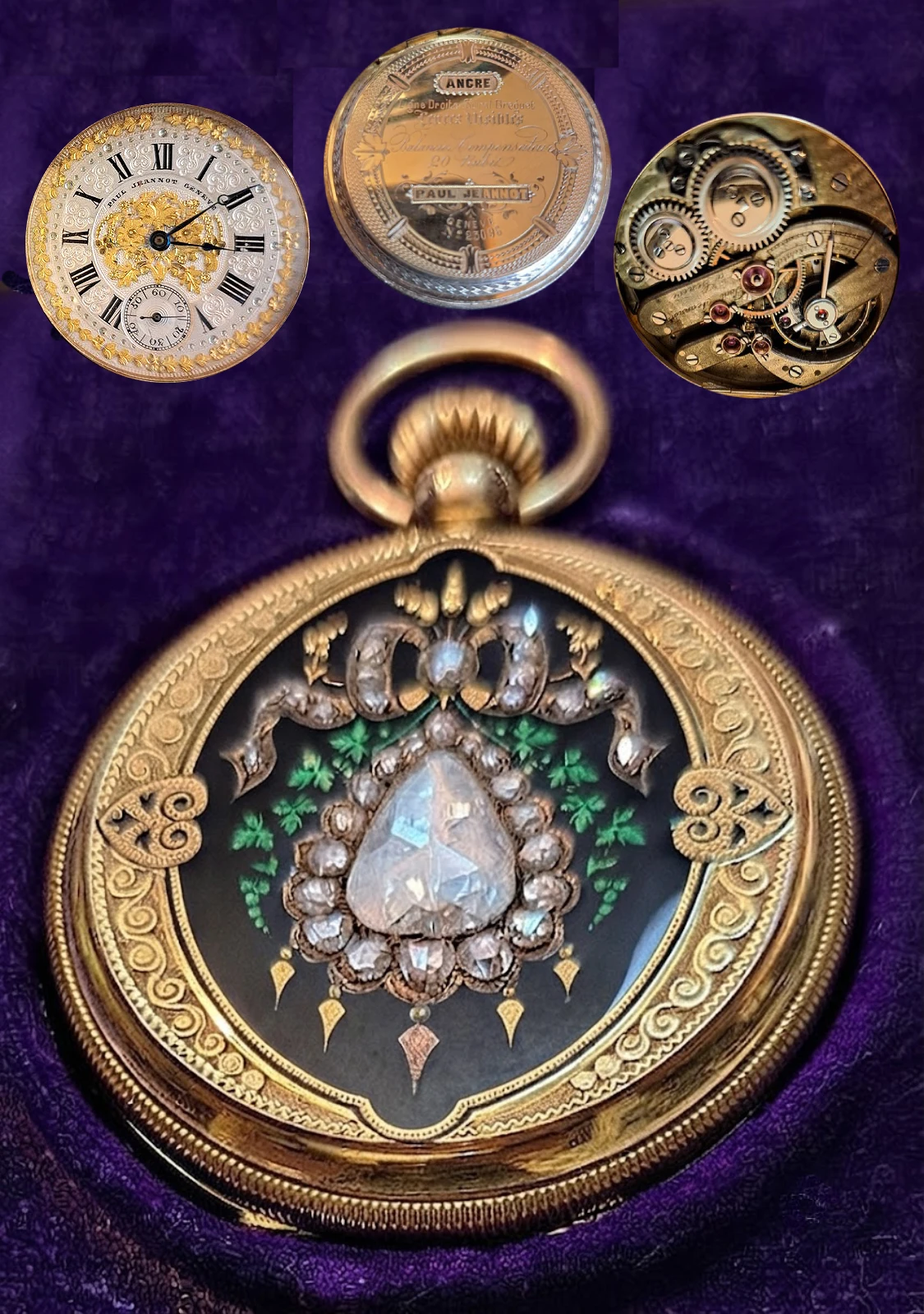
On the left, exceptional Paul Jeannot pocket watch No. 23096, illustrating the pinnacle of Geneva watchmaking luxury. The 18K gold hunter case is sumptuously decorated with black enamel mesh and a complex setting of diamonds or rock crystal, featuring a spectacular central almond-shaped briolette-cut stone surrounded by rose-cut stones, forming a floral motif. The dial is in the “genre Espagne” style. The high-precision movement is distinguished by a winding bridge held by three screws, pierced rubies on the center wheels, and stone counter-pivots on the pallet lever and balance axes, the whole superbly adjusted with gold chatons.

Paul Jeannot 21-jewel 18K gold "Favory" pocket watch, No. 111635. It comes with its original presentation case: an elegant ebony box inlaid with stringing and lined with purple satin. The satin lining bears the serial number 111635 in gilt letters, which also appears on various parts of the watch. The case features a compartment to protect the spare crystal as well as the replacement white enamel dial. The watch case is made entirely of solid gold, making it a true piece of jewelry. The front cuvette features a superb central raised crest adorned with a fine engraving depicting children on vacation among stones, surrounded by a garland. This motif, hand-engraved with impressive precision, is enhanced with touches of enamel, much like the motif on the back cuvette (a helmet of armor). Inside the front cuvette, the engraved name Paul Jeannot Geneva can be seen, accompanied by his logo and the 18K hallmark. Width: 57 mm. Weight: 158 g.
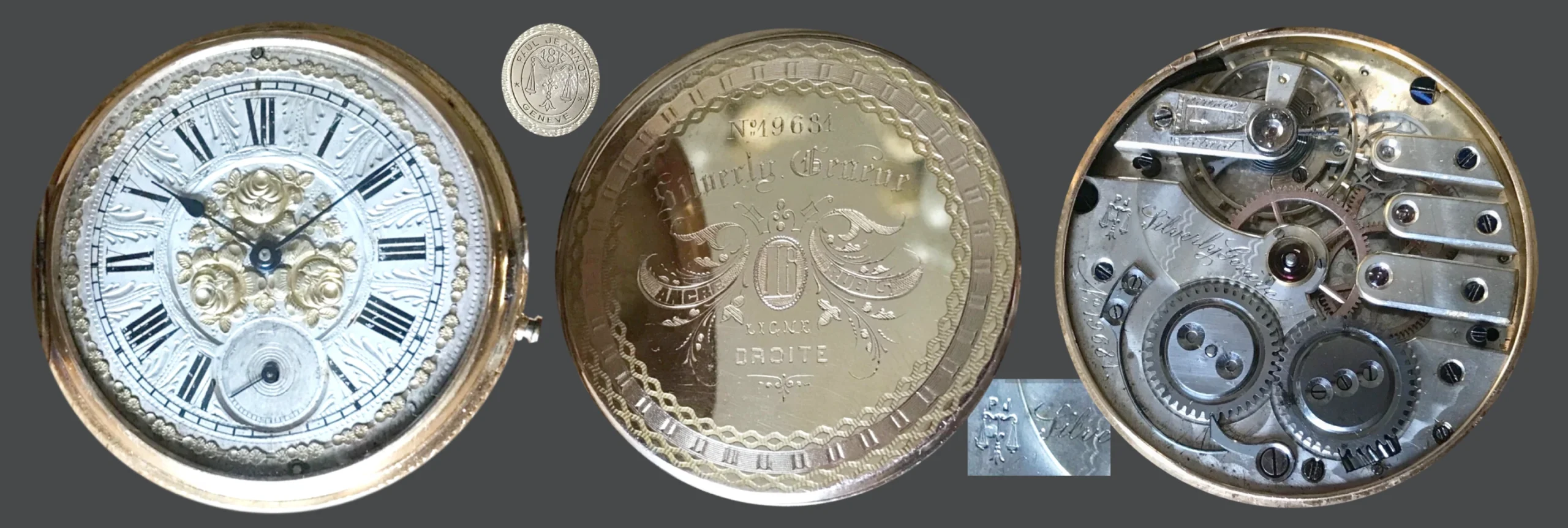
"Silverly" pocket watch No. 19681 by Paul Jeannot.

Victor Jeannot: A Watchmaking Legacy and Pioneering Philanthropy

Victor Jeannot, brother of the founder and technical director of the Geneva workshops, passed away on May 31, 1891, at the age of 61, at his home in Geneva. He bequeathed a fortune of approximately 200,000 francs to the municipality of Les Brenets (Neuchâtel), his birthplace, thereby permanently inscribing the Jeannot dynasty into the horological history of the Swiss Jura.

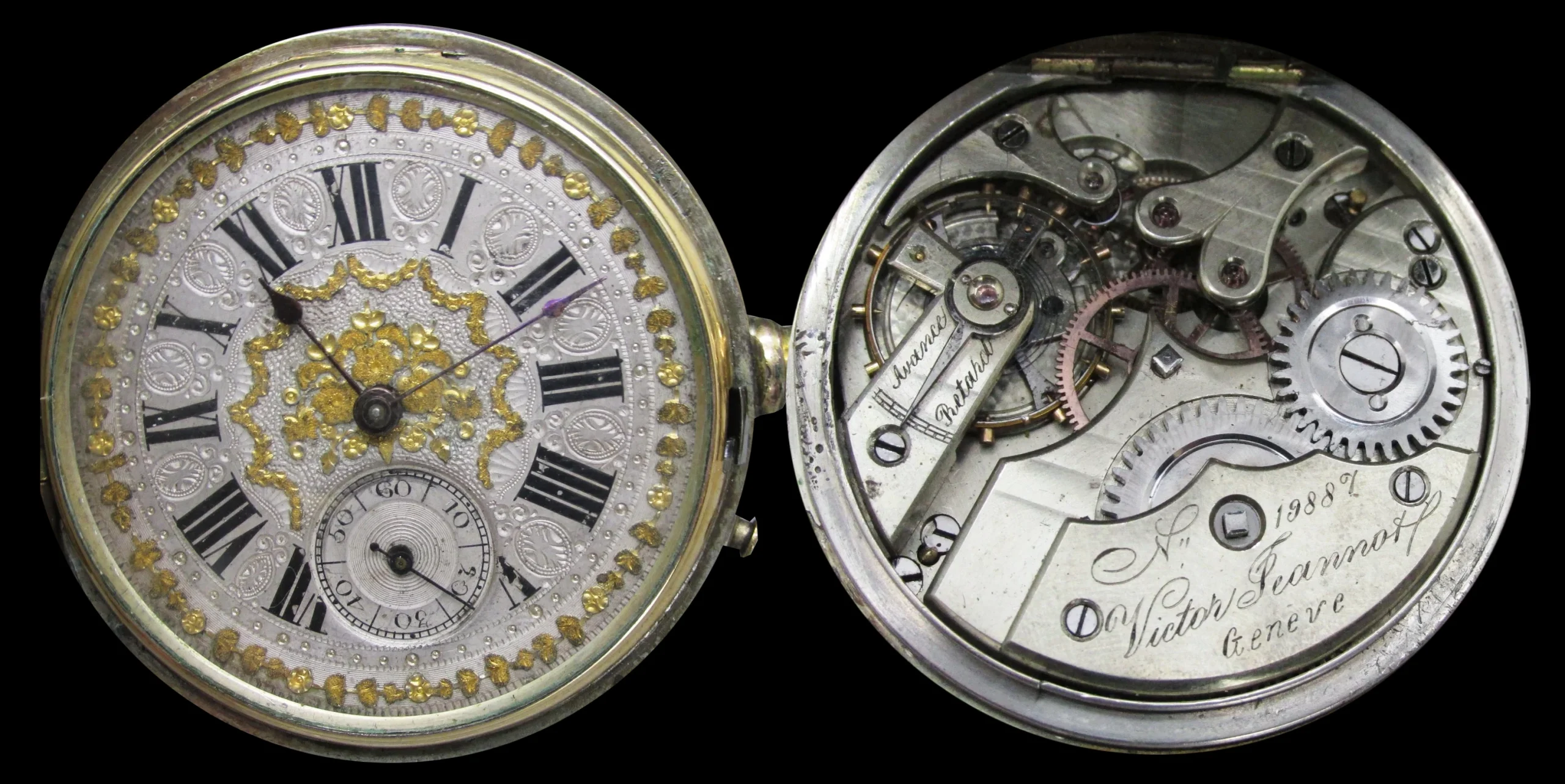
Victor Jeannot pocket watch nº 19887

Epilogue (1896–1903)

In 1896, the Paul Jeannot watchmaking firm in Barcelona relocated to 5 Rambla de los Capuchinos during the final reorganization of its workshops.

In 1899, Paul Jeannot transferred his Besançon manufacture to the Barcelona jeweler-watchmaker José Rafel.

Following the death of Paul Jeannot in 1903, the enterprise that had marked one of the most prolific pages in the history of Spanish-genre watchmaking was definitively extinguished.

Afterward, the remaining trademarks were liquidated and acquired at the turn of the century by the Droz & Co. firm.

Circular black-and-white seal featuring the name Ramón Campos, researcher of 19th-century Swiss watchmaking and early fountain pens.