Their “Genre Espagne” Pocket Watches
The Japy Empire: Two Centuries of Innovation and Horological Tradition
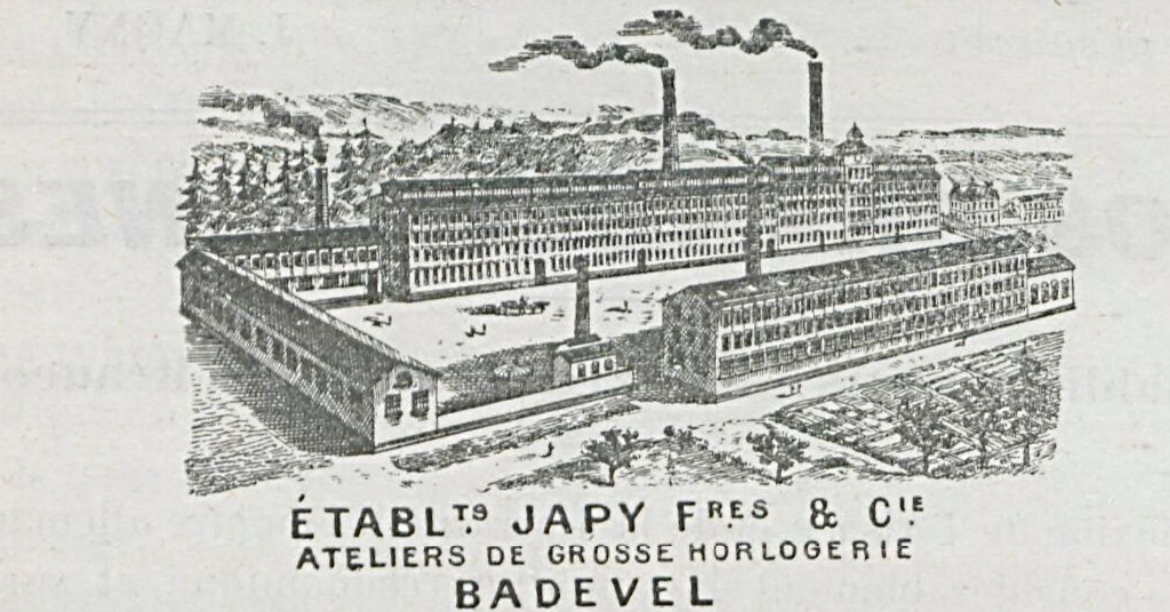
Beaucourt, a small town located near Belfort, has left a significant legacy in the history of horology. It all began with Frédéric Japy, born in 1749. After completing his apprenticeship as a watchmaker in La Chaux-de-Fonds, he founded a manufacture dedicated to the production of watch movement blanks (ébauches) for pocket watches in his hometown of Beaucourt in 1777.
This manufacture fell prey to the flames on July 1, 1815, set on fire by allied Austro-Hungarian troops. This act of vandalism, motivated by international rivalries, destroyed one of the finest factories in Europe, causing losses estimated at two million francs. Despite this tragedy, Japy’s legacy endured, demonstrating the resilience of his industrial empire.
In itself, this was nothing exceptional, because since the beginning of the 18th century, the division of labor had dominated watch manufacturing. Workshops organized as manufactures prepared the blank movements, and their finishing was subsequently carried out by independent master watchmakers. Thus, the production of large-volume pieces could be rationalized. The manufacture of blanks (ébauches) was then carried out by skilled artisans, and the use of machinery was still very limited.
Frédéric Japy organized production in an entirely new way. He purchased a complete set of machines from Jean-Jacques Jeanneret-Gris for the industrial manufacture of movement blanks (ébauches), and more specifically of their individual components. It is interesting to note the reason why Jeanneret-Gris sold these machines: he was encountering problems with his workers, who apparently disliked working with these new machines and devices.
Frédéric Japy precisely held a very clear strategy to secure a positive attitude from his workers. A convinced Protestant, he maintained a social vision: “I want my workers to form a single family with me and mine. My workers must be my children and, at the same time, my collaborators.” This was on the eve of the French Revolution.
Consequently, the organization of the Japy factory was not limited to the workday, but encompassed the entire lives of the employees. For example, the male and female workers ate separately under the supervision of Frédéric Japy and his wife, respectively. On Sundays, there were Bible readings led by the boss, and on working days, he gave short lectures on work-related topics. In addition to factory work, a little agriculture was also practiced. Even clothing and other goods were acquired centrally, so that the workers were entirely provided for.
Revolutionary Manufacturing Methods
In this idyllic environment, a true revolution took place. The manufacture of watch movements was completely reorganized thanks to machines. The various work steps were simplified to such an extent that “women, the elderly, and even blind people could shape the individual parts of the movements using a simple hand lever.”
The method consisted of dividing the different work phases, with each operator having to perform only a single movement or manipulation. Thus, approximately 150 people worked on a single movement blank (ébauche). Furthermore, the manufacturing of parts was pushed further than in traditional production. Only the escapement remained in the rough state; all other mechanical parts were completely machined.
These latter found themselves on the verge of ruin and, in 1801, went so far as to demand the destruction of the Japy factory to prevent the bankruptcy of their trade. This demand came to nothing, even in revolutionary France, for reason is almost always on the side of those who succeed. And Frédéric Japy was one of them. Furthermore, despite his Protestant faith, he had no trouble with the Republic; for him, the economic advantages of the free movement of goods weighed heavier.
Production figures literally skyrocketed. In 1780, the company produced nearly 30,000 movements with only 50 employees; by 1806, with 500 male and female workers, it already reached over 150,000. This also triggered a massive drop in prices. Japy could supply its products at one-third the price of other manufacturers. By 1860, this industrial center employed nearly 6,000 workers, about a third of whom, dedicated to watchmaking work, annually produced over 50,000 clock gear trains (roulants de pendules) and 640,000 watch movement blanks (ébauches).
The Birth of an Empire
With his watchmaking factory, Frédéric Japy laid the foundations of an immense empire. He himself had sixteen children. Initially, three of them took over the management of the company in 1806. Staying fully within the spirit of pre-industrial family enterprise, the company was considered a family patrimony intended to serve all the heirs of the lineage.
More and more family members joined the management of the firm and its various subsidiaries. Production diversified increasingly: in addition to pocket watch movement blanks (ébauches), the manufacture soon began producing movements for heavy clocks (wall clocks, table clocks), screws, enameled articles, hardware of all kinds, and more.
The business conglomerate initially prospered magnificently, but precisely for this reason, it suffered from a chronic lack of liquidity, as it was entirely financed by the family. The descendants, growing ever more numerous, wanted to draw from the inheritance, while increasingly capital-intensive manufacturing methods required continuous investment.
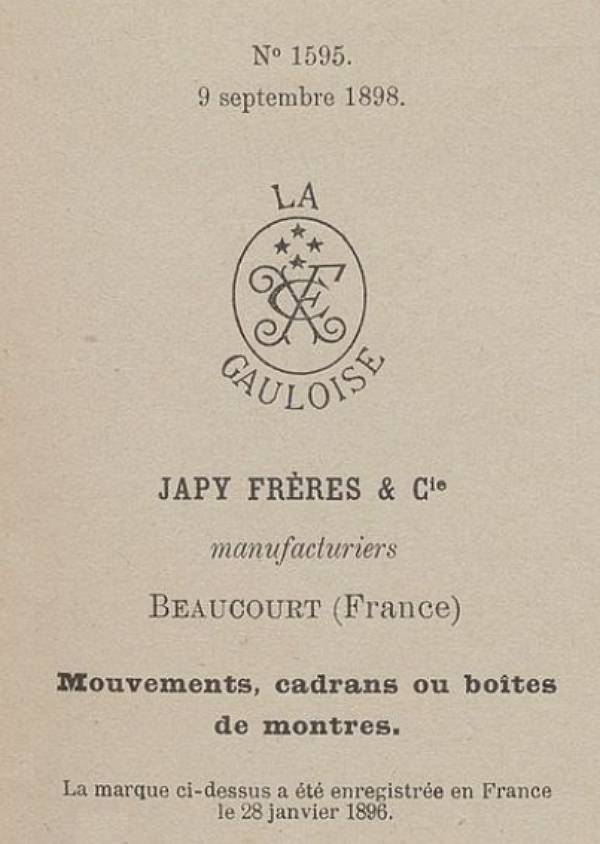
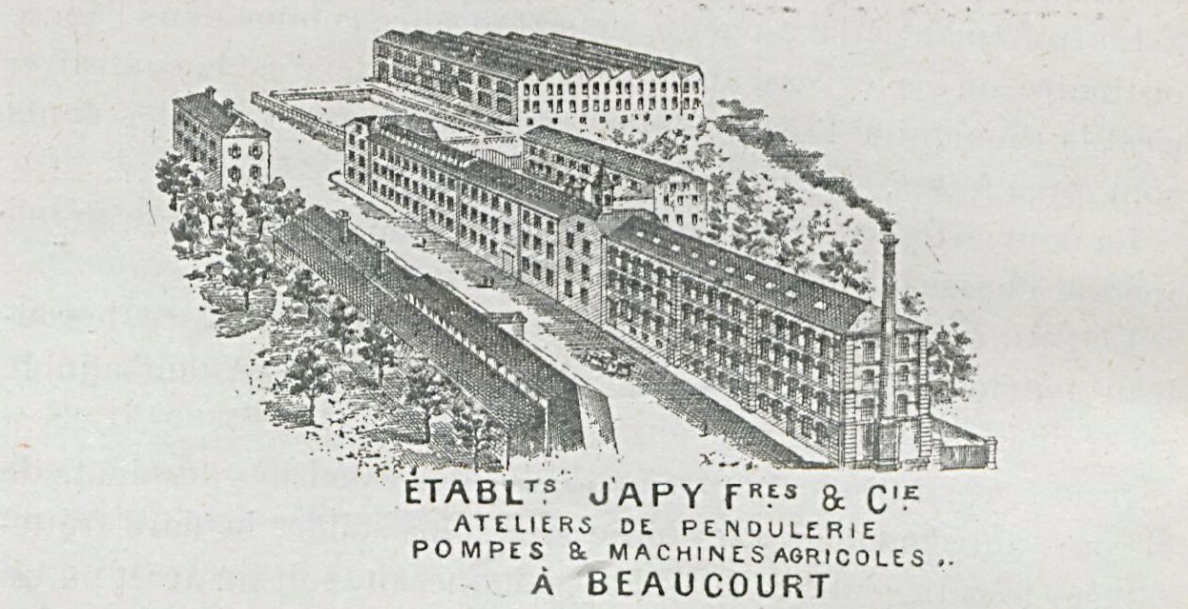
In the 1860s and parallel to this industrial development, social commitment toward workers took an institutional form. The Société immobilière de Beaucourt, created under the impetus of MM. Japy frères & Cᵉ with a capital increased to 200,000 francs in registered shares of 100 francs, had the mission of building individual housing for the workers (comprising three rooms, a ground-floor kitchen, two attic rooms, a cellar, and a garden for approximately 2,000 francs) and serving as their savings bank. By allowing employees to gradually acquire their housing through their savings or a staged rent while guaranteeing them a 5% annual interest rate, the Japy house extended the social paternalism founded by Frédéric to durably attach working-class families to the enterprise.
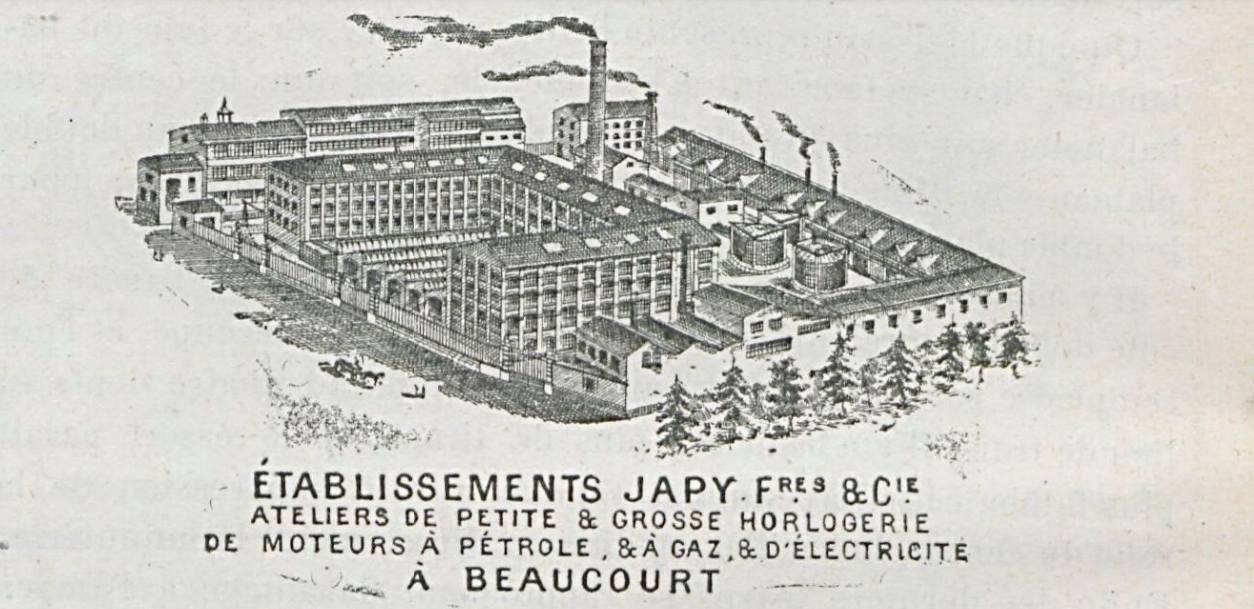
While other later major French entrepreneurs took advantage of fundraising possibilities on financial markets from the outset (by creating joint-stock companies, issuing bonds, etc.), the Japy empire remained under the traditional family company structure. For this reason, it could not keep pace with frantic industrial development. Around 1870, the group had already passed its golden age.
Si, au début du XIXe siècle, l’activité principale de l’entreprise était la production de mouvements pour montres de poche à forte valeur ajoutée, ses piliers devinrent par la suite des secteurs commerciaux de plus en plus modestes : la fabrication d’ustensiles émaillés bon marché pour les foyers modestes ou des horloges murales/horloges de table économiques en tôle. Il fallait donc traiter de plus en plus de matière pour obtenir le même bénéfice ; bien que les installations industrielles fussent de plus en plus imposantes, la rentabilité diminuait.
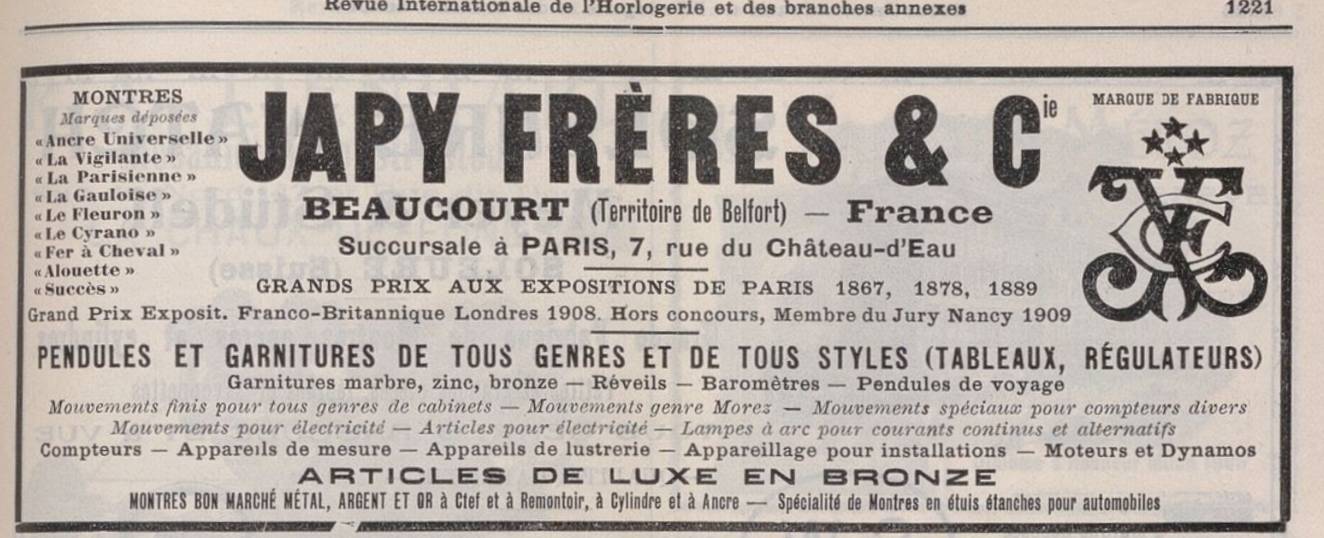
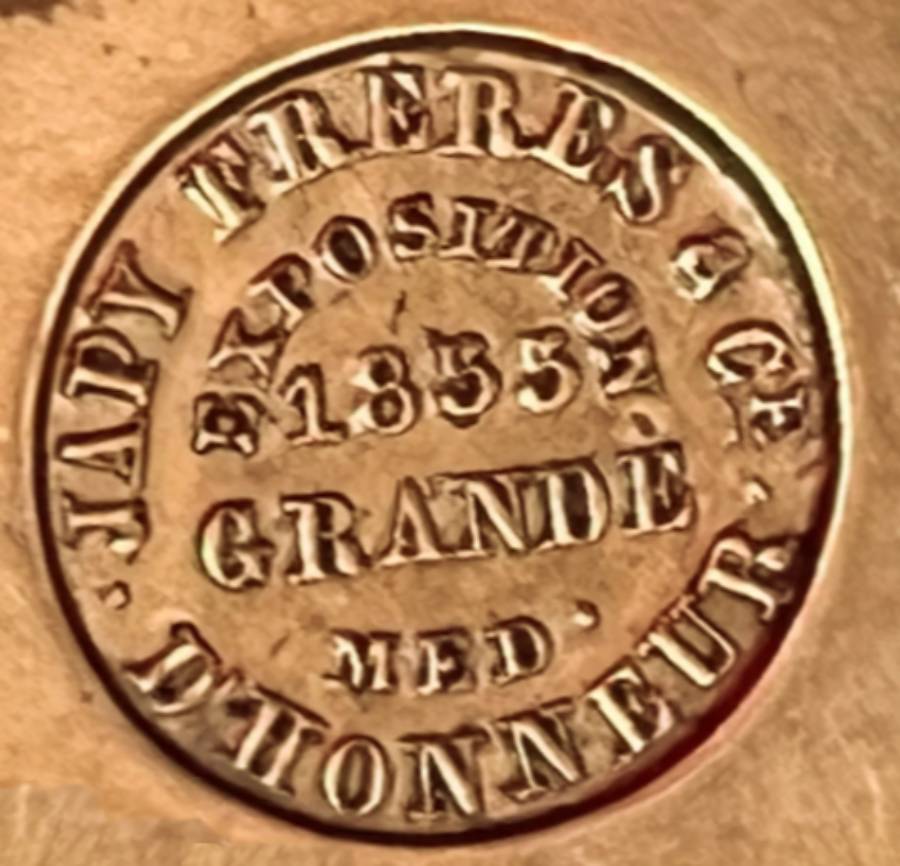
Japy Frères & Cie established itself as a benchmark for innovation and quality, earning recognition at the Paris Universal Exhibitions in 1867, 1878, and 1889, as well as the Grand Prix at the Franco-British Exhibition in London in 1908. Furthermore, its excellence was recognized as hors concours (member of the jury) for the Nancy Exhibition in 1909, consolidating its reputation as a leader in the manufacture of watches, bronze objects, and advanced technical solutions
The Japy family, thanks to a clever matrimonial policy, enjoyed excellent access to the circles of power in Paris. Many family members also became involved in regional and national politics. This temporarily guaranteed them large and lucrative government contracts, such as during the First World War, when they supplied more than 3 million steel helmets to the French army.
The Evolution of the Enterprise in the 20th Century
Following the First World War, the evolution of the company continued. The poor economic climate of global markets ultimately made its presence felt by the end of the 1920s. In 1928, the company became a joint-stock company (société anonyme), which allowed for the influx of external capital, although management remained in the hands of family members.
Losses continued to mount, and the first factories soon had to close. The banks, which had heavily invested in the firm, demanded in 1937 the appointment of a general manager from outside the family.
Following the Second World War, the dismantling of the empire continued. In 1954, the watchmaking manufacturing division was sold; a year later, the group was divided into four separate enterprises, which were successively merged with other firms or bought out.
The flagship sector of those years was the production of office machinery, notably typewriters and calculating machines. However, this branch could not sustain itself in the long term either. In 1971, it was acquired by the Swiss firm Hermes-Paillard, and production in Beaucourt was definitively abandoned.
Finally, in 1979, the last remaining enterprise, Japy-Marne, was liquidated.