eugenio couillaut

His “Genre Espagne” Pocket Watches

E. Couillaut pocket watch, Genève-Madrid, No. 21116, c. 1865 18-karat gold pocket watch accompanied by an 18-karat gold lenticular fob chain (léontine), decorated with an engraved pendant featuring inlaid agate and a T-bar terminal serving as a key for winding and hand-setting. It features a Victorian "Spanish style" (genre Espagne) silver dial, fully chased with spiral motifs arranged in three concentric, ascending levels occupying each inter-hour space. This is accompanied by a gilded micro-relief central motif and a gilded peripheral garland. The Roman numerals for the hours and Arabic numerals for the small seconds sub-dial are hand-painted in lampblack, set off by gilded arrow-style (flèche) hands set with precious stones. The movement features a 1/2-plate and bridge layout with stem winding and setting. It is equipped with a straight-line lever escapement with visible pallets (levées visibles) and a bimetallic compensation balance, with jewel pivoting via pierced stones and an endstone for the balance arbor. The steel barrel click, secured by a small bridge (pontet) with three screws and paired with its polished and blued curved spring, ensures secure winding lock-up while reflecting the high level of component finishing.

Eugenio Couillaut: The Commercial Hub of the “Spanish Style” (Genre-Espagne) in Madrid and the British Connection with José Rodríguez de Losada and Joseph Sewill

The historical reconstruction of commercial horology in 19th-century Spain finds in Eugenio Couillaut a paradigmatic testament to the dynamics of the luxury market of that era. Established on Calle Sierpes in Seville in 1847, likely in partnership with his brother Julio, he is recorded as permanently settled in Madrid by 1860. The presence of his signature on dials and movements, accompanied by the inscription “Genève-Madrid,” reveals a sophisticated strategy of importing, casing, and distributing timepieces tailored to the trend known as genre Espagne. Couillaut did not operate as a traditional manufacturer on Swiss soil, but rather as an influential commercial agent equipped with his own technical workshops, in direct contact with Parisian and Genevan ateliers to satisfy the refined tastes and demands of Madrid’s high society.

By May 1860, the establishment was fully consolidated on the iconic Calle de Carretas, No. 27. Presenting himself to the public as “Watchmaker from Paris and Geneva,” Couillaut ensured a direct supply chain from his partner workshops abroad, enabling him to eliminate intermediaries and adjust the pricing of a remarkably advanced technical catalogue.

In his display cases, pocket chronometers coexisted with gold and silver timepieces featuring lever and cylinder escapements, repetition watches, stem-winding systems freeing the user from the traditional key, as well as complex wall, table, and mantel regulators equipped with musical mechanisms. Such was his confidence in the Genevan and Parisian manufactures he imported that he established an exceptionally rigorous commercial policy for the era, issuing written guarantees covering the proper operation of the timepieces for two to five years.

Advertisement by the firm Joseph Sewill (Las Novedades, September 12, 1862) formalizing Eugenio Couillaut’s exclusivity in Madrid. This historical document is crucial for price history under Isabella II: it details the typology of timepieces (lever escapements, cylinders, chronometer balances) and converts tariffs from English pounds (£ s. d.) into Spanish reales (Rs. vn.)—with silver pocket watches ranging from £5 ($24.33) to £12 12s ($61.32), and marine chronometers priced at £35 ($170.33)—at the official gold parity rate of $4.86 per pound sterling.

The most relevant milestone in Couillaut’s trajectory occurred around 1862, at which point he became a gateway for high-precision British horology into the Iberian Peninsula. The famous firm Joseph Sewill of Liverpool, renowned for its marine chronometers supplied to the British Admiralty and awarded at the London International Exhibition of that same year, accessed the Spanish market exclusively through his agency. Documentary records demonstrate categorically that the introduction of the Liverpool manufacture began as an operation of absolute exclusivity centered on his person; Couillaut was invested as the sole general agent and absolute representative of Sewill for the entire national territory.

The growth of his business required a major logistical transformation in mid-1868. In July of that year, Eugenio Couillaut relocated his main establishment to the first floor of Calle de Alcalá, No. 5. At this new location, the merchant advertised a subscription sales system at 10 reales per month, a commercial arrangement of the era designed to facilitate access to his timepieces among Madrid’s clientele. This unprecedented location, combined with the constant offering of foreign calibers in his firm, consolidated his position along the capital’s principal commercial axis.

It is highly probable that Couillaut’s subsequent decision to resolutely market watches featuring chased silver dials with applied gilded elements—genre Espagne, as they would be known in the Swiss Jura years later—was directly influenced by the extraordinary commercial reception he observed in the Madrid market for imported timepieces: first those of the celebrated José Rodríguez de Losada, followed by their adoption by Sewill.

The Assimilation of International Prestige and the Influence of High Horology

The assimilation of these international prestige flows and direct contact with the highest spheres of fine chronometry decisively shaped his commercial direction. This openness to the leading figures of the sector is strikingly evident in the close display relationship he maintained with timepieces from the most renowned workshops of the era, transforming his own establishment into a cutting-edge showcase for the diffusion of the most influential technical horology.

E. Couillaut pocket watch (Genève-Madrid) in a blackened steel case Pocket watch housed in a steel case blackened using an oxidation technique. It features a Victorian "Spanish style" (genre Espagne) silver dial, fully chased and highlighted by meticulous micro-relief beadwork—forming a dense stippled pattern—that enlivens the central medallion around its gilded floral motif, frames the scalloped intermediate garland, and fills the inter-hour spaces with geometric patterns where each Roman numeral is enclosed within stylized almond-shaped ovals extending toward the minute track, under "Stuart pear" (poire Stuart) style hands. The timepiece is powered by a 1/2-plate and bridge movement equipped with a straight-line lever escapement, a Breguet overcoil hairspring, and a bimetallic compensation balance. It features high-grade jeweling with screwed chatons on the three wheels of the gear train (center, third, and fourth wheels). Its high level of finishing is evident in the regulating organ, where the escape wheel bridge features a polished steel endpiece (coqueret), gilded with fine gold, serving as a cap jewel setting to limit axial play of the arbor.

Parallel to his commercial activity, various indications in industrial property registers suggest an inventive side and a deep mastery of theoretical mechanics on Couillaut’s part, forging a path in the field of patents. On July 11, 1868, a patent application was recorded for an escapement and compensation system—a technical innovation aimed at neutralizing thermal variations in precision mechanisms. This inclination for applied physics and fluid mechanics appears to have continued decades later; on December 28, 1882, under the name of Eugenio Couillaut, patent number ES2987A1 was registered in Spain for a hydraulic machine designed to raise water to any height.

In the context of the Glorious Revolution (La Gloriosa), the establishment served as a strategic public showcase by displaying in its window an object of extraordinary historical importance: the famous commemorative watch dedicated to Admiral Casto Méndez Núñez, hero of the Pacific campaign aboard the ironclad frigate Numancia. The exhibition of this timepiece from Losada’s workshop—a precursor to the genre Espagne—in Eugenio Couillaut’s display cases demonstrates not only his firm’s connection to horological networks of the highest international prestige, but also how the trade in Madrid successfully merged top-tier mechanical precision with the major political events and cultural symbols of late 19th-century Spain.

After filing this patent in December 1882 and a commercial announcement from the same year, the absence of subsequent documents and commercial registers prevents us from reconstructing the remaining trajectory of Eugenio Couillaut, as well as that of any potential successors, if indeed any existed.

charles-edouard lardet

His “Genre Espagne” Pocket Watches

Charles-Édouard Lardet and the Lardet Saga of Spain: Between Fleurier’s Bienfaillage and the Madrid Trade

Charles-Édouard Lardet y Bovet, son of Philippe “Célestin” Lardet (1808–1889) and Julie Henriette Bovet (1804–1860), was born in Fleurier, Switzerland, in 1832.

His horological activity, documented as early as October 1854, began when he left Fleurier as a representative for one of the most flourishing Swiss horological firms of the period. After a decade of experience, he established his own business in August 1864, which quickly became one of the most prosperous in the Spanish capital. This expansion culminated in the formal establishment of his main enterprise on the first floor (piso principal) of Calle de Victoria, No. 2, in Madrid, while simultaneously maintaining a strategic branch in Lisbon, located at Rua do Chiado, No. 61.

The firm’s commercial operations in Fleurier, based at Place d’Armes, No. 11, were managed by his younger brothers: Louis “Gustave” Lardet (1839–1901) and Louis “Alfred” Lardet (1842–1914). Alfred was a watchmaker of high repute who actively participated in drafting the regulations for timing chronometers at the Neuchâtel Cantonal Observatory and served as secretary to the Board of the Fleurier School of Watchmaking (École d’horlogerie de Fleurier).

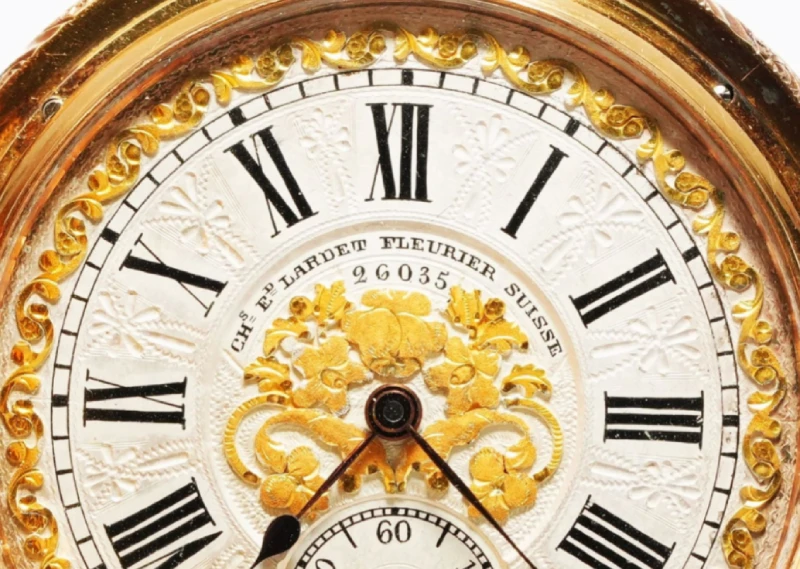
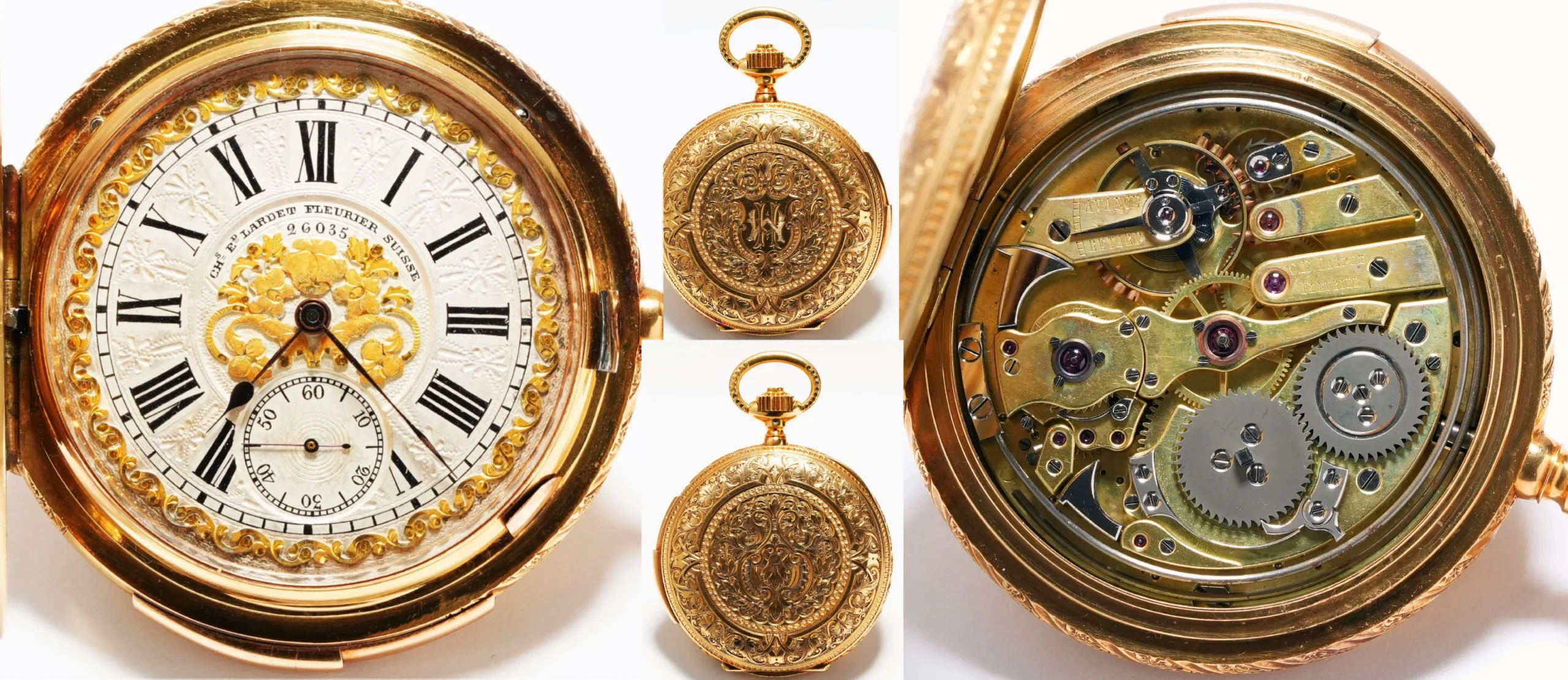
Minute repeating hunter-case pocket watch, signed C.E. Lardet (Fleurier), No. 26035, circa 1895. Manufactured by LeCoultre—because its architecture and evidenced by the signature beneath the hour hammer—this high-precision movement features a wolf-tooth winding system, a straight-line lever escapement with visible pallet jewels, and an exposed minute-repeating mechanism. The stem-wound caliber is set via a slide lever and features a two-arm bimetallic balance with timing screws for precise adjustment, paired with a graduated index regulator. All arbors are jeweled, with endstones protecting both the balance and escape wheel arbors. The 18K gold hunter case—bearing post-1880 French "Minerve" hallmarks and the maker's mark "JL" within an oval—displays lavish hand-engraving with deeply chased scrollwork and foliage. The front cover features a central cartouche with the monogram "HW" set within a dense floral motif. The silver genre Espagne dial is adorned with applied, multi-colored gilded foliage and scrollwork in micro-relief against a hand-stippled background. Signed in a black arc beneath XII o'clock above serial number "26035", it features black Roman numerals bordered by a gilded garland, a engine-turned blue sub-seconds dial at 6 o'clock, outer concave minute bead track, and blued-steel Stuart pear hands. (Photo courtesy and © https://www.jones-horan.com/)

Movement and dial of the Charles-Édouard Lardet pocket chronometer with detent escapement

Pocket chronometer movement by Charles-Édouard Lardet, Fleurier, No. 14833, 20 lignes. Features stem winding with a setting lever mechanism (tirette). Equipped with an Earnshaw-type detent escapement and a split bimetallic balance wheel—designed to compensate for temperature variations—with timing and compensation screws, paired with a helical balance spring (spirale cylindrique). The gear train arbors pivot on jeweled holes set in black polished steel chatons, with cap jewels on the balance and escape wheel arbors, the latter mounted in a gilded chaton. Presented in an ebony box; the original gold case has not been preserved.

Silvered and gilded metal dial in “Spanish style” (genre Espagne), circa 1885, characterized by high-grade engraved ornamentation.

The inner circular section features hand-engraved scrollwork and volutes. The upper sector displays the hand-engraved inscription “Chs. Éd. Lardet Fleurier Suisse 14833”. A peripheral garland and the dial center are decorated with rich floral motifs in gilded micro-relief. The hour ring is complemented at 6 o’clock by a small seconds sub-dial whose central arbor features a delicate multi-pointed star rosette, fully hand-guilloché and hand-chased, typical of prestige pocket watches destined for the Spanish market. Originally fitted with gilded pear hands, high-end watches of this caliber were delivered accompanied by spare crystals, hands, and more traditional replacement dials.

Charles-Édouard Lardet pocket watch, circa 1880, 18K gold four-body hunter case. Finely chased case with an inner hinged cuvette and rear cover, decorated with floral motifs highlighted with black enamel and featuring a central medallion. Silver dial richly decorated with engravings and a peripheral gilded garland border, Roman numerals, and Stuart pear hands. Fine bridge movement, signed "Chs. Ed. Lardet / Fleurier Suisse" and numbered 9498. (Photo courtesy and © https://www.maykajewels.com)

Origins in Fleurier and Establishment in Madrid

The Lardet family’s insertion into the Spanish market for luxury goods was part of the export maturity of the Fleurier watchmaking district (Val-de-Travers, Switzerland). Spanish press archives confirm that by the early 1870s, the firm was fully established and active in the commercial heart of Madrid. From his location on Calle de Victoria, Charles-Édouard—known in Spain as Carlos Lardet—coordinated the importation and flow of calibers in direct connection with the family manufacture in Val-de-Travers. Subsequently, the expansion of his business led him to transfer his offices and retail premises to the city’s most prestigious thoroughfares, such as Carrera de San Jerónimo and Calle de Alcalá.

Chs-E. Lardet (Fleurier) No. 3831, circa 1875. 18K yellow gold four-body hunter case pocket watch. "Genre Espagne" dial with a hand-chased ground, highlighting hand-engraved floral motifs set between the hour markers, complemented by gilded micro-relief ornamentation at the center and periphery. Roman numerals, blued-steel Stuart pear hands, and a small seconds sub-dial at 6 o'clock. The watch features an inner hinged cuvette and rear cover, and was originally retailed in its wooden presentation box containing a traditional white enamel spare dial. (Photo courtesy and © https://www.subastassegre.es)

Trademarks and Offer Diversification

His trade name, engraved on movement plates, appeared as Chs-E. Lardet – Fleurier, though he also utilized other trademarks, such as the acronym C.E.L., registered in 1891, and “El Castillo”. This mark served both for white-label production supplied to third parties and for a line of more economical pocket watches commercialized directly by Lardet to reach a less affluent clientele unable to afford luxury “genre Espagne” pieces.

This rigorous standards-driven approach also extended to precision timing: a regular participant in the pocket chronometer trials at the Neuchâtel Observatory, Charles-Édouard Lardet earned a diploma of merit as early as 1873. Beginning in the mid-1880s, he became a constant competitor. His performance reached its peak in 1892, when two of his pocket chronometers ranked 6th and 7th, competing directly alongside the most renowned names in fine Swiss watchmaking.

The “Genre Espagne” Style at Charles-Édouard Lardet

His technical mastery was also recognized internationally for many years. The firm first earned a diploma of merit at the Vienna Universal Exhibition in 1873, followed by a bronze medal at the 1878 Paris Exhibition and a silver medal at the 1879 Exhibition. It was further honored with a silver medal in 1889, as well as another silver medal—in this case, a collective award—in 1900. During these exhibitions, Lardet distinguished himself particularly with his pocket watches, including a 45 mm (20-ligne) hunter case decorated with a chased dragon, pieces specifically recognized as being destined for the Spanish market.

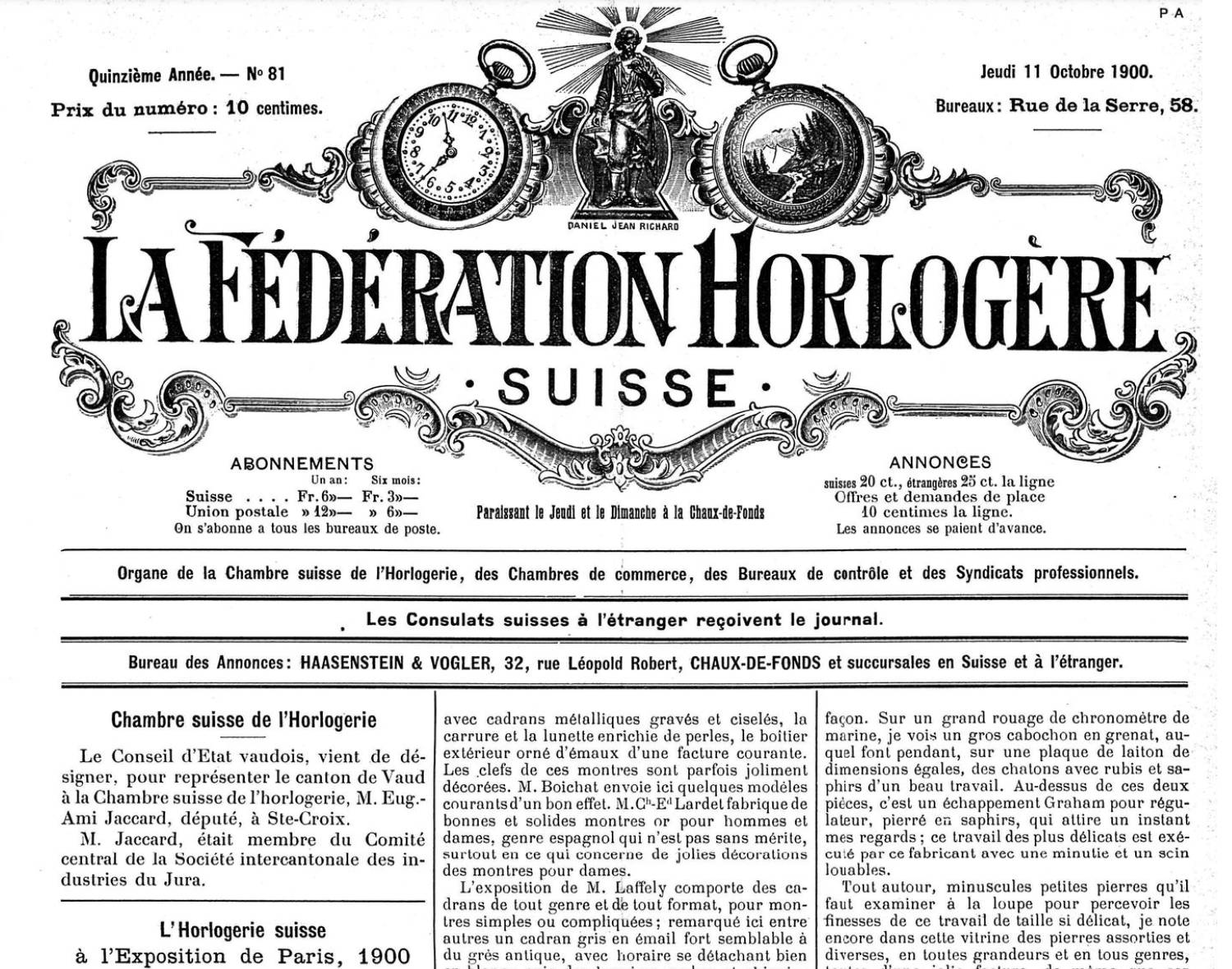
The reputation of Lardet-signed pocket watches rested on a combination of technical rigor and ornamental virtuosity, widely acknowledged at major international exhibitions. During the 1800 Paris Universal Exhibition, the specialized press, such as La Fédération Horlogère on October 11, 1900, highlighted his excellence:

“Charles-Édouard Lardet manufactures good, solid gold pocket watches for men and women in the Spanish style (genre espagnol), which is not without merit, particularly regarding the lovely decorations on women’s pocket watches.”

Press clipping from La Fédération Horlogère Suisse (October 11, 1900) dedicated to the Paris Universal Exhibition This period testimonial confirms the technical and aesthetic recognition of Mr. Ch.-Ed. Lardet's production, explicitly distinguished under the designation "genre espagnol".

The Diplomatic Hub and Commercial Reports (1887–1892)

Charles-Édouard Lardet’s key point of differentiation from other merchants of the period was his official appointment as Swiss Consul in Madrid. This dual role as watchmaker and diplomat made him the most qualified observer of industrial exchanges between the Swiss Jura and the Spanish market. His annual reports on the state of the watch trade in Spain, highly regarded in Switzerland, were regularly published by the specialized press.

Testament to this position, his famous Commercial Reports of 1887 and 1890 offer a clear-sighted analysis of customs dynamics, the impact of silver and gold tariffs under the regency of Maria Christina, and the technical adaptations required of Swiss manufacturers. Under his consulate, Lardet’s Madrid office functioned as a true technical embassy, guiding Val-de-Travers manufactures according to the aesthetic tastes of Spanish society.

This rigor was equally evident in the field of precision timing: from the mid-1880s onward, Charles-Édouard Lardet became a regular competitor at the Neuchâtel Observatory. His performance reached its peak in the 1892 trials, where two of his lever chronometers ranked among the top ten of the year, outperforming other famous names in fine Swiss watchmaking.

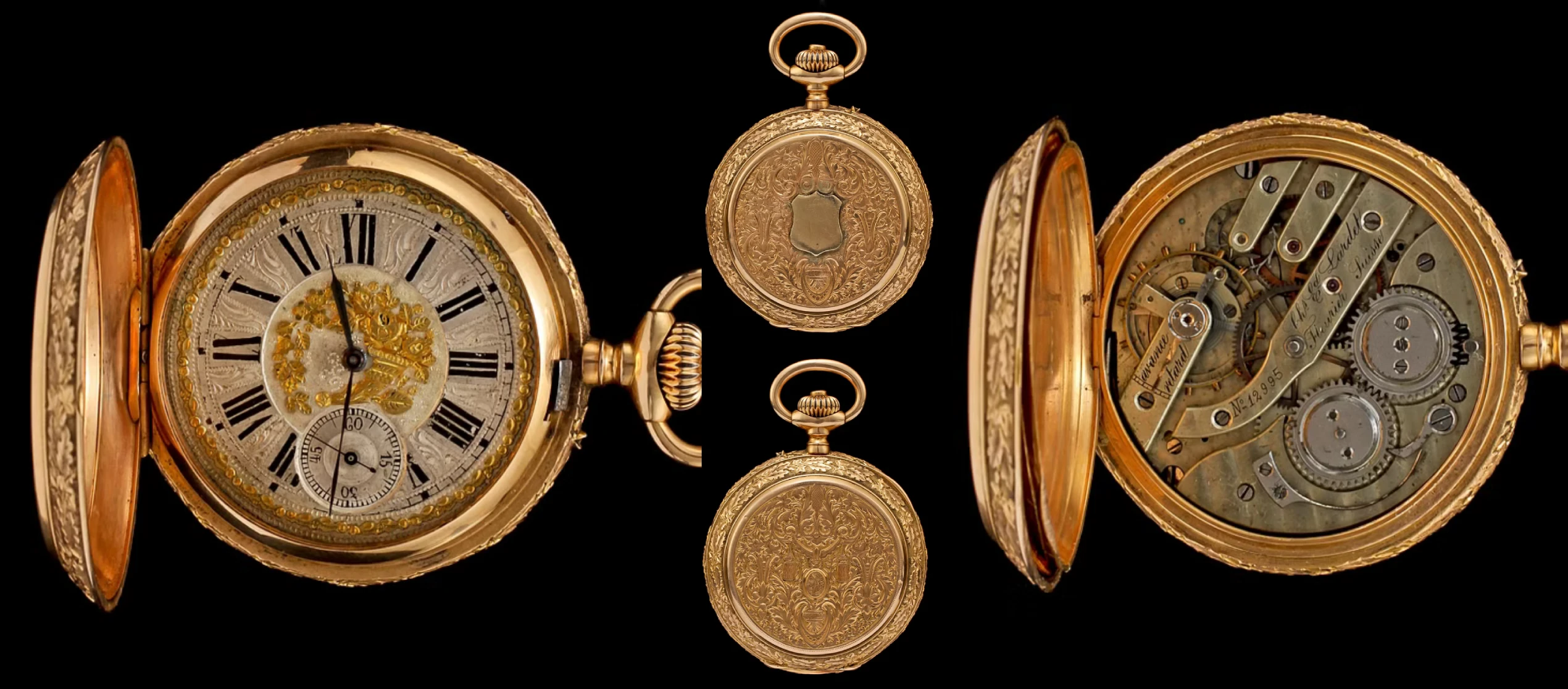
Charles-Édouard Lardet "genre Espagne" pocket watch, No. 12995, circa 1881.

Recognition, Heritage, and Death (1896–1904)

Charles-Édouard Lardet’s commercial success resulted in the accumulation of substantial real estate holdings in Spain, as evidenced in April 1896 by the acquisition of the famous “Hôtel Laredo” (Palacete Laredo), a remarkable Neo-Mudéjar palatial residence located in Alcalá de Henares.

The trajectory of this Swiss native, a major figure in Spanish horological history, came to an end in early 1904. His death in the spring was recorded in the trade press of the era by a Todesbericht in April 1904, followed by an extensive obituary in the Revue internationale de l’horlogerie on October 24, 1904, paying tribute to his dual legacy as an elite craftsman and diplomatic official.

Continuity of the Firm: Sucesores Lardet (1904–1909)

Following the founder’s death, the continuity of the firm in Madrid was maintained through the family structure. Beginning in 1904, industrial records officialized the succession under his daughter’s name, using the business name Luisa Lardet (Dame L. Lardet, successeur de Ch.-Ed. Lardet – fabricant de Fleurier). She sustained the operations of the capital’s premises—initially from her father’s former location at Calle de Victoria, No. 2, and from 1907 onward at Calle Preciados, No. 10—as well as the importation of pocket watches originating from Place d’Armes, No. 11 in Fleurier, in close commercial collaboration with her uncle Alfred. This female management continued until at least 1909, preserving the prestige and technical service of one of the most stable and decisive commercial signatures in Spanish market horology.

Biographical Note: Eduardo Lozano Lardet

The Lardet family’s imprint in Spain extended into the 20th century through the figure of his grandson, the eminent Madrid architect Eduardo Lozano Lardet (1902–1983). Son of Luisa Lardet and the painter Eduardo Lozano Rodríguez, he became one of the key representatives of architectural rationalism and the modernist movement in Spain during the Second Republic and the post-war period. He is credited with major works of Madrid’s urban heritage, such as the famous Barceló Cinema (1930)—a masterpiece of rationalist architecture with lines inspired by naval aesthetics—and the Callao Cinema (1926, designed alongside Luis Gutiérrez Soto), illustrating the family’s seamless transition from the high technical precision of 19th-century horology for the Spanish market to 20th-century architectural avant-garde.

A Glimpse into Lardet’s Workshop: Ferdinand Hodler’s Spanish Sojourn
L’atelier d’horloger à Madrid (1879), oil on canvas by Ferdinand Hodler. During his stay in Spain under the mentorship of Charles-Édouard Lardet, Hodler painted this scene in the workshop of Charles Abet, a fellow citizen from Fleurier. Located at Plaza de la Provincia, No. 4, this location is identifiable by the pediment and tower of the Palacio de Santa Cruz visible through the window. It was likely in this workshop that the adjustment and fine-tuning of watch movements for Lardet took place. Gottfried Keller Foundation / Federal Office of Culture. Kunstmuseum Luzern.

Charles-Henri Grosclaude

His “Genre Espagne” Pocket Watches

Pocket watch Charles Henry Grosclaude - Fleurier 32190
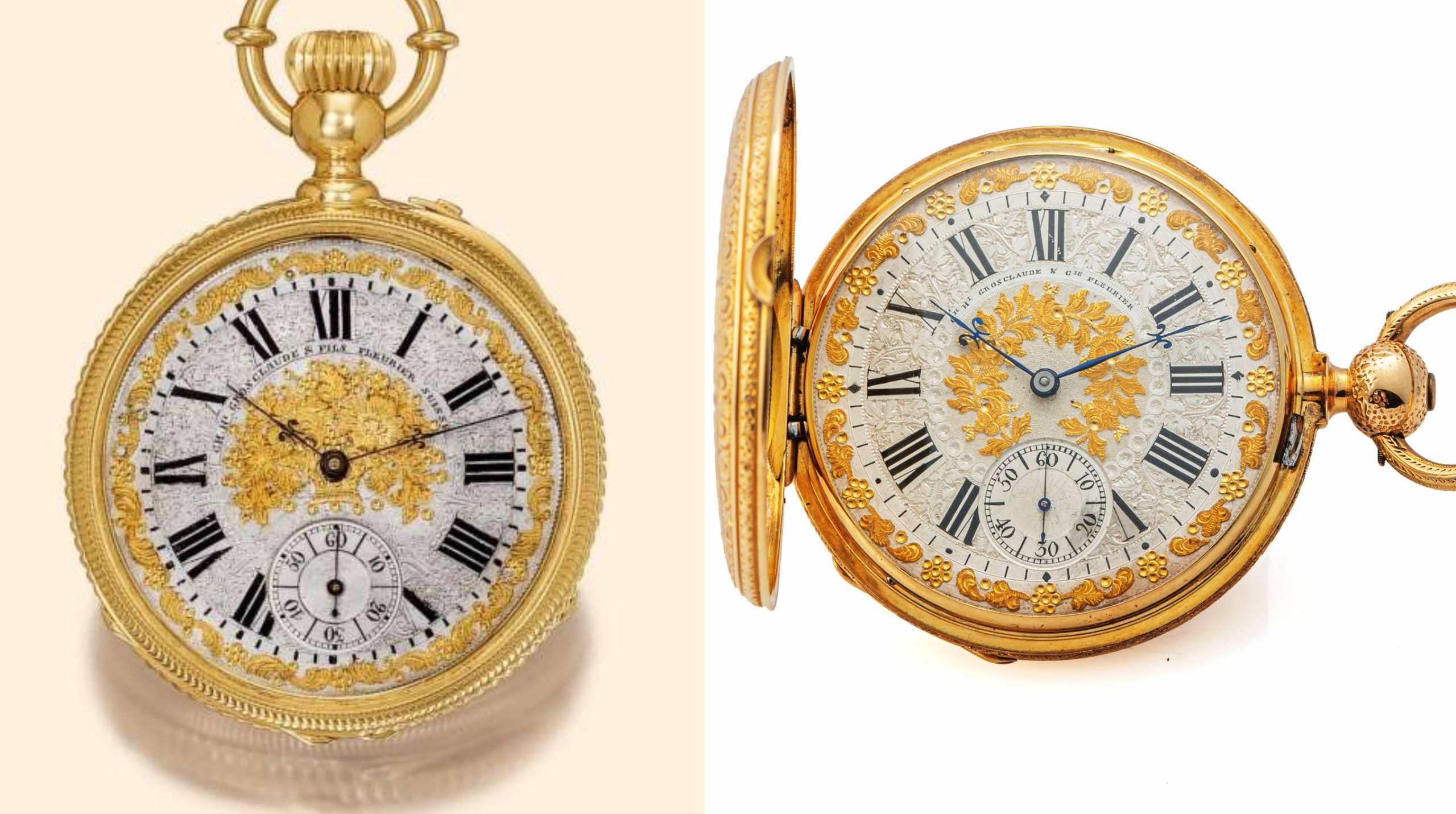
Charles Henri Grosclaude & Fils (Fleurier) pocket chronometer, No. 32190, circa 1880. 30 jewels, quarter repeater, stem-winding caliber, hand-setting via push-piece at 4 o'clock. Bimetallic open compensated balance wheel with gold adjusting screws, Breguet balance spring, and straight-line lever escapement with visible jewels. Victorian "genre Espagne" dial with blued-steel fleur-de-lys hands, hand-painted lampblack Roman numerals for the hours and Arabic numerals for the small seconds sub-dial over an entirely hand-chased silver ground—including the inter-hour spaces—adorned with the traditional peripheral garland and central floral motifs featuring gilded micro-relief inlays.

Charles-Henri Grosclaude (1814–1884): Master Watchmaker and Legacy of Excellence

Born on May 16, 1814 in Les Planchettes (Canton of Neuchâtel), Charles-Henri Grosclaude established himself as one of the major figures of 19th-century Swiss watchmaking. Son of Abram Louis Grosclaude and Émélie Contesse, he dedicated his life to the manufacture of chronometric timepieces of exceptional precision.

A Life Dedicated to Watchmaking and Strategic Alliances

On July 16, 1835, he married Henriette Calame in Le Locle. Together they had ten children, several of whom carried on his horological legacy: Albert, Louis, James, Cécile, and Louise. Others married into prestigious regional watchmaking dynasties—such as Koenig, Chopard, Marchand, and Jéquier—strengthening the network of a community dedicated to excellence.

His workshop, primarily established in Fleurier, evolved over the years under various business names:

  • circa 1850 / 1856–1859: Chs.-H. Grosclaude

  • 1861–1865: Chs.-H. Grosclaude & Cie

  • 1867–1877: Chs.-H. Grosclaude & Fils, following the integration of his sons, notably James and Louis.

Charles Henri Grosclaude (Fleurier) pocket watch, No. 19551, circa 1867. 18K gold four-body hunter case. Front cover decorated with rose-cut diamonds and enamel; enamel rear cover. Victorian "genre Espagne" silver dial featuring hand-engraved field detailing across the central area and inter-hour spaces, enriched with gilded micro-relief inlays both centrally and along the peripheral garland, set with blued-steel Stuart pear hands. 15-ligne bridge movement equipped with a dual winding system (stem-winding at the pendant via pull-out hand-setting mechanism, alongside traditional key winding/setting capabilities). Features a straight-line lever escapement with visible jewels, Breguet balance spring, and a bimetallic split compensation balance with regulation screws. Jewels set in single pierced stone pivot holes, with endstones fitted to the balance staff arbor. Photo courtesy of © https://www.balclis.com.

Recognition and Technical Success

The Grosclaude firm distinguished itself on the international stage during Victorian-era exhibitions and astronomical precision trials. Its creations, submitted to the rigorous testing of the Neuchâtel Observatory, achieved remarkable results:

  • London Exhibition (1851): First Class Medal. At the first Universal Exhibition held in London in 1851, Grosclaude exhibited a seconds pocket watch with minute repeating, sounding the hours, quarters, and minutes. Its motion work mechanism, featuring a highly successful layout and remarkable execution, demonstrated top-tier craftsmanship in high complications. The piece successfully integrated independent center seconds with repeating mechanisms within the compact confines of a pocket timepiece. Period commentators highlighted the virtuosity of its mechanical architecture: the under-dial motion work—a complex array of racks, snails, and levers—revealed an optimized, ingenious design engineered to reduce friction and ensure flawless operation.

  • Paris Exhibition (1855): Bronze Medal.

  • London Exhibition (1862): The Grosclaude firm was listed among the elite of Swiss watchmaking. Grosclaude presented a marine timepiece certified by the Neuchâtel Observatory, alongside approximately fifteen remarkable pieces, including several seconds pocket watches and two split-seconds timers.

  • 1865 (Neuchâtel Observatory): 3rd place with a marine chronometer (No. 446).

  • 1866 (Neuchâtel Observatory): 3rd place with a pocket chronometer featuring a pivoted detent escapement and spherical balance spring (No. 30682/30681), alongside 12th place (No. 31463).

  • 1881 (Neuchâtel Observatory): 7th place for a lever chronometer (No. 33166) and 43rd place (No. 33191), under the trade name Ch.-H. Grosclaude et fils.

These results demonstrate exceptional technical rigor and consistency, consolidating the reputation of the Grosclaude manufacture as one of the most competitive of its era for the Spanish market and international clientele.

Charles Henri Grosclaude & Fils (Fleurier) pocket watch, No. 19874, 19 lignes, 18 jewels, circa 1867. 18K gold four-body hunter case bearing hallmarks pre-dating the Federal Act of 1880 on the control and guarantee of gold and silver wares. Victorian "genre Espagne" silver dial with gilded micro-reliefs. The ground is finely hand-engraved—including across the inter-hour spaces—featuring delicate, regular scrolling foliage and arabesques, contrasting with the central composition and peripheral garland in gilded micro-relief. Fitted with blued-steel counterpoised fancy hands for minutes and seconds, and painted black Roman numerals. Separate-bridge movement, stem-winding at the pendant with hand-setting via push-piece at 4 o'clock. Train running on 18 jewels, with endstones fitted to the balance and lever arbors, and center wheel arbor set in a jewel chaton. Escapement and regulator featuring a straight-line lever escapement with visible jewels, bimetallic split compensation balance with regulation screws, Breguet balance spring, and regulator index.

Charles-Henri Grosclaude and Experimental Horology: The Mechanical Dilemma of Movement No. 3537

An examination of Charles-Henri Grosclaude timepiece No. 3537 reveals a highly singular technical configuration: a direct winding and hand-setting system comprising two circular components with hinged rings that lift for operation and fold back flat. The maker’s signature on the movement—predating the formation of the “Cie” company name and the integration of his sons—alongside the serial numbering, points to an initial movement manufacture date prior to 1860. However, this mechanism presents a striking analogy to the patent granted in Great Britain on April 8, 1870 (No. 1032) to Alexander Watkins and Robert Cory Hanrott.

Charles Henri Grosclaude movement, No. 3537, keyless winding and hand-setting system. Author's collection.

Technical analysis of the timepiece requires considerable caution. While the base movement undeniably belongs to the 1850s, the high level of refinement, the crisp milling, and the industrial precision of the hinged rings point toward a later execution. Consequently, a scientific analysis of this piece allows two historical trajectories to coexist:

Subsequent Modification and Adaptation (Preferred Hypothesis Based on Finishing Quality): The base movement, originally manufactured for key-winding prior to 1860, likely served as an experimental chassis long after its initial fabrication. Grosclaude—or a contemporary workshop operating at a later date—may have taken advantage of the robustness of this Fleurier caliber to fit and test this Watkins & Hanrott-type mechanism, thereby utilizing more mature ring manufacturing technologies postdating 1870.

  • Helvetic Technical Priority: The timepiece may have been originally designed with this mechanism as early as the 1850s. In this scenario, the watchmaker would have demonstrated a mastery of execution and tooling of absolute modernity for his time, anticipating the legal filing in England by other inventors by nearly twenty years.

    Although the degree of finishing on the moving parts strongly points toward a retrospective modification, movement No. 3537 remains—in the absence of definitive archival documentation—a fascinating witness to 19th-century experimental horology, illustrating the transformation cycles and constant pursuit of simplification in keyless winding systems.

    The significance of this invention is attested by the British Museum in London, which holds an original movement under reference H_1958-1201-1209. This isolated trial illustrates Grosclaude‘s approach: exploring, among hundreds of patents, those worthy of concrete application.

On the left: Charles Henri Grosclaude & Fils (Fleurier, Switzerland) pocket watch, No. 26177, circa 1875. Very fine and rare 1-minute tourbillon regulator in 18K gold and enamel, keyless, with inverted fusee and special patented winding and hand-setting mechanism. Gold four-body "bassine et filets" case, the engine-turned rear cover centered with enamelled initials, reeded bezel and band, and a hinged glazed inner gold cuvette. On the front, the Victorian "genre Espagne" silver dial features black Roman numerals and an outer minute track; the central composition displays a delicate flower-basket motif in gilded copper (mercury-gilded) micro-relief, composed of stamped appliques standing out against a finely hand-engraved field. The peripheral border is highlighted by a rich matching garland, also with stamped gilded-copper appliques. Fitted with blued-steel fleur-de-lys hands. 45 mm sandblasted gilded brass movement, inverted fusee with chain and maintaining power mechanism, mainspring barrel and fusee set beneath a single bridge. Tourbillon cage similar to the Guinand and Grether design, fitted with a calibrated side-lever escapement, bimetallic split compensation balance wheel with regulation screws, and blued-steel Breguet balance spring. Features the rare keyless winding and hand-setting mechanism patented by Olivier Courvoisier (British Patent No. 1114 of 1873) with a hand-setting slide bolt on the band at 1 o'clock. Signed on the dial, bearing the manufacturer's trademark punch "CH G&F" inside the case back. Diameter: 55 mm. On the right: Charles Henri Grosclaude & Cie pocket watch, No. 30833. Fine key-wound pocket watch in an 18K gold four-body hunter case, with front and rear covers finely hand-engraved. On the front, the Victorian "genre Espagne" silver dial displays matching refinement, with its center featuring a floral decoration in gilded copper (mercury-gilded) composed of stamped micro-relief appliques, a matching peripheral garland along the outer border, and a chapter ring with black Roman numerals. At 6 o'clock, the engine-turned small seconds sub-dial is traversed by a blued-steel second hand, providing superb contrast with the blued-steel fleur-de-lys hour and minute hands. 19-ligne sandblasted gilded brass movement, 15 jewels, calibrated straight-line lever escapement, bimetallic split compensation balance wheel with blued-steel Breguet balance spring. Diameter: 50 mm.

The Horological Legacy of the Grosclaudes: James in Fleurier and Commercial Expansion in Spain

His son Albert emigrated to Cuba, Mexico, and the United States, where he handled the marketing and distribution of the timepieces as the family firm’s overseas representative.

With Charles-Henri retired and ailing, his partner and son James—married to Cécile Othenin-Girard—continued the watchmaking business and the production of the “genre Espagne” style. The firm was established in 1883 under the business name J. Grosclaude & Cie (engraved as “& Co.” on the movement plates), in partnership with Auguste Welter, another watch manufacturer, located at Ruelle Berthoud, No. 4 in Fleurier. A few years later, in 1899, this enterprise failed and was declared bankrupt.

In the first decades of the 20th century, Charles-Henri‘s grandsons—the sons of LouisJuan (born Jean) and Fernando (born Fernand) Grosclaude, maintained the watch and spare parts business “Casa Grosclaude”, located at Plaza del Ángel, No. 2 in Madrid, thus consolidating the ties between the Grosclaude family of Fleurier and Spain.

Charles Henri Bovet-Lardet

His “Genre Espagne” Pocket Watches

17-ligne pocket watch, 10 jewels, circa 1880. Engraved with a five-pointed star set within a crescent moon, potentially corresponding to the maker Eugène Lebet & Bovet (*). Assembled in a silver case, likely destined for the Algerian market, bearing the pre-1893 “Chimère” hallmark and fitted with a dust-proof inner cuvette. Victorian “genre Espagne” silver dial featuring gilded micro-reliefs and stamped dots for the minute divisions. The ground is finely hand-engraved—including across the inter-hour spaces—presenting a mandorla motif with a central scroll-tipped V, contrasting with the central composition and the peripheral garland in gilded micro-relief, typical of these dials. Set with blued-steel English pear hands (Poiré) and a gilded small seconds hand, with micro-relief gilded metallic Roman numerals for the hours. Separate-bridge movement featuring a delicately engine-turned flat surface finishing. Stem-winding at the pendant with hand-setting via push-piece at 11 o’clock. Train running on single pierced jewel stone settings, with an endstone setting fitted to the balance staff arbor. Regulator assembly comprising a cylinder escapement and a simple monometallic balance wheel without regulation screws, equipped with a flat balance spring and a regulator index. Author’s collection.

Born in Fleurier on April 9, 1831, Charles Henri Bovet—son of “Louis” Frédéric Bovet (1799–1871) and Susanne Marguerite Gabrielle, known as Charlotte (1803–1871)—played an active role in the golden age of watchmaking in the Val-de-Travers. His industrial career was initially tied to Eugène Lebet, a foundational collaboration for local manufacturing, although exact records regarding the start of this early commercial period remain undetermined. The close ties with this watchmaking dynasty were formally consolidated after Eugène’s death, when Charles Henri formed a general partnership with his widow, Dame Émilie Lebet, giving rise to the famous firm Eugᵉ Lebet & Bovet. This house specialized with great success in the manufacture and export of fine horology and jewelry, establishing its offices in Fleurier and opening a key distribution channel via a trading post (comptoir) in Alexandria (Egypt).

Charles-Henri Bovet was married to Sophie Caroline Lardet, sister of Charles-Édouard Lardet.

His integration into the industrial and social fabric of the region was further consolidated on a personal level through his marriage to Sophie Caroline Lardet, sister of the remarkable timer and watchmaker Charles-Édouard Lardet.

Following the dissolution of the partnership with the widow Lebet in 1885, Charles Henri assumed the assets and liabilities of the business under his own name, Ch.-H. Bovet-Lardet. The enterprise encompassed the manufacture of complete high-grade timepieces and specialized meticulously in the execution of cases, cuvettes, dials, and movements (rough ebauches and finished calibers).

After operating for a time alongside Louis Lardet under the general partnership C.-H. Bovet-Lardet & Cⁱᵉ, Charles Henri protected his designs and trademarks—including the historic crescent moon and star trademark inherited from the Lebet period—under Swiss registration numbers 5928, 5929, and 5930.

After his death in 1896, his technical heritage and official trademarks were transferred in August 1897 to Louis Lardet (Lˢ Lardet), thereby ensuring the continuity of this manufacturing tradition. This timepiece represents the material testimony to the convergence of the Lebet, Bovet, and Lardet families at the heart of the Neuchâtel mountains.

(*) This hallmark also bears a striking resemblance to the registered trademark of Dubail, Monnin, Frossard & Cie (Porrentruy, 1881). Pending further archival confirmation, priority is nevertheless given to the attribution to the Bovet manufacture (succession of Eug. Lebet & Bovet in Fleurier), on account of its close commercial and familial ties with the Lardet firm.

Circular black-and-white seal featuring the name Ramón Campos, researcher of 19th-century Swiss watchmaking and early fountain pens.