His “Genre Espagne” Pocket Watches
Isaac Haas-Privat (1823–1881). Swiss watchmaker, industrialist, educator, and major player in the reform of watchmaking education in the 19th century
Isaac Haas-Privat, born Jean Isaac Haas on April 17, 1823, in Geneva, and deceased on October 13, 1881, in Publier (Haute-Savoie) at the age of 58, was a prominent figure in 19th-century Swiss watchmaking. A watchmaker by profession, active industrialist, thinker committed to the reform of technical education, and first president of the Journal Suisse d’Horlogerie—as well as the true intellectual driving force behind the publication—he embodies one of the essential craftsmen of the intellectual and structural modernization of the profession.
Family Origins and Context
Isaac Haas was the son of Jean Michel Chrétien Haas, originally from the Grand Duchy of Baden, who settled in Geneva in 1813 and was naturalized in 1816, and Jeanne Barbara Kleinknecht.
The family environment, originating from recent Germanic immigration that quickly integrated into Genevan society, provided a favorable context for a solid education and professional advancement based on hard work and merit.
On June 3, 1846, in Geneva, he married Jeanne Philippine Élisabeth Privat (1825–1877), with whom he had five children. This family alliance also played a role in his industrial activity, particularly through his later collaboration with his brother-in-law Privat.
Education and Early Beginnings
He completed his early studies at the College of Geneva before entering the School of Watchmaking at the age of thirteen. He quickly distinguished himself through his diligence, seriousness, and aptitude, earning several awards during his training.
In 1841, at just eighteen years old, he set up his own business as a repasseur—a demanding craft involving the fine adjustment, finishing, and precision timing of watch movements.
A First “Masterpiece”: The Automaton Clock
A revealing episode of his early talent dates back to this period: he was entrusted with restoring an extremely complex clock preserved at the Public Library of Geneva.
This remarkable piece featured an automaton mechanism that set figures into motion—Christ, the twelve apostles, and the Virgin Mary—at each striking of the hour.
After delicate and meticulous work, the young Haas succeeded in restoring its regular operation. Throughout his life, he spoke of this restoration with the pride of a craftsman recalling his first major achievement. The object is preserved today at the Museum of Archaeology.
Early Professional Experiences
After a period with the firm Dupan and Haim, he took a decisive step in 1851 by leaving Geneva to settle in La Chaux-de-Fonds, then a major center of Swiss watchmaking.
Industrial Activity and Commercial Expansion
In La Chaux-de-Fonds, Haas-Privat founded a watchmaking company with his brother-in-law Privat.
At first, the house worked with France. Starting in 1858, it extended its commercial relations to Spain, which became its primary market. He remained in this city until 1873, a period corresponding to the most active phase of his industrial career.
Civic and Institutional Engagement
During his stay in La Chaux-de-Fonds, Haas-Privat played an active role in public life:
Member of the Education Committee
Participant in the creation of the School of Watchmaking
Pioneer in participating in the timing competitions at the Neuchâtel Observatory
Involvement in the cadet corps, testifying to his interest in military affairs and civic organization
In this city, as in Geneva, he left behind the memory of a man deeply committed to collective progress.
During the Second Half of the 1860s and Beyond
During the second half of the 1860s, the firm brilliantly continued its participation in the prestigious timing competitions of the Neuchâtel Cantonal Observatory. This technical rigor was crowned with success by securing first place for pocket chronometer No. 41949, observed over 32 days with an average variation of only 0.24 seconds per day—a major distinction that allowed the firm to rise above the most renowned watchmakers and maintain its standing among the elite of Swiss chronometry. In 1880, Haas-Privat & Cie also obtained an honorable mention alongside Patek, Philippe & Cie. at the Geneva Observatory Chronometer Competition.
This level of excellence was brilliantly confirmed at the Melbourne International Exhibition (1880–1881). During the timing competition supervised by the Melbourne Observatory, Haas-Privat & Cie achieved third place globally with the remarkable score of 490 out of 500 points, ranking ahead of prestigious first-rate manufactures, including the famous American Watch Co. of Waltham and other renowned horologists of the era.
However, this ascending trajectory was abruptly interrupted by the sudden passing of Isaac Haas-Privat in 1881.
During their La Chaux-de-Fonds period, the movements were generally marked “Haas & Privat,” whereas from around 1873, following their relocation to Geneva, the watches bore the inscription “Haas-Privat & Cie.” (likely in connection with Mr. Ducommun). In many cases, a number also appears next to the signature, corresponding to the internal caliber number.
Return to Geneva and Industrial Projects
Upon returning to Geneva in 1873, he partnered with Mr. Ducommun to establish a mechanized manufacture on Rue Gutenberg, intended to integrate modern technical advancements in watchmaking.
However, this ambitious project was struck by a double tragedy:
The death of his partner
His own passing shortly thereafter
These events prevented the full fruition of this enterprise.
Institutional Activity in Geneva
In Geneva, Haas-Privat maintained a sustained commitment to public and professional service:
Member of the Oversight Committee of the School of Watchmaking
Active participant in the Watchmaking Section
Author of diverse and notable technical communications
Expert frequently called upon in delicate commercial matters due to his competence and integrity
The Journal suisse d’horlogerie: A Major Work
Isaac Haas-Privat was:
Founding member of the Journal suisse d’horlogerie
First president of its steering committee
The true intellectual driving force behind the publication
The first issue appeared in 1876, a symbolic date coinciding with the anniversary of the Society to which it was linked.
He collaborated there with prominent figures such as L. Lossier, Professor Thury, J.-B. Grandjean, and Joseph Rambal, among others.
For six years, he devoted a large portion of his time to this publication, even encroaching upon his rest hours. He sought no material reward, asking only for “the satisfaction of duty accomplished.”
Reform of Horological Education
One of Haas-Privat‘s most decisive contributions concerned the transformation of technical education. He strongly advocated the transition:
From an exclusively practical model (learning by doing)
To a model incorporating theoretical training (learning by learning)
He advocated the systematic introduction of disciplines such as:
Technical drawing
Geometry
Mathematics
His ideas, initially contested by traditional circles, gradually gained acceptance and helped re-establish modern horological education. Many of the articles on this reform, published in the early years of the Journal suisse d’horlogerie, were written by him.
Participation in Technical and Industrial Progress
Haas-Privat actively participated in various collective initiatives:
Exhibitions and Competitions He contributed notably to an intercantonal exhibition dedicated to horological tools and instruments, jewelry, and music boxes, which attracted 4234 visitors in 60 days, demonstrating its importance.
Technical Standardization He supported the “Swiss thread” (filière suisse) project, a system aimed at standardizing horological screws on metric foundations, developed with the assistance of Thury and J.-B. Grandjean.
Timing Competitions He participated in the promotion of timing competitions (institutionalized in 1872), which contributed greatly to the advancement of horological precision.
Personality and Character
Contemporary accounts unanimously describe Haas-Privat as a man of:
Absolute rectitude
Great affability
A rare spirit of conciliation
Remarkable modesty, considered characteristic of elite minds
Despite his technical authority, he remained open to discussion, attentive to criticism, and ready to acknowledge the value of others’ ideas. It was said that he likely had no enemies.
Death and Reception
His death, occurring suddenly in 1881, was felt as a profound shock. It came after a period of fatigue caused by overwork, just as he was considering a temporary reduction in his activities. It left a considerable void:
Within his family
Among his colleagues
Within the Journal suisse d’horlogerie, of which he was the soul
Legacy
Isaac Haas-Privat leaves a lasting legacy:
In the modernization of horological education
In the intellectual structuring of the profession
In the development of the Journal suisse d’horlogerie, which became a major reference
In the promotion of a horology based simultaneously on science, rigor, and the transmission of knowledge
A man of action as much as of thought, deeply selfless and driven by a sense of duty, he embodies an exemplary figure of the 19th-century horologist at the intersection of craftsmanship, industry, and pedagogy.
Continuity and Generational Transition: Charles-Adrien Haas (1881–1902)
Family Continuity and Continuation of Business (after 1881)
Following the death of Isaac Haas-Privat in 1881, a portion of the commercial business, particularly the relationships established with the Spanish market, was taken over by his son Charles-Adrien Haas (1847–1902).
On February 6, 1883, he reconstituted a business structure in Geneva under the firm name C. Haas, Thellaeche & Cᵉ, headquartered at 11 Rue Petitot. He partnered with Celestino Thellaeche, a merchant based in Madrid, to maintain commercial outlets in Spain. Following the latter’s death in 1885, his widow, Ana María Muñoz y Saco, participated in continuing the business within the company.
In the following years, the firm pursued its commercial operations between Geneva and the Iberian Peninsula, with a location in Madrid (4 Calle de la Victoria) and extensive commercial ties extending to Lisbon.
Charles-Adrien Haas remained at the head of this organization until his death in 1902.
Clarification Note
Care should be taken not to confuse Isaac Haas-Privat with the distinct firm known as B. Haas Jeune (Benjamin Haas), nor with its successor Haas Neveux & Co., nor with the various corporate names derived from them, which belong to a different horological lineage with no established connection to Haas-Privat.
Their “Genre Espagne” Pocket Watches
Elias Frères – Geneva
In the current absence of reliable documentary sources attesting to the existence of a watchmaker or manufacture clearly identified under the firm name Elias Frères – Genève, this denomination remains problematic given the current state of available knowledge. Indeed, beyond the physical existence of the watches themselves bearing this signature, no known archival document to date allows us to confirm the existence of a corresponding Genevan horological entity in 19th-century watchmaking registers.
A plausible explanation would therefore be to consider that the name does not correspond to an independent manufacture, but rather to a brand name used within the context of the international trade of Swiss watchmaking. In this context, it was common for signatures referencing Geneva to be employed to enhance the perceived value and origin of the movements, without corresponding to a clearly documented manufacturing entity.
From this perspective, a coherent hypothesis would be to link this name to Eduard David Elias, a merchant and wholesaler based in Amsterdam during the 19th century. His activity as a distributor of Swiss watches, associated with recognized horological houses, shows that he possessed a commercial network sufficient to have specific signatures affixed or utilized for marketing timepieces intended for export.
It is therefore conceivable that certain watches signed “Elias Frères – Genève” reflect a distribution brand system rather than autonomous manufacture production. Under this model, Geneva would denote the origin of the movement or the assembly circuit, while the name Elias would refer to the Dutch importer or distributor.
In the current state of research, this interpretation remains a working hypothesis. However, it provides a coherent framework to reconcile physical observations with the absence of corresponding Swiss documentation beyond the surviving timepieces themselves. These pieces thus constitute an interesting testimony to the history of late 19th-century Swiss watchmaking, and future information will hopefully shed further light on their precise origin.
His “Genre Espagne” Pocket Watches
Édouard Châtelain (1811–1892), a watchmaker established in Tramelan, is a figure known solely through the few surviving timepieces that have come down to us. His documented body of work is limited to a small number of key-wound pocket watches, placing them within an early or conservative typology of 19th-century Swiss watchmaking.
The dials associated with his timepieces, Victorian in style but restrained in ornamentation without extensive hand-engraving, reflect a production that was primarily functional, distinct from the more elaborate decorative styles that emerged later. The hunter cases (savonnette) found on these watches are in silver and were reportedly crafted by his elder brother, Julien Édouard Châtelain; they accordingly bear the trademark stamp “JEC“.
Beyond his own independent production in Tramelan, Édouard Châtelain was sought out as a master watchmaker-mechanic for his technical expertise by Ernest Francillon and Jaques David, the directors of Longines. He was the craftsman commissioned to design and manufacture a large portion of the machinery required for the industrial transition envisioned by the Saint-Imier manufacture. Although his difficult temperament and occasionally confused ideas posed a challenge to the project, he served as the key figure in establishing these innovative production tools. However, this industrialization effort was not without initial setbacks for Longines: notably, the escapement built according to the principles advocated by Châtelain exhibited early design flaws, forcing the manufacture to revert to the classic lever system to ensure its technical viability.
He was the father and master of Ariste Châtelain (1843–1928), who played a significant role in local industrialization as one of the primary promoters of the Record watch manufacture in Tramelan, to which “he devoted himself body and soul.”
His “Genre Espagne” Pocket Watches
Ariste Châtelain (1843–1928). Swiss industrialist, watch manufacturer, banker, and public figure whose career remains inseparable from the industrial history of the Bernese Jura and, more specifically, the genesis of the renowned Record manufacture. From his youth, Châtelain combined a remarkable calling for public administration and the educational development of his municipality—presiding over the primary school board at the age of 22 and actively contributing to the founding of the Tramelan secondary school in 1874—with a major career in the horological and financial sectors.
Established in Tramelan-dessus, he founded his own watch case and movement manufacturing firm in 1863. His financial solidity and institutional influence within the community led him to serve also as a banker; in March 1889, he was thus appointed by the general assembly as one of the official liquidators of the Banque Populaire de Tramelan. Possessing an early commercial vision oriented toward export, he registered that same year, 1889 (under registration number 2621), a figurative trademark depicting a lion intended for overseas markets, before modernizing his production at the turn of the century under the “MYRIA” brand, which specialized in flat and extra-flat lever and cylinder calibers designed for high interchangeability.
The crowning achievement of his industrial maturity took shape in 1903 with the founding of the Record Watch company, established in Tramelan with the initial objective of producing a triangular pocket watch with a retrograde display, based on acquired rights to patent No. 27961 by Giovanni Sgherlino (Turin). Under his leadership, growth was lightning-fast, reaching 250 employees in its first year alone and establishing its headquarters in Geneva, with offices in Tramelan-dessus, La Chaux-de-Fonds, Les Pommerats, and London.
In 1916, Record Watch Co. merged with several entities, including Z. Perrenoud & Cie, Stabilis, and Châtelain Leal & Co. (London), to form Record Dreadnought Watch Co. SA, considerably expanding its product line. Having become a major player in mass production, the manufacture produced military watches for the German and British armed forces during the 1930s and 1940s, before reverting to its original name, Record Watch Co. S.A., in 1949. The excellence of its calibers was affirmed late in the American market by the success of its railroad movement (caliber 435B) in 1960, one year prior to the company’s acquisition by Longines in 1961. Record’s technical and commercial legacy subsequently endured through joint signatures (Longines-Record) and the continued production of its own calibers under the aegis of Longines. |
His “Genre Espagne” Pocket Watches
From Art Rooted in the Jura to the Conquest of the Spanish Watch Market
Introduction: The Face of a Discrete Craftsman of High Precision
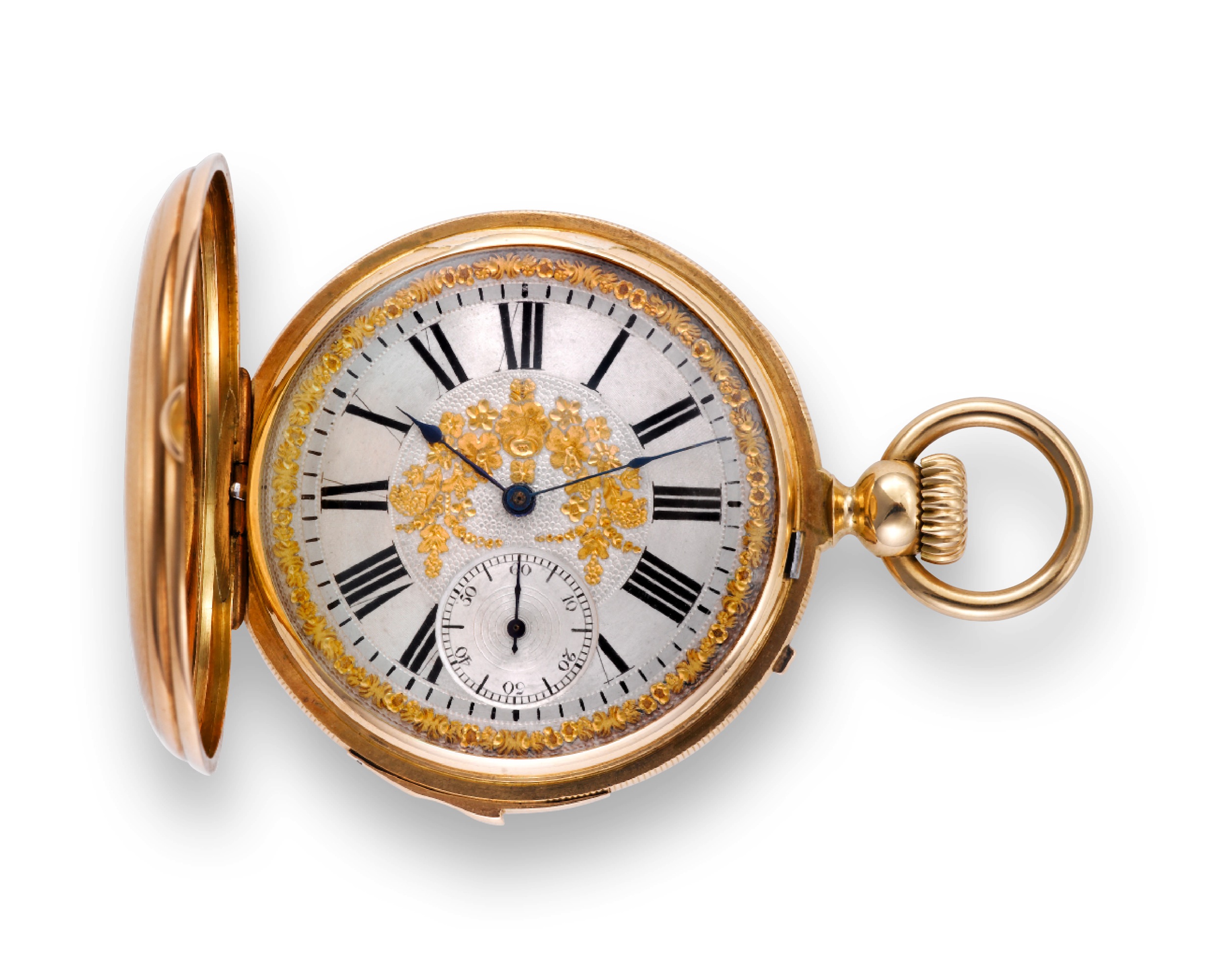
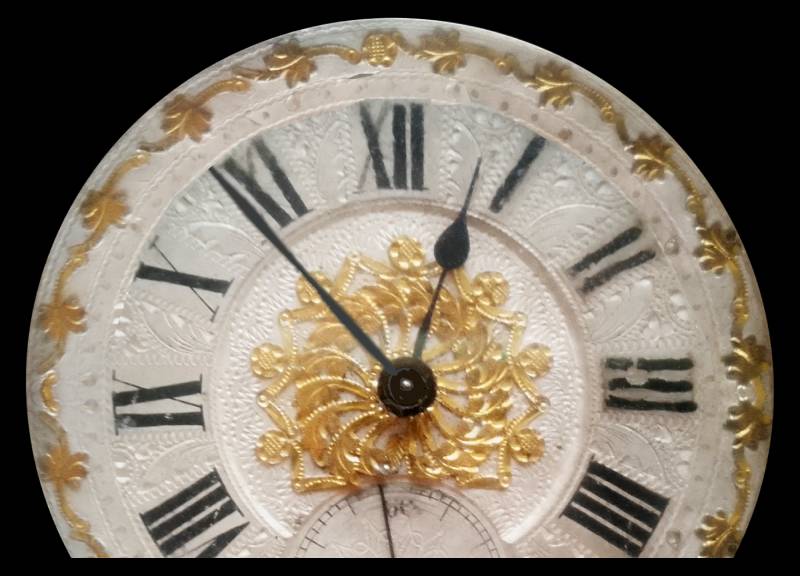
The history of Swiss chronometry is not written solely through the celebrated names of the Universal Expositions. Behind the robustness and elegance of the timepieces that crossed borders in the 19th century lies the labor of passionate independent makers. Eugène Monnier, born around 1837 and long established in the Bernese and Neuchâtel Jura, embodies the very essence of these trade watchmakers. Specializing in robust movements and “Spanish style” (genre Espagne) cases, his career reflects a constant adaptation, extending from the craftsman’s workbench to industrial collaboration with renowned casemakers such as Fritz Jeanneret.
Origins and Technical Rise (1860–1875)
Early Beginnings in Renan and Cernier: From the early 1860s, trade directories attest to Eugène Monnier working as a finisher (repasseur) and assembler (remonteur) in Renan, a foundational period during which he mastered the painstaking adjustment and finishing of complex movements. By 1870, his expertise was recorded in Cernier among lever escapement specialists, confirming his technical grounding in the premier Jura school of watchmaking.
Establishment in Tramelan: In the mid-1870s, Monnier relocated his workshop to Tramelan-Dessus, integrating fully into the local production network of watch manufacturing and participating in the civic life of the community, as evidenced by his contributions to local infrastructure committees.
Industrial Structuring and the Partnership with Fritz Jeanneret (1883–1888)
The Manufacturing House: Commercial registers officially recorded the house under the direction of Eugène Monnier in Tramelan, before setting up its administrative and sales offices in La Chaux-de-Fonds (notably on Rue Fritz-Courvoisier, and later Rue du Parc).
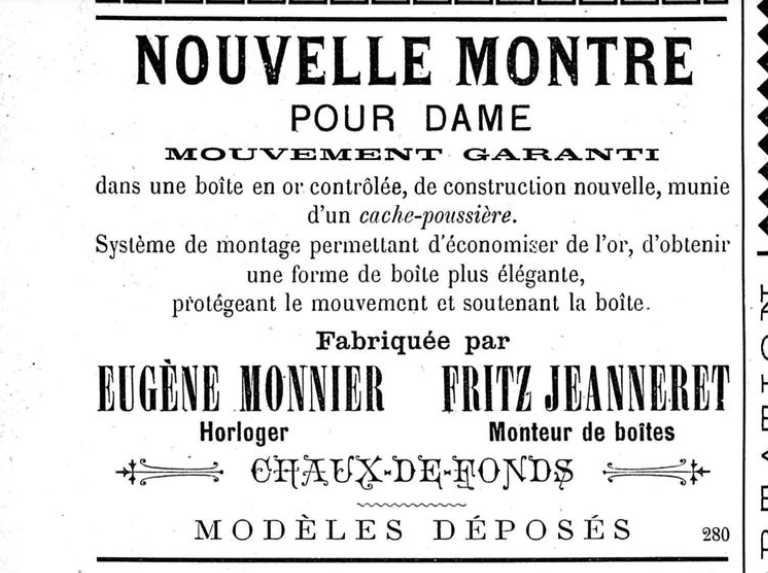
Strategic Collaboration with Fritz Jeanneret: In 1888, a decisive synergy emerged in La Chaux-de-Fonds. Monnier partnered with the casemaker (monteur de boîtes) Fritz Jeanneret to launch protected lady’s watch models featuring a guaranteed movement and an innovative case construction with a dust cover. This technical alliance allowed for the optimization of precious metal—saving gold while providing a rigid structure to protect the movement—and for the efficient coordination of the joint production of Lépine watches and large-aperture hunter cases (boîtes savonnettes à grand guichet).
The “Pelayo” Trademark and the Mystery of the Spanish Distribution Network
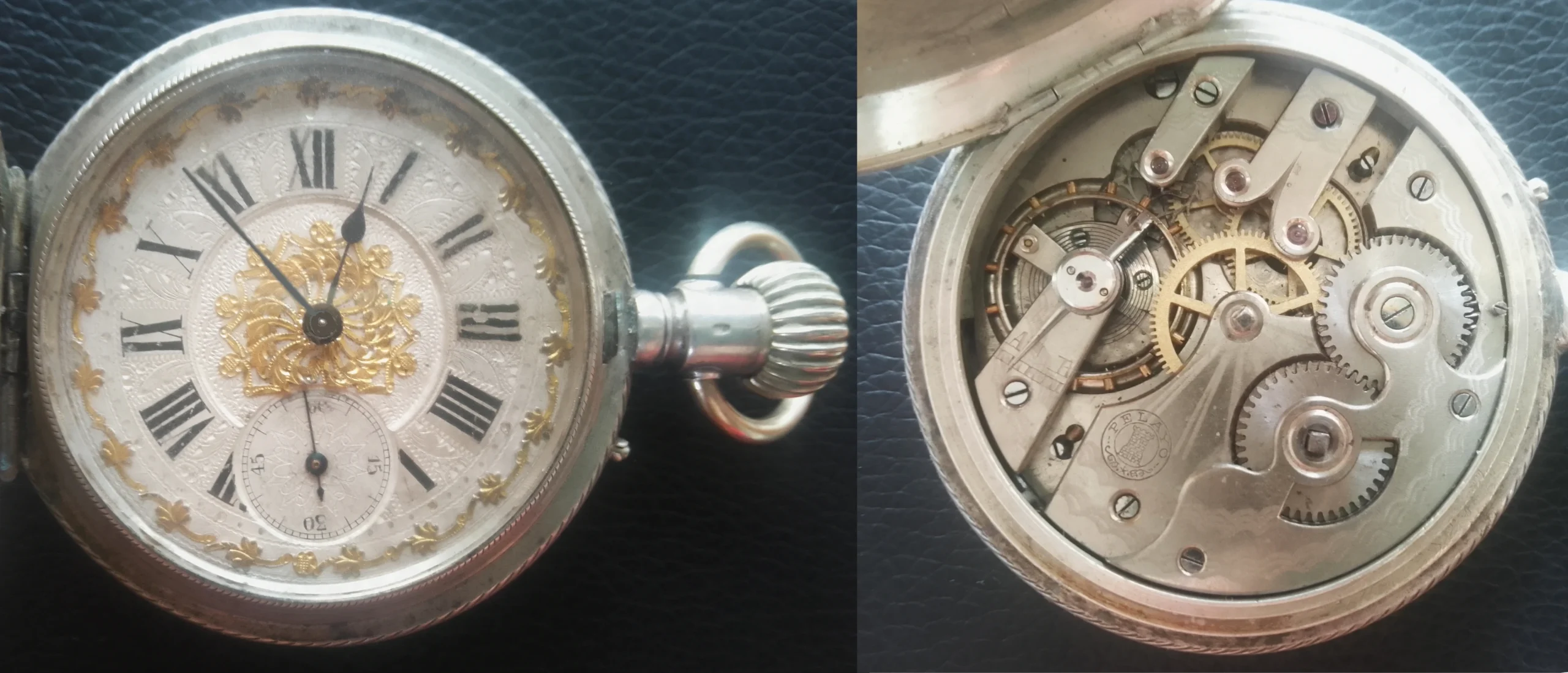
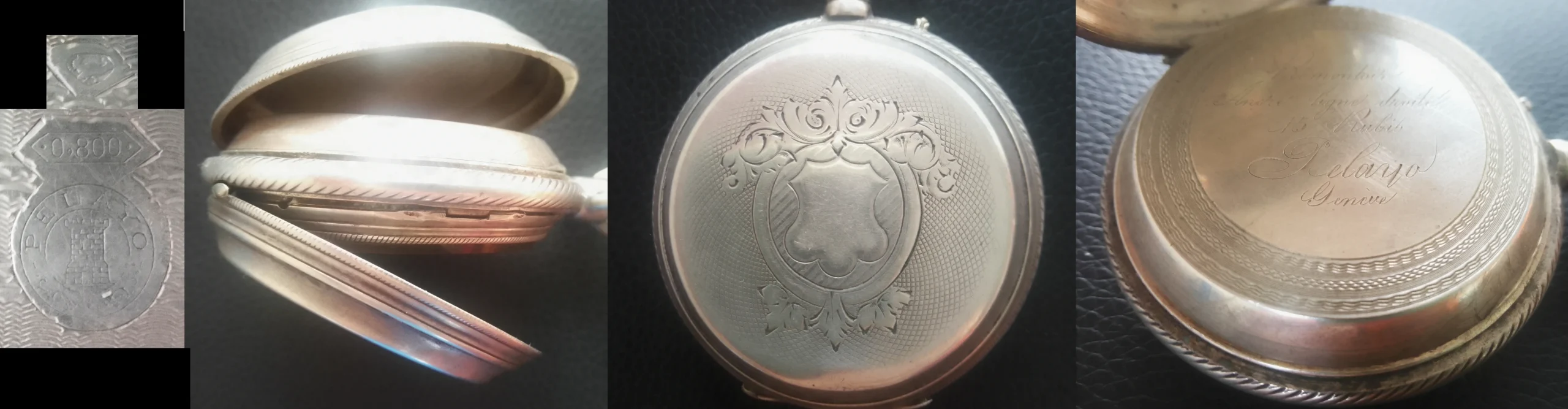
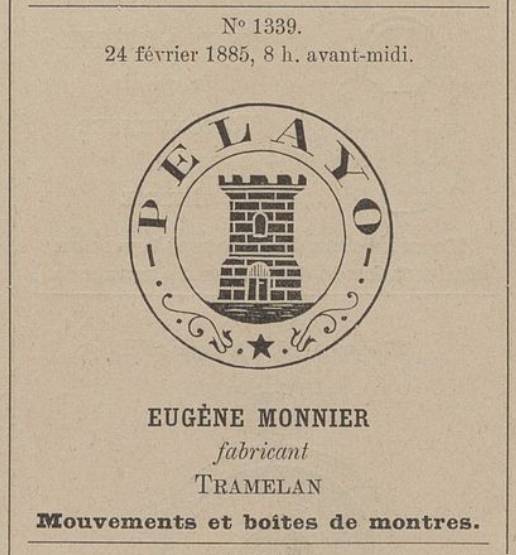
On February 24, 1885, the firm officially registered the trademark and hallmark “Pelayo” (registration No. 1339), centered on a depiction of a crenellated stone tower surrounded by the brand name arranged in an arc, encircling the fortified structure, all completed by delicate floral motifs and a star in the lower section, designed to certify its watch movements and cases. Likely inspired by the chivalric and historical Spanish figure of Don Pelayo, this choice of identity was far from accidental: period trade directories, particularly at the turn of the 20th century, ultimately classified Eugène Monnier‘s production explicitly under the “Spanish style” (genre Espagne) category.
- The Distribution Chain Enigma: While Spanish-style (genre Espagne) watches signed by Eugène Monnier reached the Iberian Peninsula due to their robust design and tailored aesthetic, the exact supply chain remains shrouded in discretion. Given his family ties with the Gindraux family, it is plausible that their introduction into the Spanish market may have occurred through the latter’s distribution networks, specifically via Louis Gindraux’s establishment in Barcelona. Furthermore, Monnier could rely on networks of commission agents, trading posts based in Geneva or La Chaux-de-Fonds, and other commercial intermediaries located in major Iberian hubs. These merchants ordered specific series adapted to local tastes—heavy cases, precise sweep-seconds, and highly legible dials—without direct archives disclosing the full extent of their cross-border sales ledgers.
Epilogue: End of the Journey and Dispersion of the Legacy
Eugène Monnier, who worked until his final days, passed away suddenly on May 26, 1907, at his residence on Rue du Parc in La Chaux-de-Fonds, at the age of 70. Following his death, the family proceeded with the liquidation of the workshop’s stock and machinery through a private sale, including all movements, parts, supplies, and tools that constituted the operational heart of the firm. In the absence of a generational successor or industrial continuity in the manufacture’s management, this inventory marked the final dispersion of his productive legacy and the definitive end of his life’s work.
Today, the rare surviving timepieces bearing the Pelayo mark or featuring his civilian calibers bear witness to this precision Swiss craftsmanship, tailored specifically to meet the demands of the late 19th-century Spanish market.
Final Note: A few years later, in 1917, the Pelayo trademark resurfaced in the hands of Jules Calame fils in La Chaux-de-Fonds, for the trade of watches, cases, movements, and dials… but that is another story.