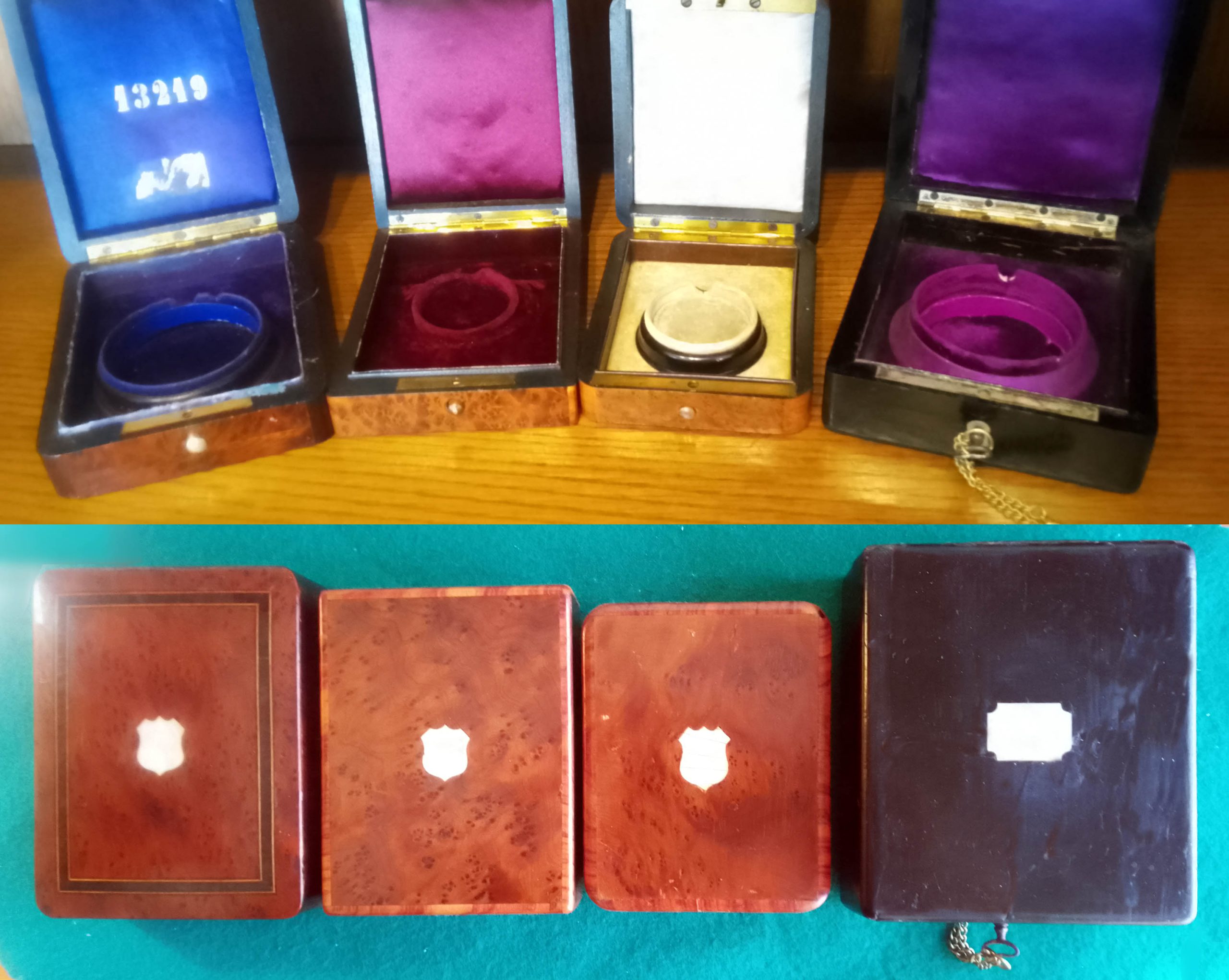
The marketing of these timepieces was not limited to the fabrication of movements, dials, or cases; their presentation to the buyer constituted an essential component of the prestige discourse. The majority of watches destined for the Spanish market were delivered in meticulously designed presentation boxes, combining aesthetic refinement with functional practicality.
19th-century presentation boxes for pocket watches, characteristic of the presentation style for «Genre Espagne» models. Crafted from precious woods (ebony, burr walnut, and burl) featuring intricate marquetry detailing and inlaid cartouches made of metal, mother-of-pearl, or ivory, they are lined on the interior with satin and velvet (author's collection).
Tailored Dimensions: The box precisely matched the watch’s diameter, determined by the movement calibre measured in lignes, preventing unwanted movement and reinforcing the perception of a bespoke timepiece.
Materials: A predominance of figured hardwoods, particularly burl or root woods, whose irregular grain produces visual depth beneath a hand-polished varnish.
Aesthetic Sobriety: For cleaner, more austere specimens, ebony was utilized, conferring elegance and understatement.
Ornamental Details
Upper Lid: Frequently decorated with inlaid central cartouches or escutcheons crafted from mother-of-pearl, metal, or other lightweight materials. These could accommodate custom engravings, monograms, or registered trademarks, though they were often left blank.
Functional Interior
Protection and Contrast: The watch recess was lined with velvet or plush textiles in deep hues (blue, crimson, violet, or burgundy), protecting the metal case while establishing a stark visual contrast.
Case Retention: The watch was secured by a padded ring or contoured recess, guaranteeing stability during transit.
Auxiliary Compartment: Located beneath the main tray, this section housed spare crystals, winding keys, or alternative white enamel dials, enabling the owner to swap the elaborate Victorian dial for a more understated option depending on the occasion.
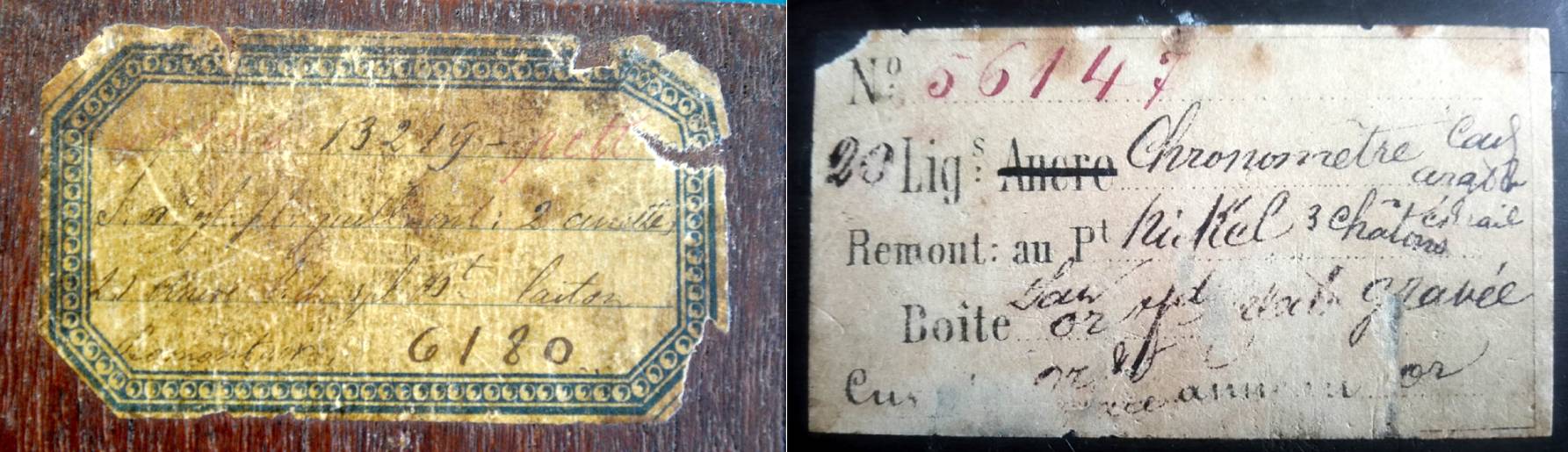
Original labels preserved on presentation boxes, providing the technical specifications of the corresponding watches. Left: « 13219 – Pet[it] Régul[ateur] Températ[ure], 2 cuvettes, à point d'Aiguille de 1re [qualité], Laiton, 6180 ». Right: « N.º 56147. 20 ligᵉ : Chronomètre, cadr[an] argent émail, Remont[oir] au P[endan]t, Nickel 3 chatons, Boîte or gravée, Cuv[ette] or, ann[eau] or » (author's collection).
Often, these elegant boxes contain timepieces whose serial numbers and specifications do not match those recorded on the housing label. This strongly suggests that, historically, commercial convenience took precedence over strict traceability: local watchmakers would routinely adjust or pair contents according to client preference or available inventory. Consequently, the presentation box functioned as an interchangeable retail vessel rather than a unique component tied exclusively to the specific movement shipped from the manufacture.
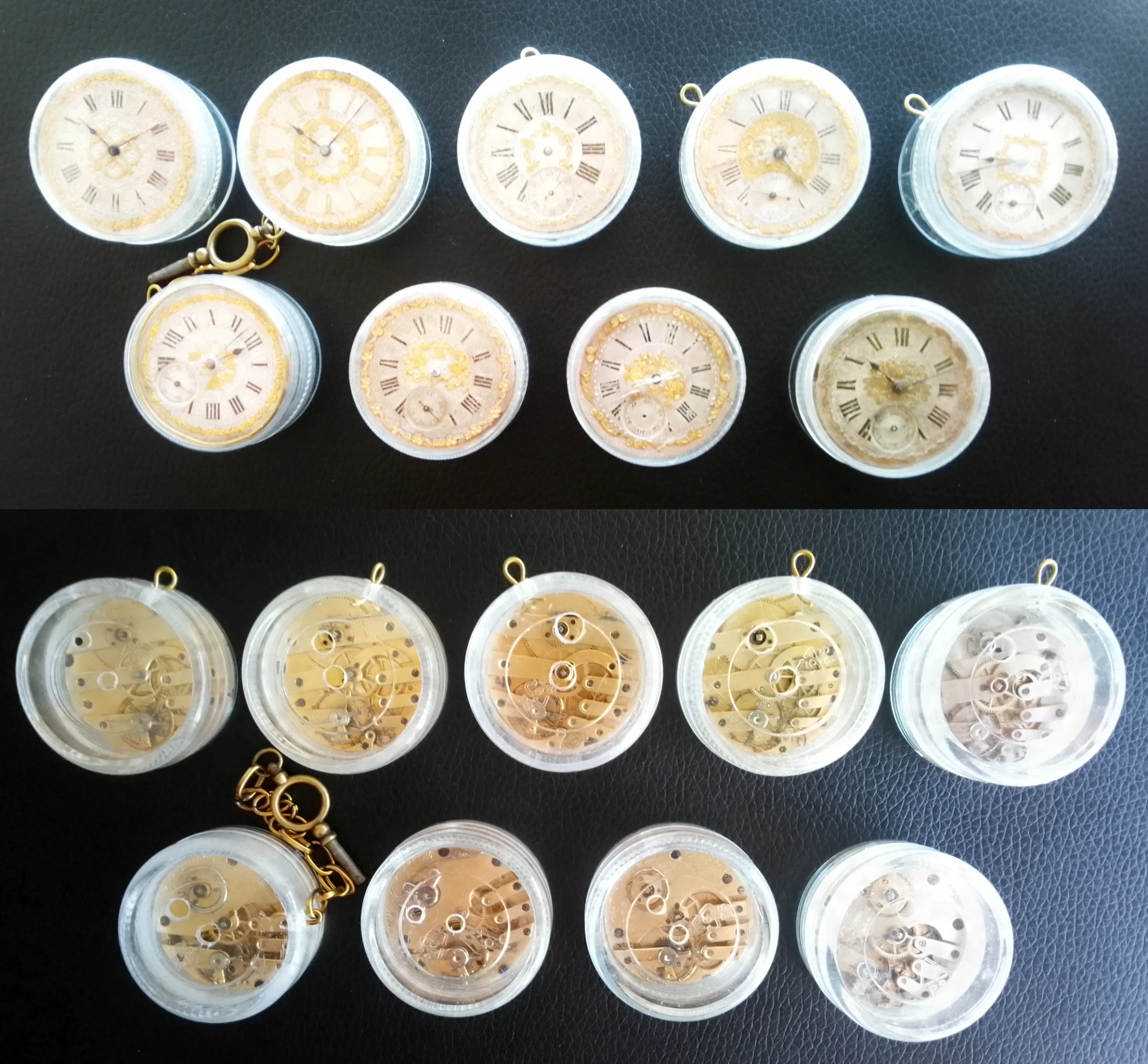
15-ligne movements paired with «Genre Espagne» dials, shown dial-side (top) and movements (bottom). These calibres illustrate a straightforward and practical production featuring independent bridges, engineered to balance functional reliability with manufacturing efficiency. Displayed here uncased and preserved inside protective capsules, these pieces bear witness to the fate of many movements left orphaned following the melting of their original cases (author's collection).
Chapter 4: Watch Architecture: Case and Movement
4.1 Typologies of Swiss Movements (~1875)
The movements powering Victorian-dial watches exhibit significant structural diversity, which can be categorized into four main architectural groups:
Independent “Radial” Bridges (Pure Lépine)
Every wheel rests on a dedicated, long, narrow bridge arranged radially.
Screws are aligned along the perimeter, establishing a linear flow.
Examples: Moutier-Grandval, Schild Frères Cal. 38, Paul Jeannot.
Curved or Sinuous Bridges (Japy / Modern Style)
Features curved or S-shaped bridges, occasionally spanning two wheels simultaneously.
Identifying features: Non-straight cuts, visual harmony, and deliberate decorative design.
Examples: Japy, Fritz Meyer, LeCoultre 14-ligne.
Three-Quarter Plate (Partial Integration)
A single plate covers the barrel and train, excluding the escapement and balance assembly.
Large expanse of exposed metal surface set with inserted jewel chatons.
Examples: Didisheim, high-grade LeCoultre.
Full Top Plate (Roskopf System / Mass Industrial Production)
The top plate covers nearly the entire movement, representing pure functionalism.
Devoid of decorative cutouts; the balance assembly and escapement are occasionally mounted on a small separate bridge.
Examples: Roskopf and industrial variants.
As a general rule, calibres measuring 17 lignes or smaller were fitted with simple monometallic balance wheels, whereas larger calibres incorporated compensated bimetallic balances—occasionally utilizing palladium hairsprings—and timing screws, reflecting the ongoing evolution of contemporary horological engineering.
During the initial phase, these bimetallic balances were closed, featuring two diametrically opposed notches interrupting the rim. Shortly thereafter, they evolved into fully open typologies, with the rim split into two independent radial segments to achieve more efficient thermal compensation.
On numerous occasions, the movement itself was treated as a showcase of luxury, displayed alongside the elaborate Victorian dial. Consequently, the top-pivot cap jewel on the balance bridge frequently stood out through the deep quality and rich ruby coloration, or via a setting incorporating a rose-cut diamond.
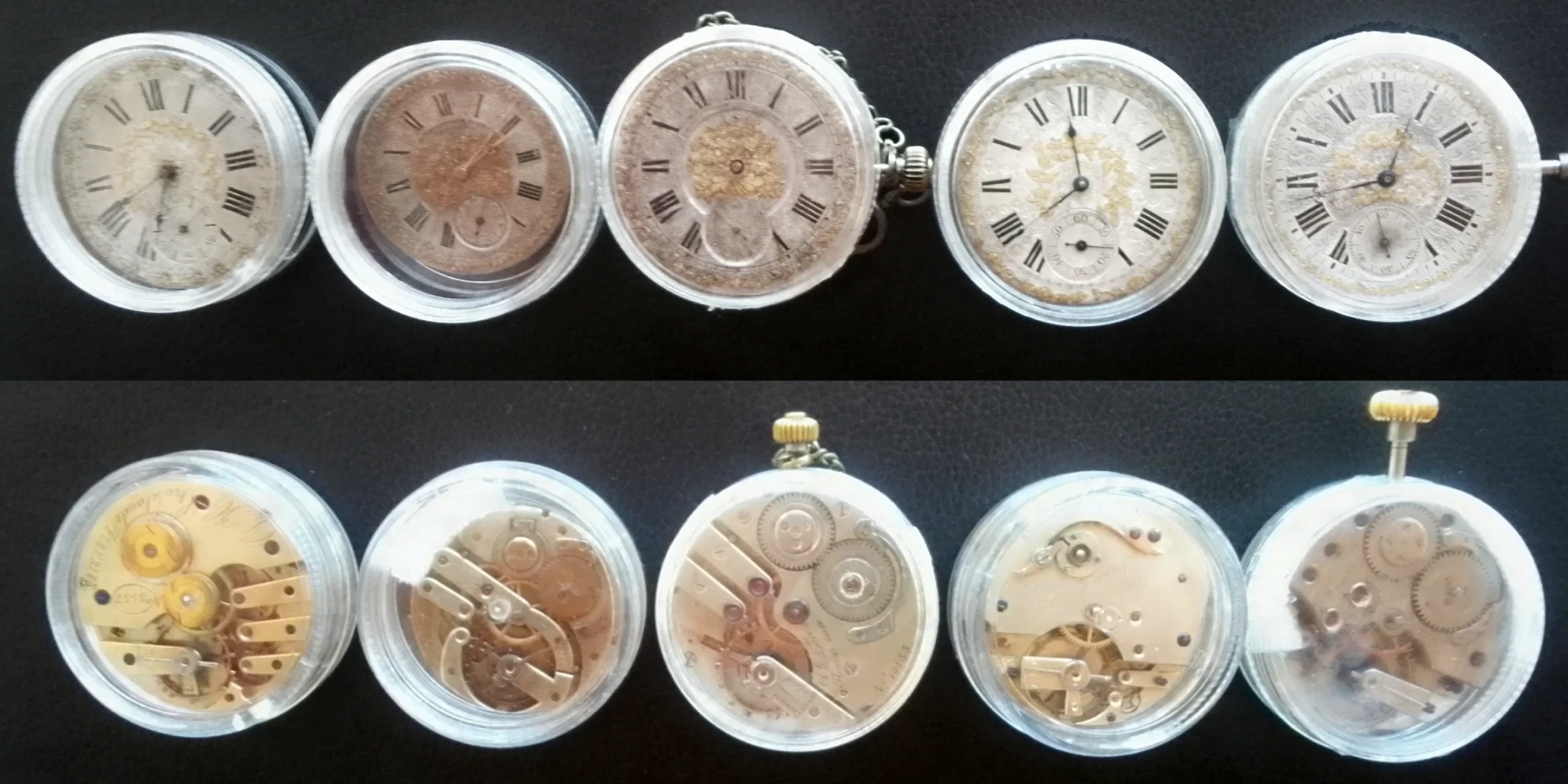
19-ligne movements with «Genre Espagne» dials, likely originally cased in gold and preserved today in transparent protective capsules. From left to right: first, signed Grosclaude, featuring a peculiar system of rotating discs turned directly with the fingers for keyless winding and hand-setting; second, by Henri Grandjean, distinguished by a curved escape-wheel bridge shielding the regulating balance; third, signed Lardet, equipped with an Earnshaw detent escapement and a cylindrical hairspring; fourth, employing a lateral lever escapement (pre-straight-line layout); fifth, signed Haas & Privat, characterized by the large diameter of its regulating balance wheel (author's collection).
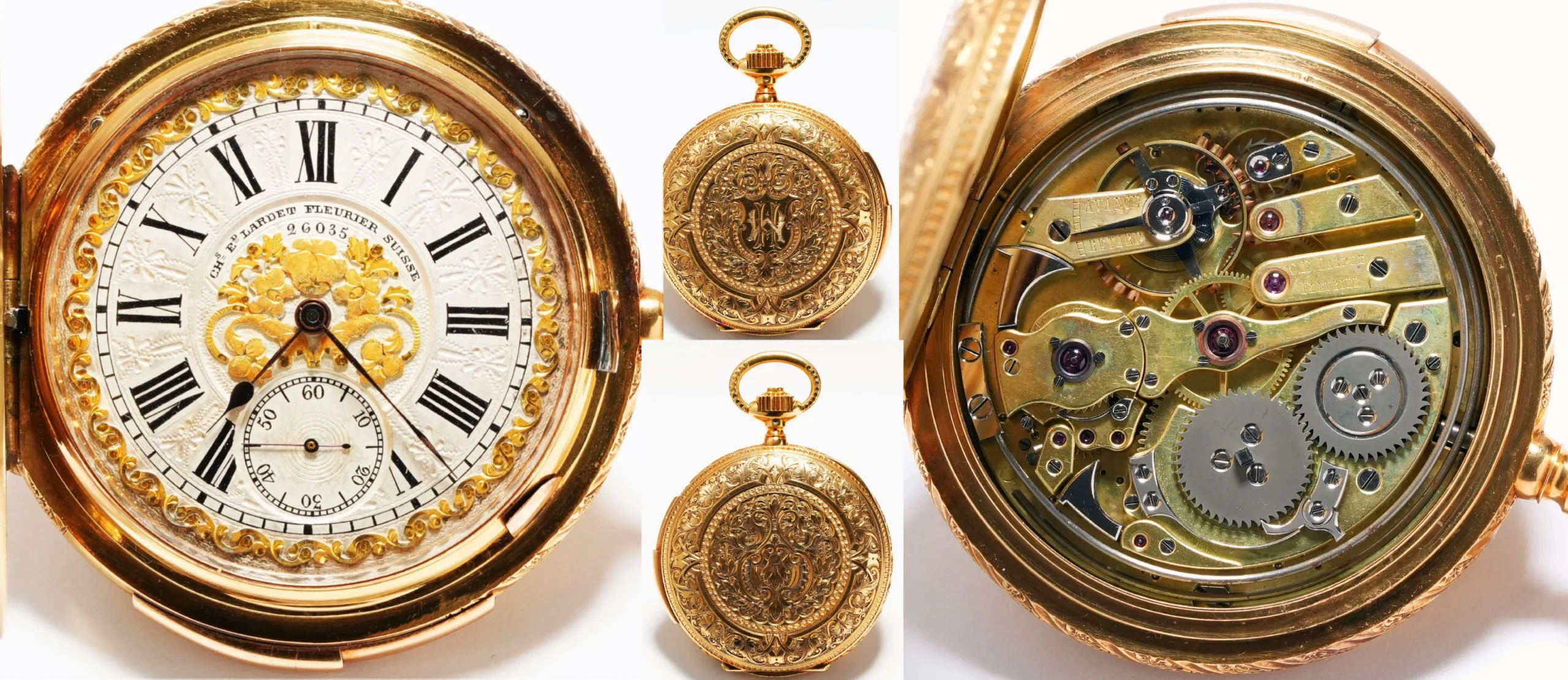
LeCoultre movement housed in Lardet pocket watch No. 26035 (circa 1895).
From the 1880s onward, the most sophisticated pocket watches—typically presented in gold hunter cases (savonnette) marketed by leading établisseurs—frequently housed LeCoultre movements. The calibre illustrated here highlights the constructive diversity of Swiss watchmaking around 1900, characterized by an architectural layout of sinuous bridges and a high level of finishing: a thermally compensated bimetallic balance with timing screws, set jewels, and a meticulously finished endpiece, turning the movement itself into a true display of luxury.
4.2 Ébauches and Levels of Finishing
The concept of the ébauche illustrates the tiered structure of Swiss manufacturing:
Raw Ébauche (Base Movement): Drilled mainplates and bridges with a partially assembled train, but lacking the regulating organ. The final établisseur installed and fitted the balance wheel, hairspring, pallet fork, and escapement assembly.
Semi-Assembled Ébauche: Complete wheel trains paired with an incomplete escapement, requiring the final manufacturer to execute adjustments, jeweling, and finishing operations.
Near-Complete Ébauche (Blanc Roulant): A fully functional movement lacking final polishing, decorative line finishes, or definitive maker signatures.
Combining these varying tiers of movement completion with standard Victorian dials allowed manufacturers to achieve consistent visual uniformity across products despite underlying mechanical diversity.
4.3 Technical Evolution and Complexity
These pocket watches illustrate a clear progression in technical solutions:
Escapements: A gradual transition from the cylinder escapement to the virgule escapement, and ultimately to the lever escapement, enhancing both rate stability and timekeeping accuracy.
Jeweling and Balances: Evolving from basic 4 to 6-jewel counts up to advanced 18-jewel configurations; bimetallic compensation balances were incorporated to offset thermal expansion errors.
Small Diameters (<19 lignes): Frequently utilized plain monometallic balance wheels without thermal compensation, as their reduced mass rendered temperature-induced variations largely negligible.
Earnshaw Detent Escapement Found in more ambitious pocket watches derived from marine chronometry; it minimizes frictional contact and ensures high oscillation regularity, delivering chronometer-grade precision.
Cylindrical Hairspring Enhances isochronism by expanding and contracting with superior concentricity; its delicate poise and adjustment demanded exceptional technical mastery, restricting its application strictly to high-end pocket watches.
Gold Chaton Settings and Precious JewelsGold chatons secured functional rubies and, in rare instances, rose-cut diamonds as endstones for the balance pivots, combining refined aesthetics with structural durability: simplifying maintenance, reducing frictional resistance, and preventing pivot wear.
The careful jeweling and setting of the regulating organ served to reinforce both the visual coherence and the technical prestige of the pocket watch.
4.4 Coordinated Diversity of Sizes
The vast array of calibres and independent manufacturers does not undermine overall visual uniformity:
Etablissage Integration: Each workshop (maison d’assemblage) selected and fitted components sourced from distinct suppliers, seamlessly integrating diverse movements into a cohesive final product.
Ornamental and Mechanical Fusion: This integration reached its peak in the combination of richly embellished dials with high-precision movements featuring cylindrical hairsprings and Earnshaw detent escapements, solidifying the bond between miniature decorative craft and chronometric excellence.
4.5 Winding Stems
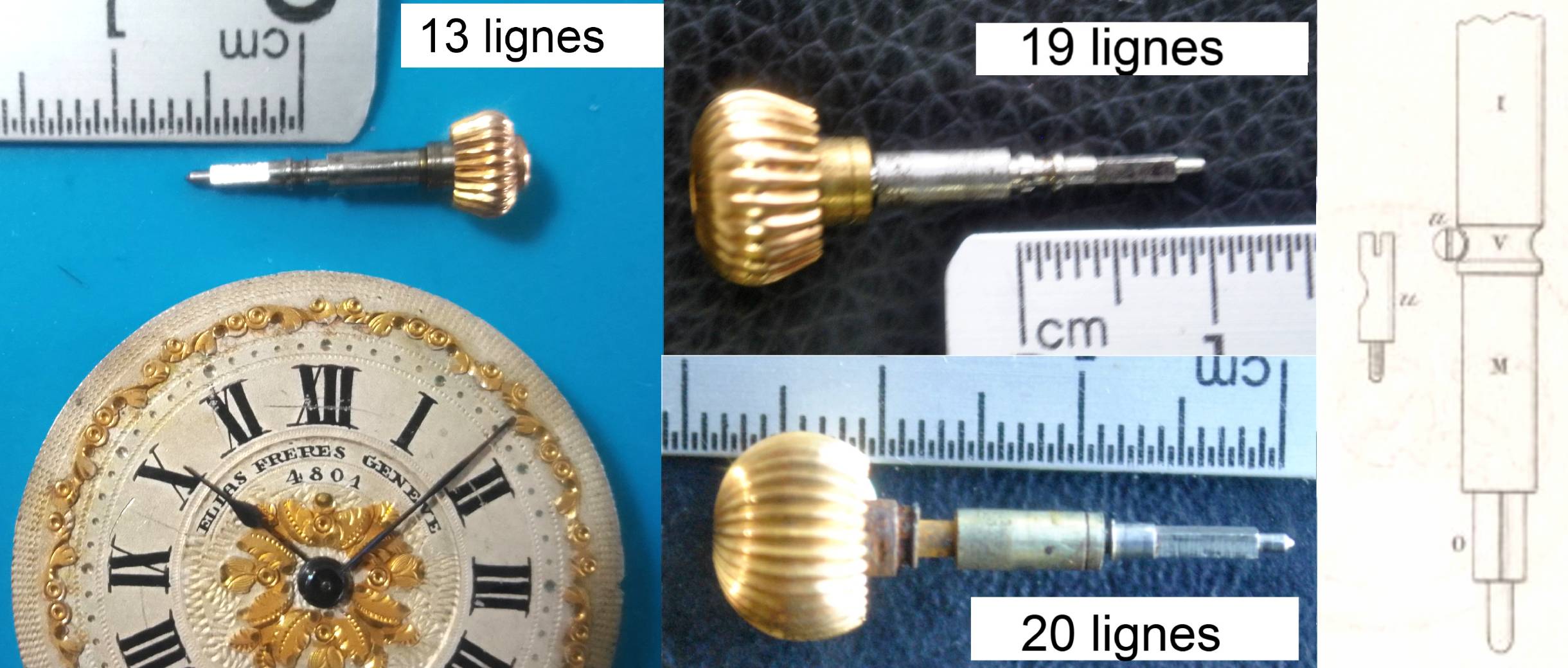
When these pocket watches were engineered with a stem-winding and setting system (remontoir au pendant), they incorporated a hardened steel winding stem designed as a dual-function drive shaft.
Square Section: The functional shaft featured a squared profile (carré) engineered to mate with the winding mechanism (the sliding pinion and crown wheel), ensuring efficient torque transmission when winding the mainspring.
Inner Pivot: At its innermost tip, the winding stem typically terminated in a guided pivot seated within a dedicated recess in the mainplate or bridge, ensuring precise axial alignment and structural stability.
Keyless Transition: The design of these stems was pivotal during the technical transition of the second half of the 19th century, eliminating reliance on external winding keys by integrating the mechanism directly into the crown.
Driven by a setting interface—governed by the setting lever (tirette) and sliding pinion (pignon coulant)—either pulling or turning the stem allowed the user to switch seamlessly between winding the mainspring and setting the hands. This established a standardized construction layout that would become universally adopted by the turn of the century.
4.6 Hunter Cases (Savonnettes) and Case Integration
It is essential to note that a significant proportion of the movements powering these pocket watches with Victorian-style dials have survived to the present day severed from their original cases. Originally, they were cased predominantly in three-lid hunter (savonnette) cases—and occasionally within open-face Lépine arrangements—whose design satisfied not only functional protective requirements, but also the owner’s desire to showcase the inner luxury and precision of the movement.
This widespread dissociation is largely attributable to the enforcement of confiscation decrees and organized “patriotic donations” during the Spanish Civil War (1936–1939), a period in which the intrinsic bullion value of the metal vastly outweighed the historical or artistic merits of the pocket watches. Official requisitions executed across the Republican zone—formalized by the decree of October 1936—alongside the “Gold for the Nation” (Oro para la Patria) campaigns in the Nationalist zone prioritized the systematic smelting of precious metal cases for financial stabilization.
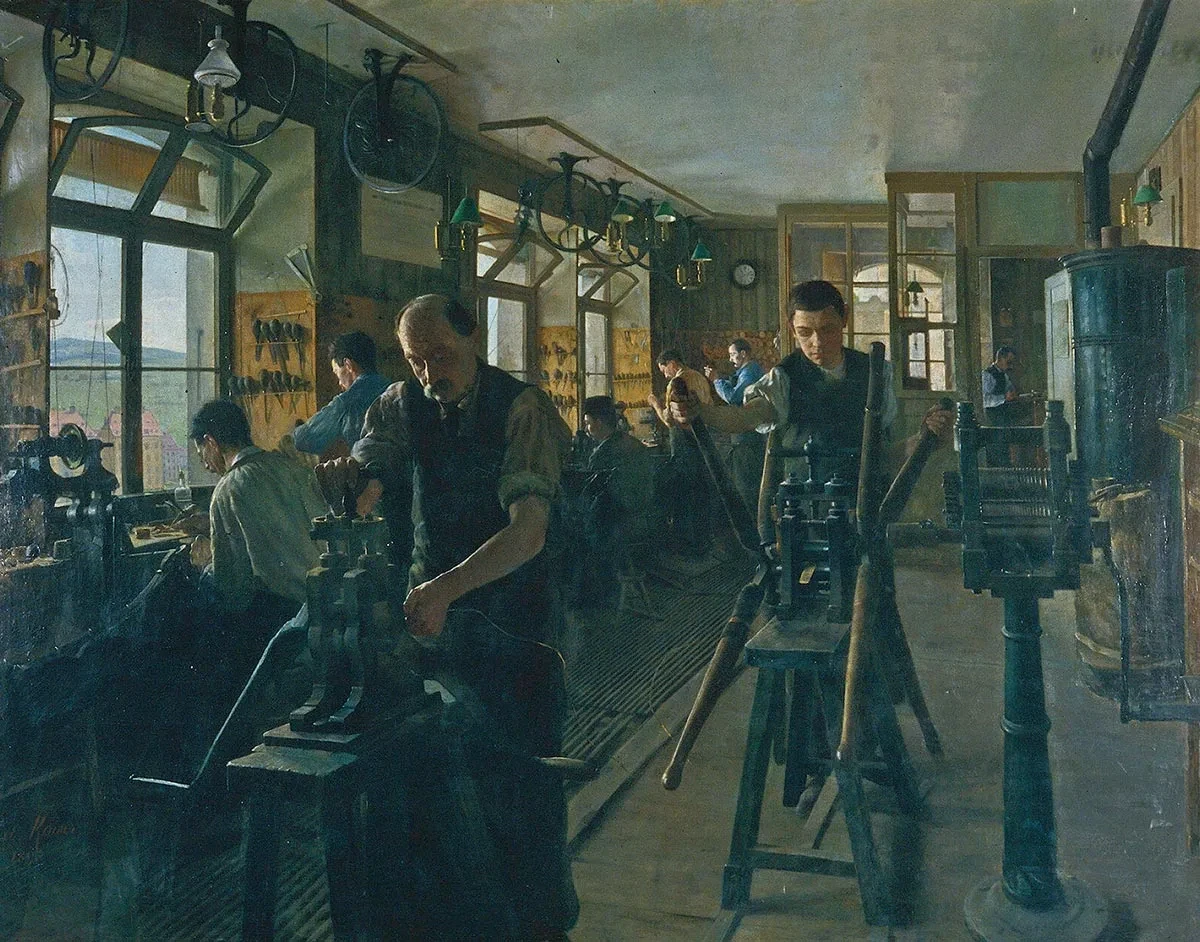
«L’Atelier de boîtiers» (1893), by Edouard Kaiser (La Chaux-de-Fonds, 1855–1931), son of Samuel, engraver and engine turner (guillocheur). Swiss National Museum https://www.landesmuseum.ch
4.6.1 Silver Cases: Morphological and Ornamental Analysis of the Studied Cases
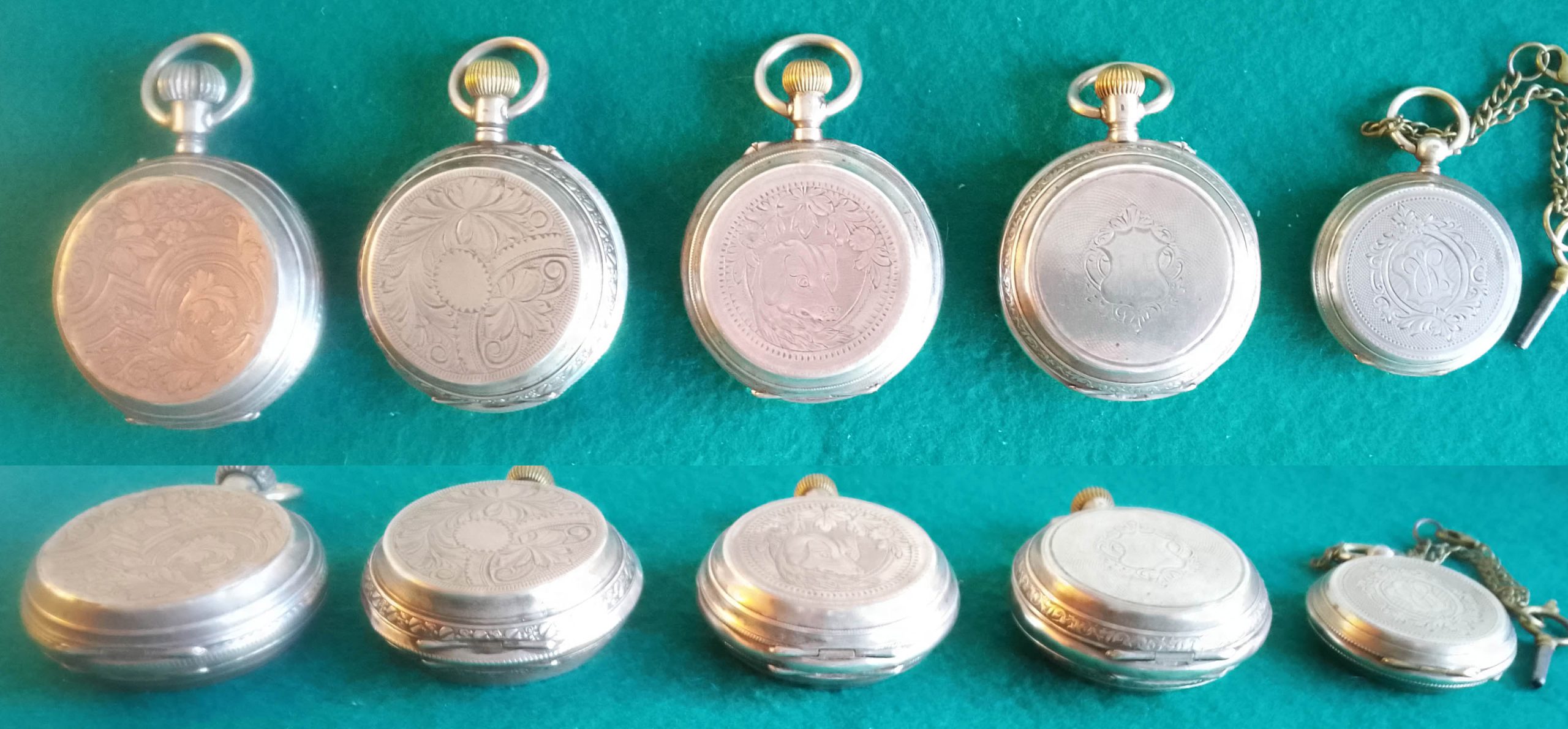
In analyzing the morphology of these pieces, a clear technical transition is observable between the drum-shaped band architecture (bassin) and the lenticular profile of the case construction—two distinct structural solutions that dictated not only overall ergonomics, but also the tactile and volumetric perception of the pocket watch.
Drum Geometry (Bassin): The first category is defined as a flattened cylinder featuring pronounced, defined edges. It incorporates a tall, near-vertical case band that acts as a robust structural frame, maximizing internal clearance to accommodate substantial movements—whether characterized by raised bridges or added mechanical complexity. Its presence is firm and structured: upon handling, the hand immediately identifies the sharp transition between the covers and the case band, perceiving a piece with clear boundaries and architectural solidity.
Lenticular Profile: Conversely, the second category—reflecting an evolution toward enhanced portability—adopts a lenticular cross-section. The domed covers merge seamlessly into the case band, producing a continuous profile free of sharp transitions. In the hand, this geometry translates into a smooth, streamlined contour engineered to slide effortlesly into a vest pocket. The case evolves from a segmented volume into a soft solid of revolution: a gently convex disc tailored to the tailored fashions and daily habits of the late 19th and early 20th centuries.
Prior to the enactment of the Swiss Federal Act of December 23, 1880, which standardized precious metal hallmarking, silver marks consisted merely of simple fineness numbers expressed in thousandths or, on occasion, remained unstandardized, bearing only the maker’s initials.
From an ornamental perspective—which reached exceptional richness on gold cases—three principal decorative treatments can be distinguished by their technical execution and tactile appeal:
Engine Turning (Guilloché)
A precision finish executed using a rose engine lathe. It generates repeating geometric patterns—sunbursts, wave patterns (barillet), lattices, or interlocking motifs—that produce a fine, uniform texture. Beyond its aesthetic merit, engine turning served a practical purpose by enhancing grip and disguising surface wear.
Hand Chasing and Engraving
Characteristic of larger, more substantial cases—frequently paired with bassin profile geometries—this technique replaces mechanical regularity with an expressive, handcrafted surface. Foliate and floral motifs were hand-engraved in relief using a burin, creating an expressive topography of raised stems, leaves, and petals. The result is both visual and tactile: a relief surface that conveys meticulous hand-craftsmanship.
Niello and Enamel Decoration
These finishes introduced strong chromatic and material contrast. Niello—an inlaid metallic sulfide compound that turns deep black—delineated delicate scrollwork and patterns that stood out in stark contrast against gold or silver. Enamel, by contrast, provided a smooth, vitreous, and cool surface that contrasted with the warmth of the surrounding metal. In both instances, the case was elevated to a high-art canvas, establishing a dialogue between exterior refinement and the mechanical sophistication of the movement within.
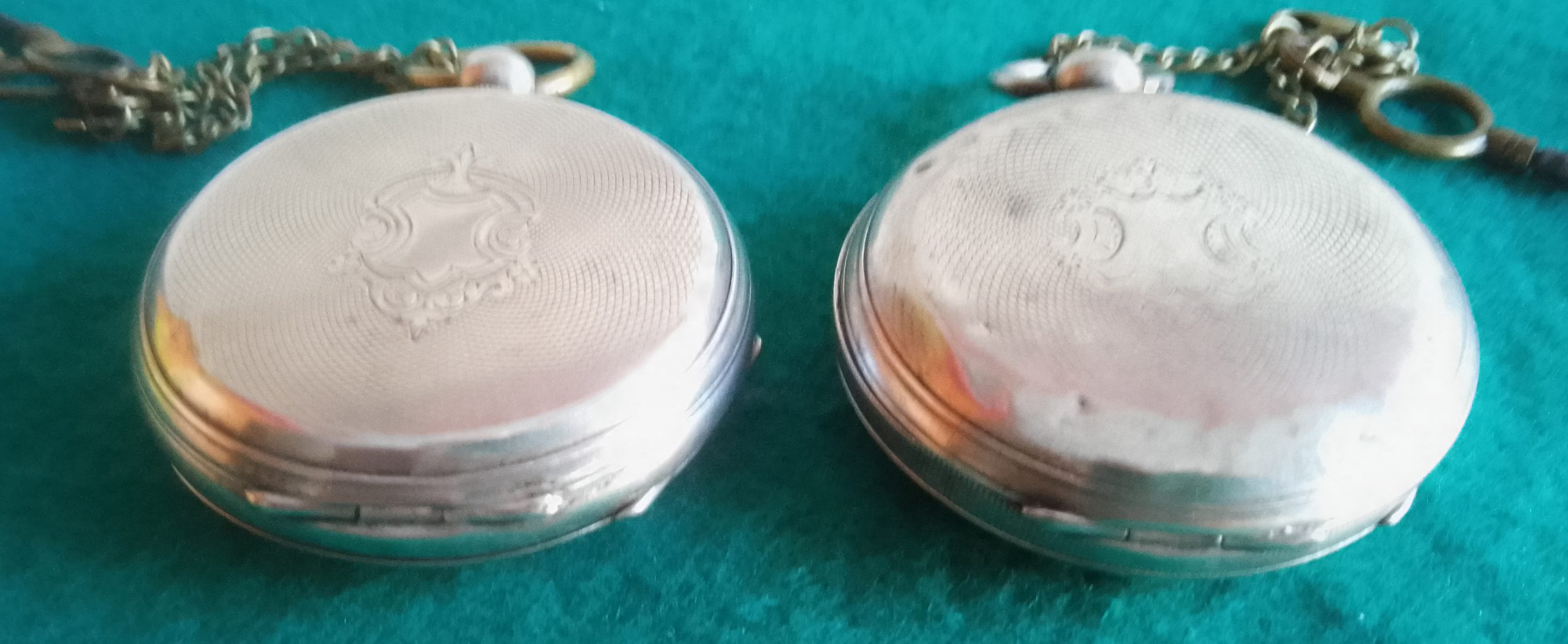
Three-lid silver hunter cases (savonnette) for «Genre Espagne» pocket watches, shown frontally (top) and in profile (bottom). Featuring the traditional three-lid construction—comprising the front cover, back lid, internal dust cover (cuvette), and a secondary glazed cuvette—the set perfectly illustrates the impressive proportions of their drum geometry (bassin), characterized by a tall case band and defined edges that assert the volumetric presence of these pieces regardless of their size (author's collection).
A significant proportion of pocket watches featuring Victorian-style dials have survived to the present day detached from their original cases, a phenomenon directly linked to confiscation decrees and organized “patriotic donation” campaigns during the Spanish Civil War (1936–1939). Official requisitions executed across the Republican zone—formalized by the decree of October 1936—alongside the “Gold for the Nation” (Oro para la Patria) deliveries in the Nationalist zone prioritized the smelting of precious metals for financial stabilization, systematically disregarding their historical or artistic value.
While gold cases were almost entirely eradicated from surviving collections, silver cases were subjected to less rigorous melting quotas, explaining why pocket watches retaining their original silver cases are far more common today. Among the rare instances where gold cases did survive, it is frequently found that only the movements and dials remained intact.
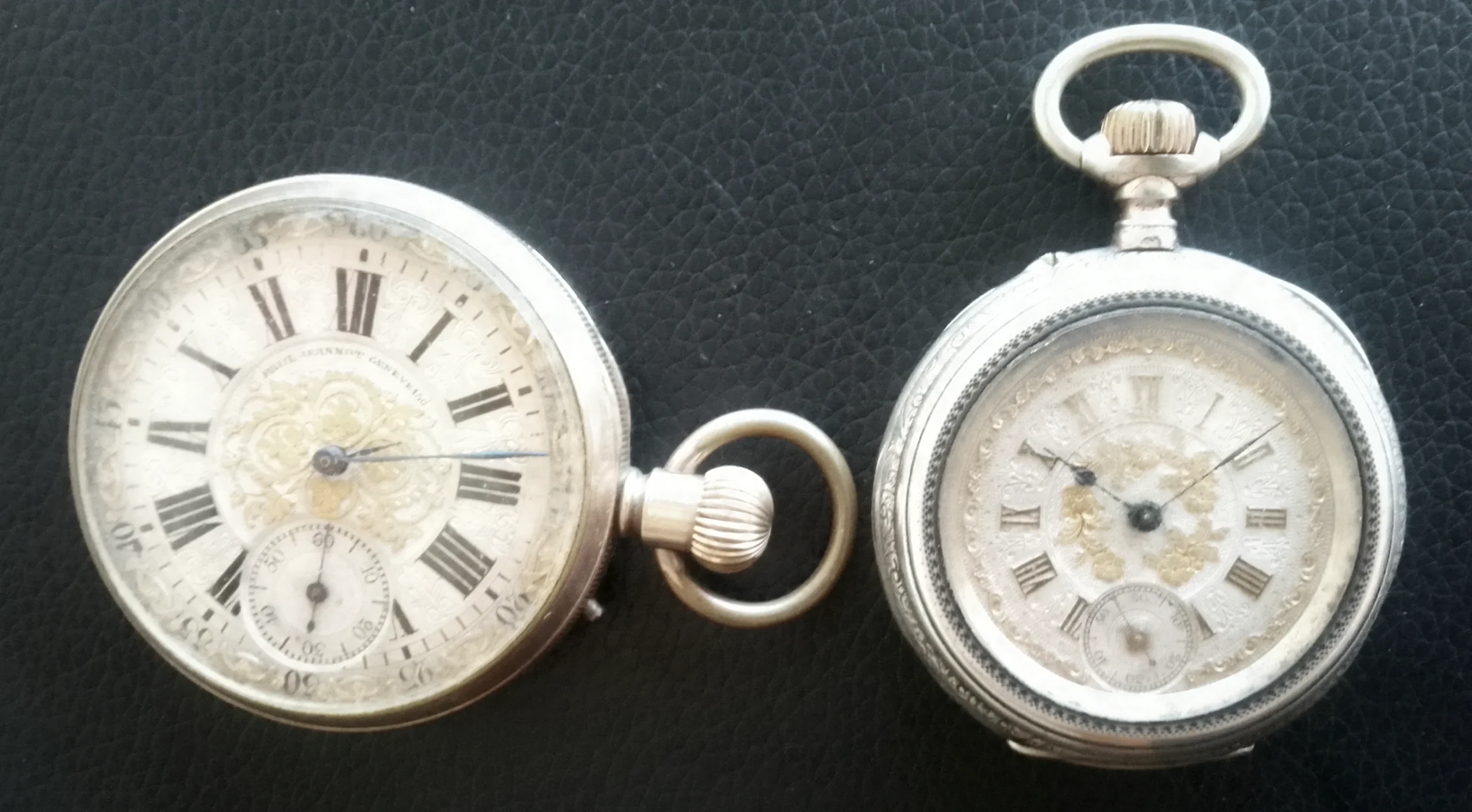
Although «Genre Espagne» pocket watches are most commonly cased in three-lid hunter (savonnette) configurations, they are occasionally housed in open-face Lépine arrangements featuring two covers (back lid and cuvette), as demonstrated by this example signed by Paul Jeannot (left) and the model attributed to Thommen (right) (author's collection).
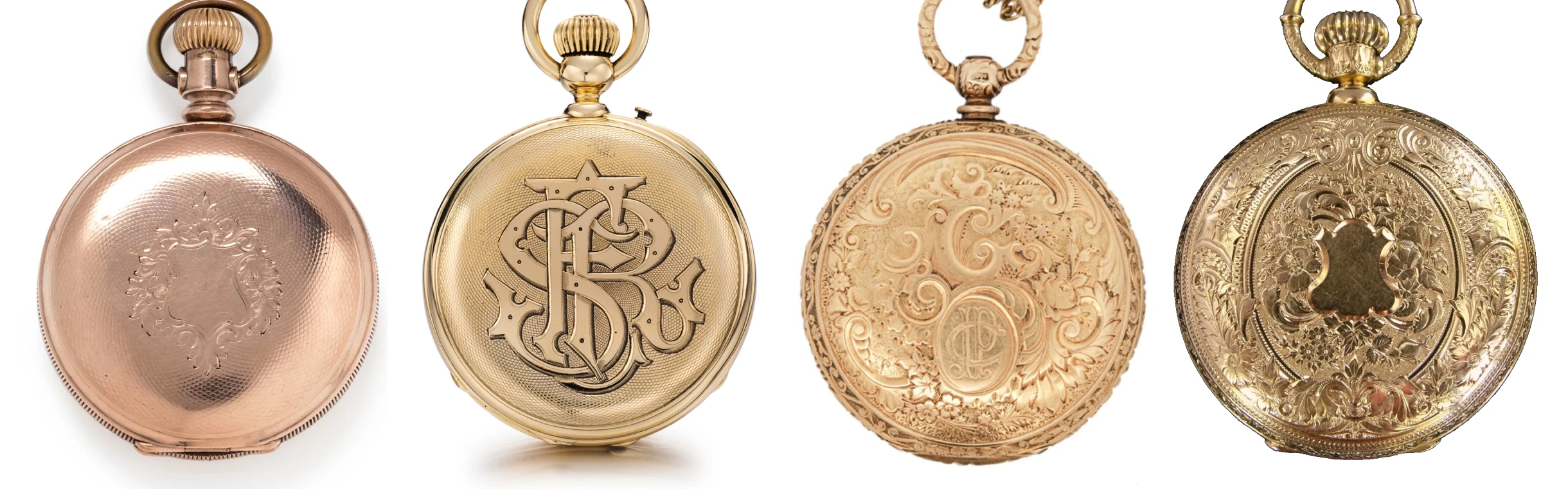
Gold hunter cases (savonnette) with a lenticular profile for «Genre Espagne» pocket watches, illustrating various tiers of decorative finish applied to precious metals. From left to right, the craftsmanship ranges from fine engine-turned barleycorn (grain d'orge) centered on a subtle cartouche, to a combination of engine-turned fields framing a prominent hand-engraved monogram, to fully hand-chased compositions where scrollwork, floral motifs, and foliage completely cover the surface.
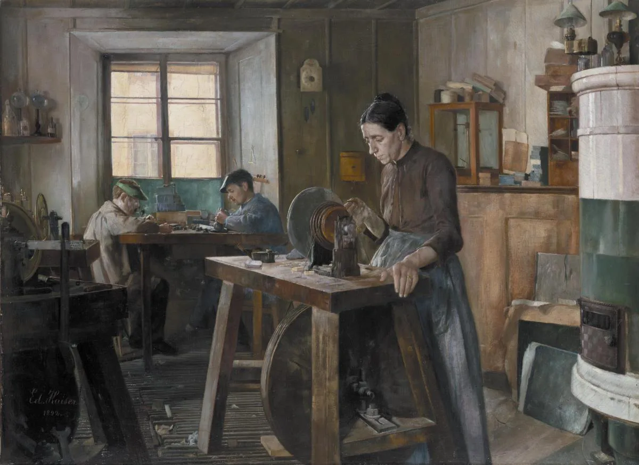
«Atelier de graveurs» (1892), by Édouard Kaiser. Art Collections of the Swiss Confederation.
4.6.2 Gold Cases
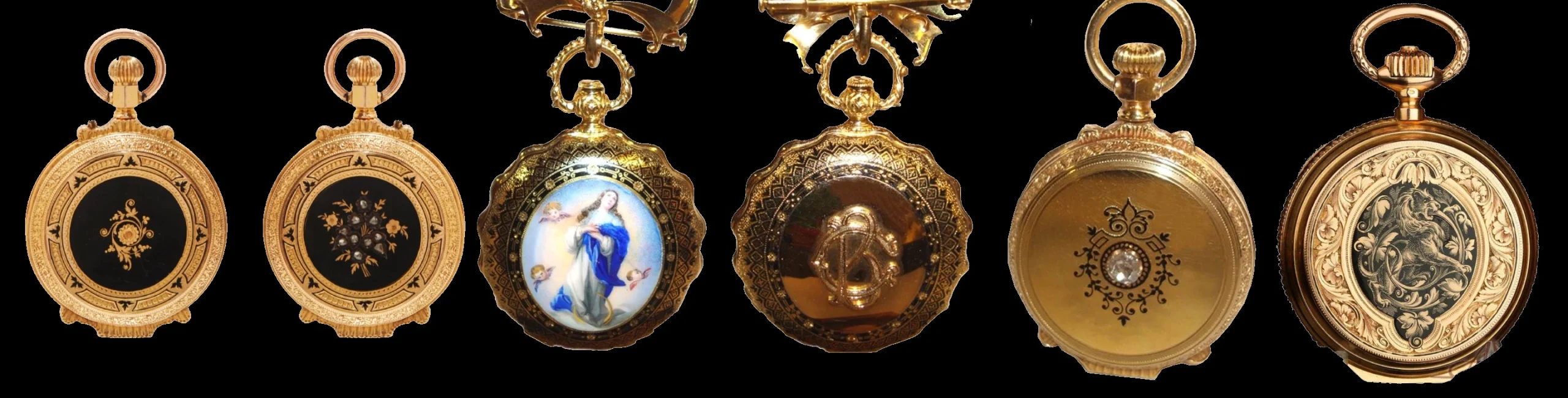
Gold cases represented the absolute pinnacle of Jurassian watchmaking, where the nobility of the precious metal directly reflected the hierarchical status of the enclosed movement. In contrast to the utilitarian robustness of silver, gold—typically standard 14K (0.585) and predominantly 18K (0.750), marked with the profile of Helvetia following the Swiss Federal Act of December 23, 1880—served as both a protective shell and an elevated canvas for top-tier mechanics.
Consequently, gold hunter cases (savonnette) embody the zenith of goldsmithing applied to prestigious 19th-century horology. They were executed across an extensive variety of decorative finishes:
Solid Gold Hand-Chasing and Engraving: Combining mechanical engine-turning (guilloché) with a profusion of scrollwork, foliate motifs, and heraldic cartouches.
Compositions Enriched with Grand Feu Enamels: Introducing rich chromatic contrasts through polychrome designs, gemstone inlays, or hand-engraved motifs set against enameled grounds.
In this manner, each case serves as a high-art canvas, offering exceptional tactile and visual depth.
High-grade gold hunter pocket watches for «Genre Espagne» pocket watches, illustrating the peak of decorative complexity inJurassian production. The selection showcases a broad spectrum of ornamental techniques: black enamel compositions set with precious stones (including rose-cut diamonds), miniature grand feu enamel portraits depicting religious subjects, chased scrolled borders, niello work, and hand-engraved scrollwork of remarkable depth (author's collection).
4.7.1 Structural Characteristics
Far from indicating a heavier weight, the overall width of these silver cases reflects the expanded internal clearance between covers. The metal sheet employed was surprisingly thin, which, in certain surviving examples, resulted in fractures across the top cover requiring structural reinforcement or re-soldering. This construction philosophy prioritized accommodating larger movements over sheer material thickness, relying on spatial geometry—such as an axial cuvette and a raised case band—to ensure structural rigidity and stability.
The vast majority of the examined cases conform to the 0.800 silver standard, an export norm following the Swiss federal legislation of the 1880s, configured around a three-lid architecture featuring double hinges. The thickness of these cases, measuring approximately 23 to 24 mm, places them distinctly outside the usual proportions of slim dress pocket watches, although a minority of slighter examples exists that retain the three-lid construction for enhanced portability.
Certain wide silver cases of “drum” geometry (bassin) exhibit evidence of later intervention: crudely executed internal soldered reinforcements applied after stress fractures and peripheral cracking occurred along the edges of the thin silver sheet, disrupting the internal engine-turned (guilloché) finish. Such unspecialized repairs appear to have been executed by local watchmakers or silversmiths in regional markets.
The profile is typically domed, incorporating a convex bezel and back cover—a structural nod to the reinforced “cradle” case style—designed to house larger calibers while orienting the piece toward durability and demanding daily wear. The cuvette, almost universally crafted from silver, seals the movement and retains serial number matching between the case and the mechanism, proving a coordinated factory assembly (établissage) rather than a later marriage.
Topped by fluted or “onion” crowns and anchored by extended, reinforced hinges, these structural elements complete a robust architectural logic, ensuring long-term durability for heavy covers and smooth mechanical operation across the entire assembly.
4.7.2 Decoration and Styles
The cases display an ornamental diversity representative of the period:
Dense, Enveloping Neo-Rococo Floral Compositions: Characteristic of the 1880s, covering the surfaces with elaborate naturalistic motifs.
Figurative Scenes: Such as hunting dogs (the “chasseur” typology), typical of field watches that demanded robust casing.
Engine-Turned (Guilloché) Finishes: Fine and uniform machine-engraved patterns executed on a rose engine, emphasizing geometric volume rather than applied ornament.
Vacant Central Cartouches: Reserved for hand-engraved monograms or owner personalization.
Gilded Lid Interiors: Present in select specimens, enhancing the overall visual richness upon opening the case.
error: Le ayudaremos si usted desea compartir esta u otras imágenes. Por favor, contacte previamente con nosotros. Gracias. We will help you if you want to share this or other ParkerSheaffer´S images. Please contact us in advance. Thank you.