Gustave-Adolphe Huguenin (Vuillemin)

His “Genre Espagne” Pocket Watches

Swiss Horological Pioneer and the Iberian Connection

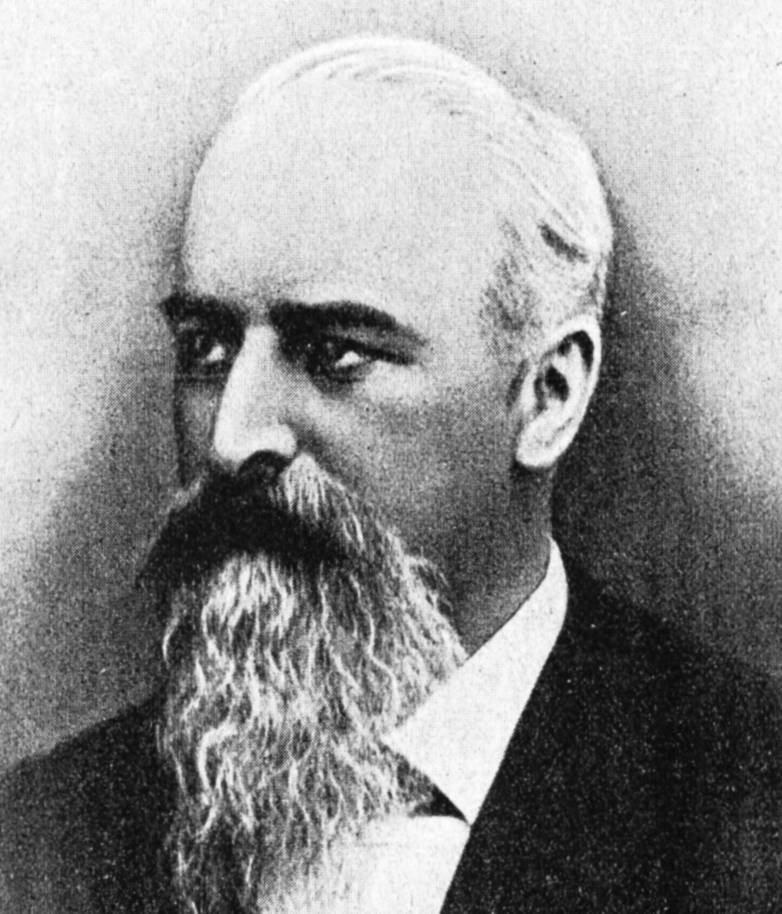
Gustave-Adolphe Huguenin, horloger (1813-1895)

Origins and Foundation of his Workshop

Gustave-Adolphe Huguenin was born on May 19, 1813, in Les Ponts-de-Martel, a village in the canton of Neuchâtel where he passed away on September 12, 1895. Initially a schoolteacher, he quickly abandoned teaching to dedicate himself to the watchmaking industry, founding an établissage workshop in his native village. As early as the 1840s, he appeared in registries as a watchmaker and merchant. In 1859, bolstered by his reputation as a manufacturer and trader, he had a large house-workshop erected to the west of the village’s main square. Deeply attached to the Plymouth Brethren movement (Darbyists), Huguenin reserved the top floor of this building as a community place of worship. His workshop became a true local economic driver, providing employment for numerous watchmakers in Les Ponts-de-Martel.

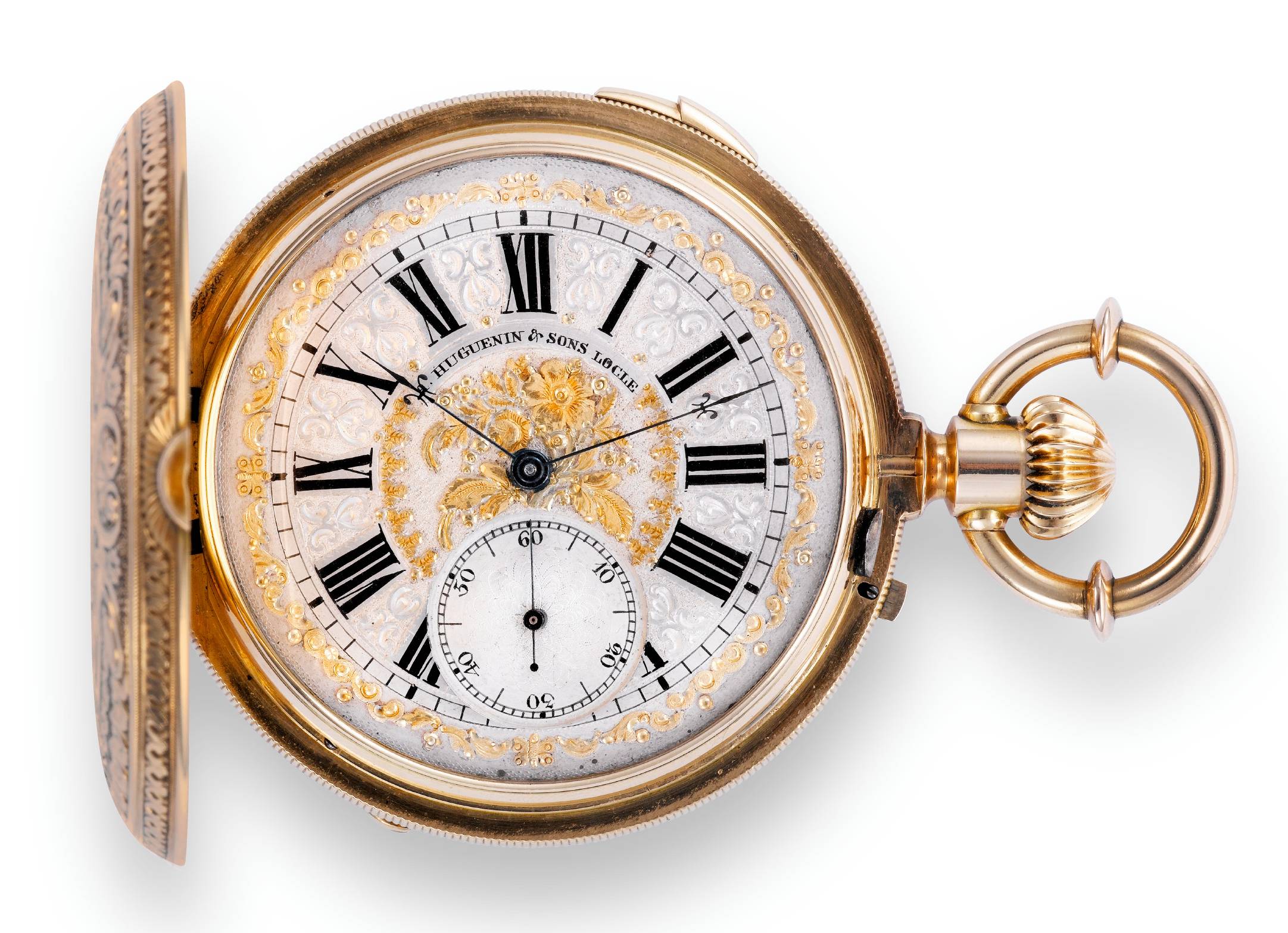
Gustave-Adolphe Huguenin hunter-case pocket watch No. 42610, 18K gold three-lid case, with a DB master mark in an oval cartouche. Lenticular profile case with a high middle case and fluted crown, entirely covered with a hand-chiseled and guilloché decoration of exceptional density and finesse of execution: the upper cover features a central medallion with a finely chiseled wild animal head in high relief, framed by concentric zones alternating radiating geometric guilloché, star motifs, and scrollwork volutes, while the back displays a central floral medallion—a bouquet of blooming flowers in high relief—surrounded by the same neo-Rococo decorative vocabulary. Photo courtesy of © http://www.antiguedades.es/
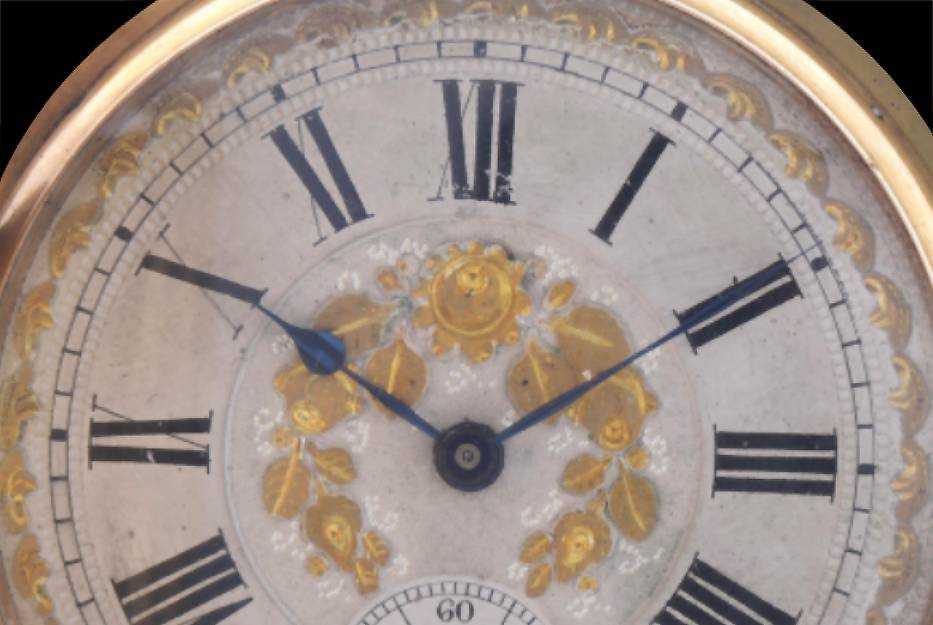
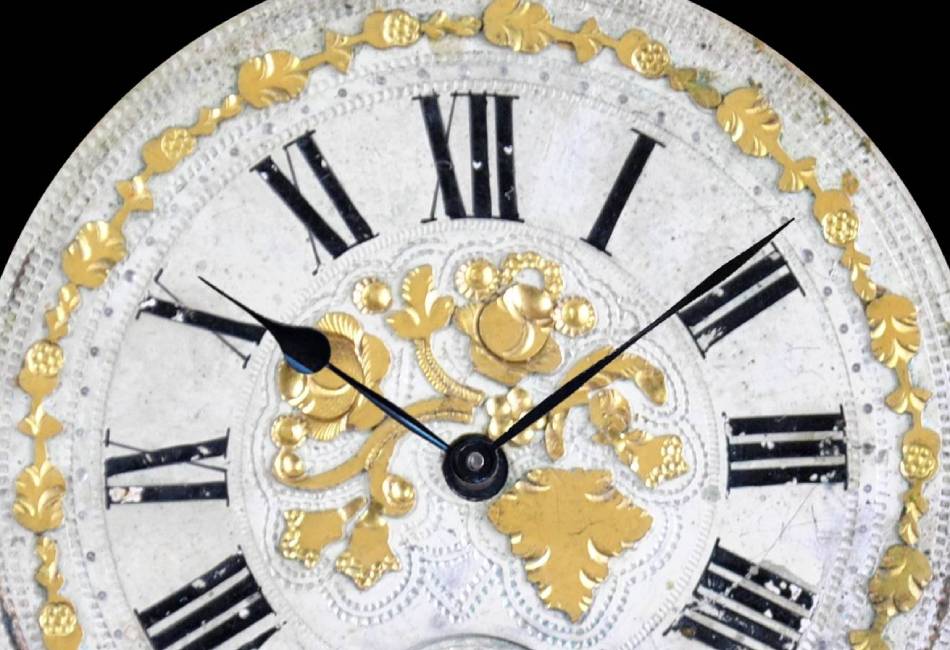
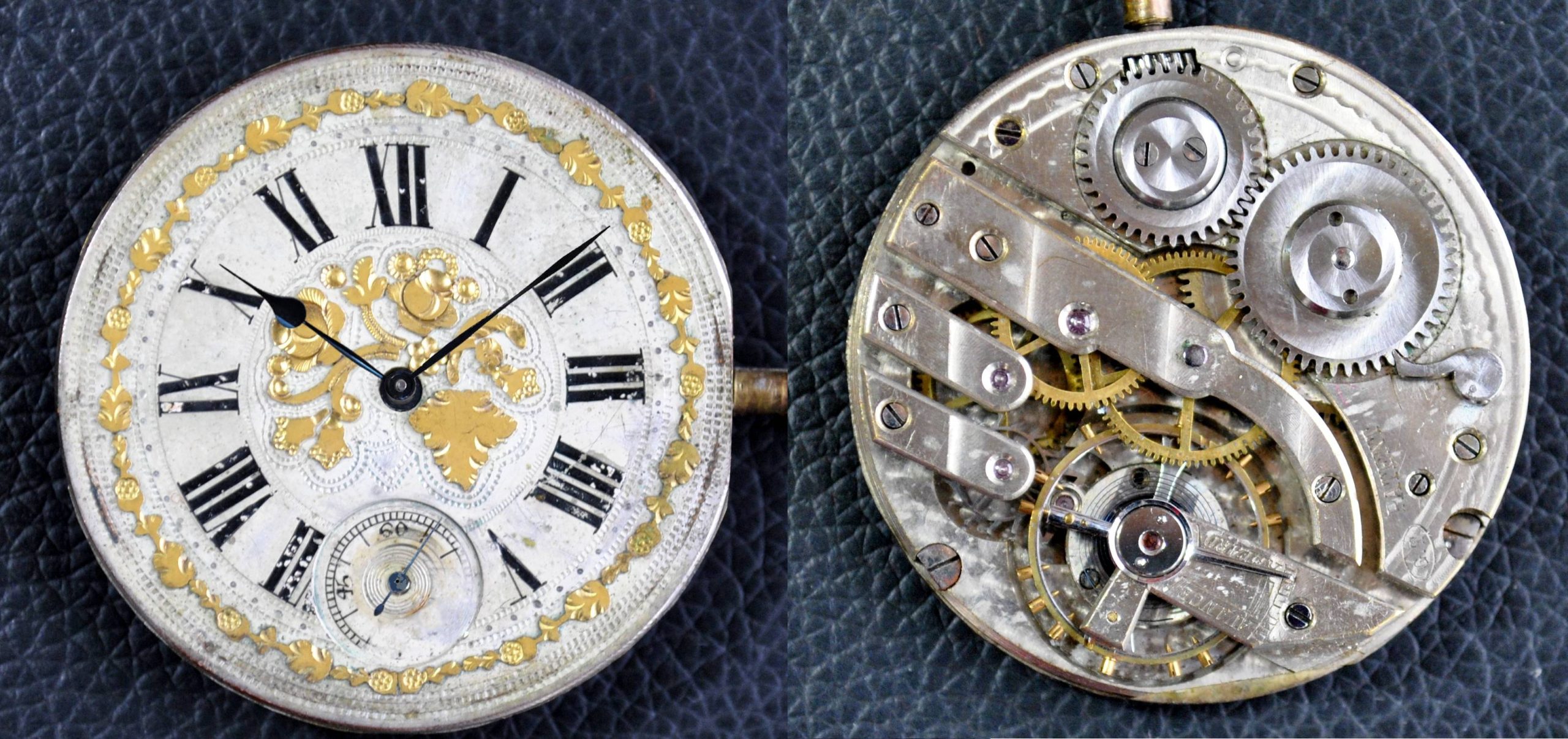
Gustave-Adolphe Huguenin pocket watch, Les Ponts-de-Martel, No. 42610, c. 1867, predating the establishment of the G. A. Huguenin & Sons company. Victorian "genre Espagne" dial with a silvered ground, chiseled exclusively in the central zone around the gold micro-relief motif, with the hour field and periphery remaining smooth, adorned with blued-steel fleur-de-lys hands. 15-jewel three-quarter bridge plate movement of classic Jura construction—characteristic architecture of the Neuchâtel school—key-wind and key-set caliber with a safety plug functioning as a key ferrule, equipped with a straight-line lever escapement with visible pallets and a bimetallic cut compensation balance with screws. Pivoting on single pierced rubies, with the exception of the balance staff mounted on a counter-pivot.

A Family Business

The business relied on family expertise closely distributed among his children: Georges worked as a winder (remonteur), César as an inspector (visiteur), responsible for quality control of subcontracted work, while their sister Emma supervised precision adjustments.

Commercial Expansion and International Reach

The firm specialized in the manufacture of high-quality pieces with meticulous finishing, securing a very select clientele abroad, primarily within the noble courts of Spain and Portugal.

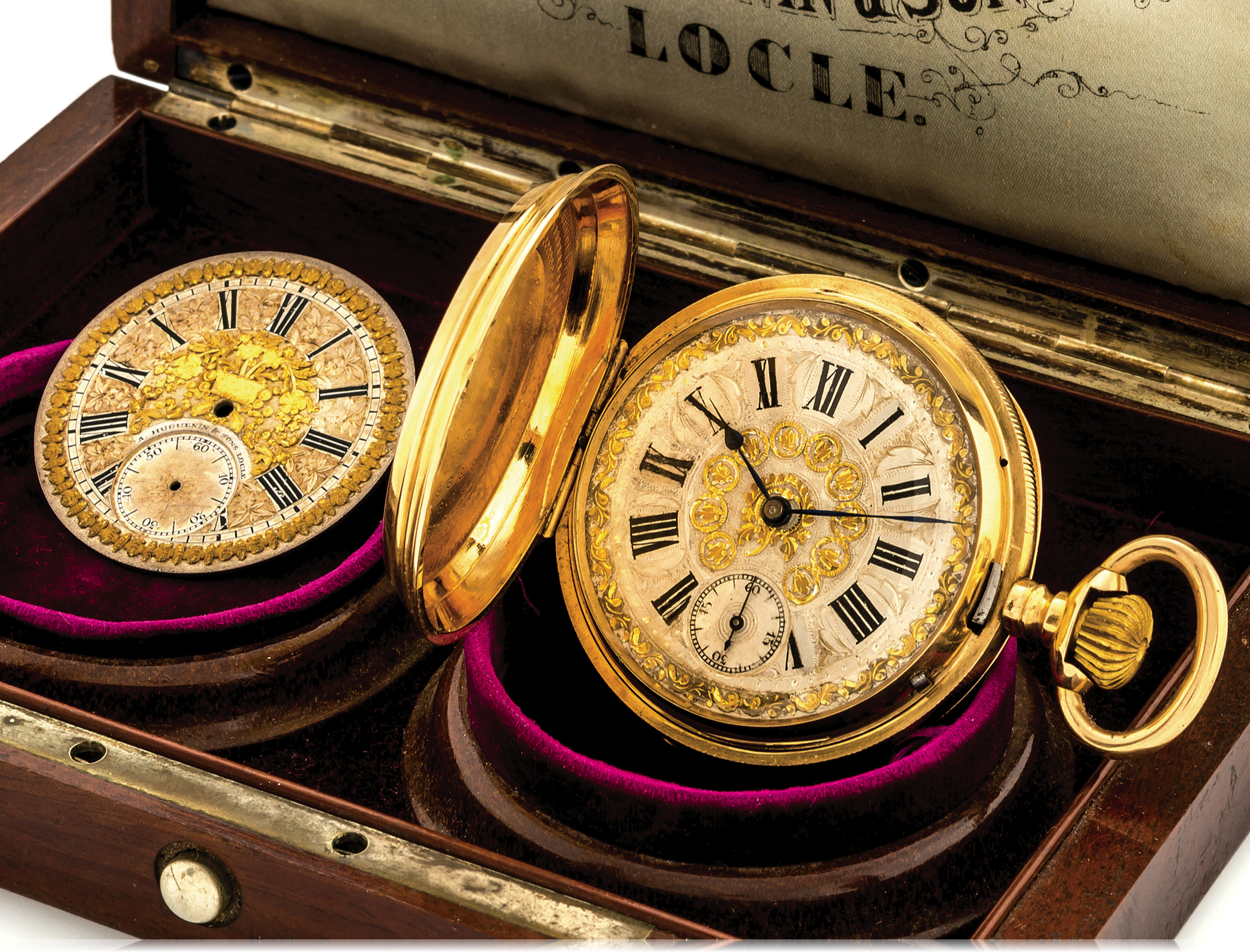
G. A. Huguenin & Sons hunter-case pocket watch, Les Ponts-de-Martel, Neuchâtel, Switzerland, No. 55596, c. 1873. 18K gold three-lid hunter case, case punched with a JV mark in a rectangular cartouche, featuring guilloché and black enamel decoration, adorned in the center with a jewelry motif set with rose-cut diamonds. Victorian "genre Espagne" dial remarkable for its finely stipple-chiseled ground, offering a matte and granulated texture that highlights delicate engraved interlaces between the hours and floral motifs in gold relief, with blued-steel Poiré Stuart hands. 15-jewel three-quarter bridge plate movement of classic Jura construction—characteristic architecture of the Neuchâtel school, distinct from the full-plate English tradition—key-wind and key-set caliber, equipped with a straight-line lever escapement with visible pallets, a index regulator, and a pseudo-compensated balance with screws (continuous uncut ring), pivoting on pierced rubies set under screwed gold chatons, with blued-steel screws on the gilt-brass plate. Photo courtesy of © http://www.antiguedades.es/
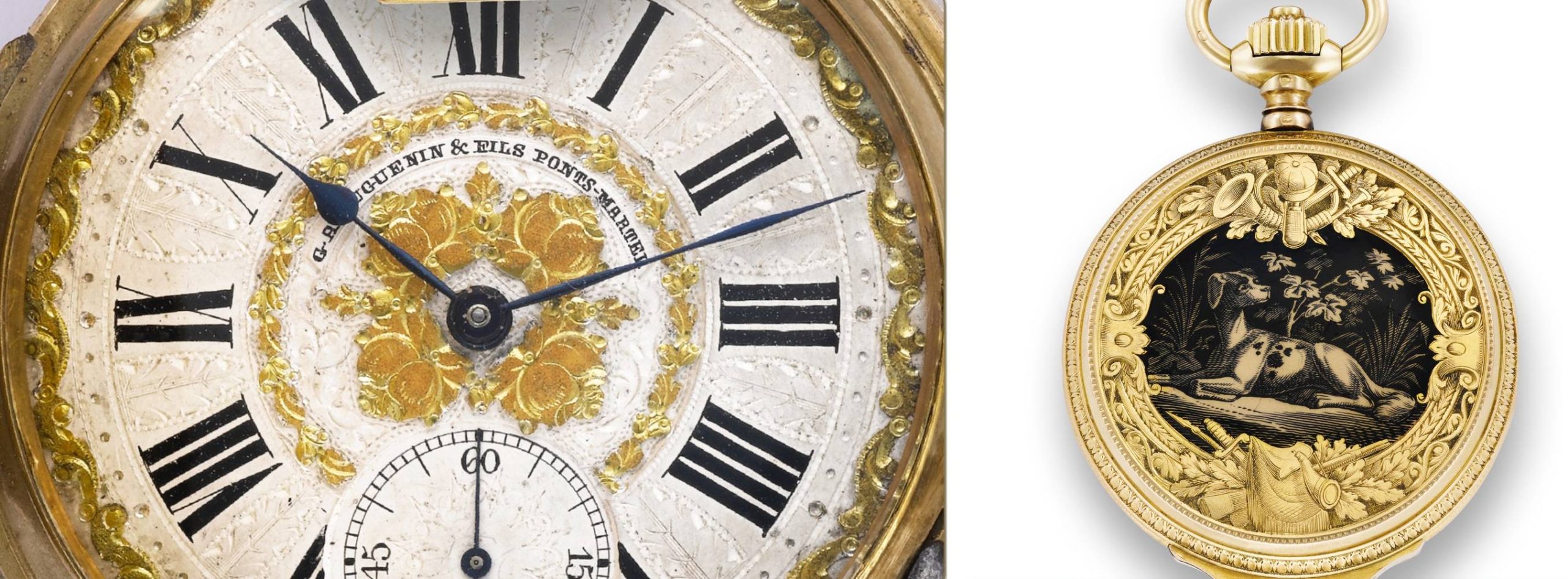
G. A. Huguenin & Sons, Les Ponts-de-Martel, No. 143662, c. 1885. Destined for the Spanish-speaking market, this very fine and heavy yellow 18K gold and black enamel hunter-case pocket watch features a pendant-wind system. Its four-body "bassine et filets" case features covers centered with black enamel painted scenes depicting, on the upper cover, a resting hunting dog, and on the back, dead game lying near a tree trunk, the whole surrounded by a rich floral decoration engraved with hunting motifs, with a finely guilloché middle case and a hinged gold cuvette. On the dial side, the silver "genre Espagne" dial features a chapter ring with painted black Roman numerals, a sunken subsidiary seconds dial at 6 o'clock, and a center occupied by a magnificent mercury-gilded copper floral motif composed of small stamped micro-relief shapes standing out against a silver background delicately engraved with a graver, while the outer border is enhanced with a rich matching peripheral garland in gilt copper, the whole swept by elegant blued-steel Poiré Stuart style hands. The 45 mm (20-ligne) nickel silver (maillechort) movement features a sunburst-engraved decoration and 15 jewels. This caliber is equipped with a straight-line lever escapement, a bimetallic cut compensation balance with screws, and a blued-steel flat balance spring. Case, dial, and movement signed. Diameter: 53 mm. Photo courtesy and © https://www.antiquorum.swiss/
Rounding-Up Machine (Machine à arrondir). A brass and steel workshop tool on a wooden base, which belonged to Gustave-Adolphe Huguenin. Intended for the final rectification of gears, this machine made it possible to perfect the outer diameter, concentricity, and cycloidal profile of brass wheel teeth in order to optimize meshing and reduce friction within the movement. (Photo: Heidi Viredaz-Barder).

The “G. A. Huguenin & Sons” Company and Its Awards

Around 1872, the family firm was officially established as a general partnership under the business name G. A. HUGUENIN & FILS, associating Gustave-Adolphe with his sons Georges and César. Under this structure, the manufacture reached the highest pinnacles of international prestige, obtaining major distinctions in high chronometry:

  • 1885 — Second prize at the chronometry competition of the Neuchâtel astronomical observatory, for a pocket watch equipped with a tourbillon escapement and a perpetual calendar, regulated by master adjuster U. Wehrly.

  • 1877 — Bronze medal at the Paris Universal Exposition.

  • 1888 — Gold medal at the Barcelona Universal Exposition, consecrating the house’s renown on the Spanish market.

  • 1889 — Second prize at the chronometry competition of the Neuchâtel Observatory, for a pocket watch with a pivoting-detent (à bascule) escapement.

Despite this prosperity, the firm suffered serious financial setbacks: the cyclical crises of the era, the loss of assets in Spain following an unsuccessful debt-collection mission entrusted to his younger son, Philémon, and the shipwreck in the Mediterranean of a valuable consignment of pocket watches.

G.A. Huguenin & Fils 74785 pocket watch
G. A. Huguenin & Sons movement, Les Ponts-de-Martel, No. 74785. 19-ligne. Victorian "genre Espagne" dial with a silvered ground finely chiseled with geometric scrollwork in the shape of inverted spades—resembling hearts—beneath each inter-hour space, the central gold micro-relief decoration depicting a basket or overflowing flower basket filled with roses, surrounded by a gilt peripheral garland featuring alternating rosette motifs, with Roman numerals painted in lampblack. Pendant-wind caliber, hand-set via a pusher at 4 o'clock, and straight-line lever escapement, distinguished by the high quality of its ruby counter-pivot on the balance staff. (Author's collection).
G.A. Huguenin & Fils no. 127576 pocket watch
Savonnette G. A. Huguenin & Fils, Ponts-de-Martel, 19 lignes, n° 127576, circa 1882, trois couvercles en or 18 carats, poinçon Helvetia — attestant une fabrication postérieure à la loi de 1880 sur le contrôle des métaux précieux —, boîtier de profil lenticulaire à carrure lisse et couronne cannelée, dont le couvercle supérieur présente une ornementation d'exception à deux registres : un fond entièrement couvert de rinceaux et motifs foliacés finement ciselés en or, au centre duquel s'inscrit un médaillon ovale en niello noir représentant un sanglier en mouvement, encadré d'un second médaillon en niello à décor d'oiseau et fleurs. Cadran victorien « genre Espagne » à fond argenté entièrement ciselé, motif central en microrelief doré de grande densité et guirlande périmérique dorée, chiffres romains peints au noir de fumée et aiguilles Poiré Stuart en acier bleui, signé G. A. Huguenin & Fils / Ponts-Martel. Mouvement 16 rubis à ponts, calibre remontoir au pendant, échappement ancre ligne droite, spiral Breguet. Photo courtoisie de © https://www.antiguedadestecnicas.com/
G. A. Huguenin & Sons pocket watch movement, Les Ponts-de-Martel, No. 89584, 19-ligne, c. 1878, preserved in a transparent PVC technical case. Victorian "genre Espagne" dial with a silvered ground entirely chiseled—featuring three-tier concentric increasing spiral motifs occupying each inter-hour space, accompanying a central gold micro-relief motif and a gilt peripheral garland—with Roman numerals for the hours and Arabic numerals for the subsidiary seconds, hand-painted in lampblack, with blued-steel Poiré Stuart hands. Bridge-plate movement of classic Jura construction. Pendant-wind caliber and hand-set via a pusher at 4 o'clock. Equipped with a straight-line lever escapement with visible pallets and a steel pallet fork, and a bimetallic continuous uncut balance with screws, flat balance spring, and index regulator with a graduated scale. Pivoting on single pierced rubies, with the exception of the balance staff mounted on counter-pivots. Author's collection.

Dissolution and the San Sebastián Branch

With advancing age, Gustave-Adolphe retired from business. The general partnership was officially dissolved on May 13, 1892: the liquidation of the Les Ponts-de-Martel headquarters was entrusted to Georges, while that of the Barcelona branch fell to César.

The latter had settled permanently in Spain due to the watchmaking crisis of the 1880s in the Jura, founding a renowned watchmaking business in San Sebastián. Married to Emma Tissot-Daguette—daughter of the founder of the Charles-Félicien Tissot manufacture in Le Locle—they commercialized their own brand “Huguenin-Tissot / Genève”, but he passed away there on November 22, 1893.

Following his death, his eldest son, Henri Huguenin, took over the family business in San Sebastián. The continuity of the Swiss watchmaking trade in the city was subsequently ensured by the latter’s brother, César Huguenin, who worked there until his death in 1986, thereby closing the chapter on this branch of the Huguenin lineage in Spain.

Auguste Huguenin (Bergenat)

Master Watchmaker of Le Locle and Complication Innovations

His “Genre Espagne” Pocket Watches

Origins and Foundation of the Firm

Auguste Huguenin-Bergenat was born in 1808 in the Neuchâtel canton, hailing from a lineage of watchmakers firmly rooted in the mountains of the Swiss Jura. His paternal grandparents, Isaac Huguenin-Bergenat and Marie Elisabeth Huguenin, had established the family in this region where watchmaking had long constituted the dominant economic activity. His father, Charles Henry Huguenin-Bergenat (1769–1835), and his mother, Judith Marie Jaquet (born 1778), transmitted this artisanal heritage to him. On May 15, 1831, the banns of his marriage to Julie Nussbaum (1811–1871) were published in La Chaux-du-Milieu, thus founding the household that would give rise to the watchmaking firm. Auguste settled in Le Locle, where he developed a watchmaking merchant and manufacturing business, specializing in precision watches with timing certificates (bulletins de marche), complications—music, automata, indicators, thermometers, perpetual calendars, moon phases—as well as in the manufacturing of chronometers.

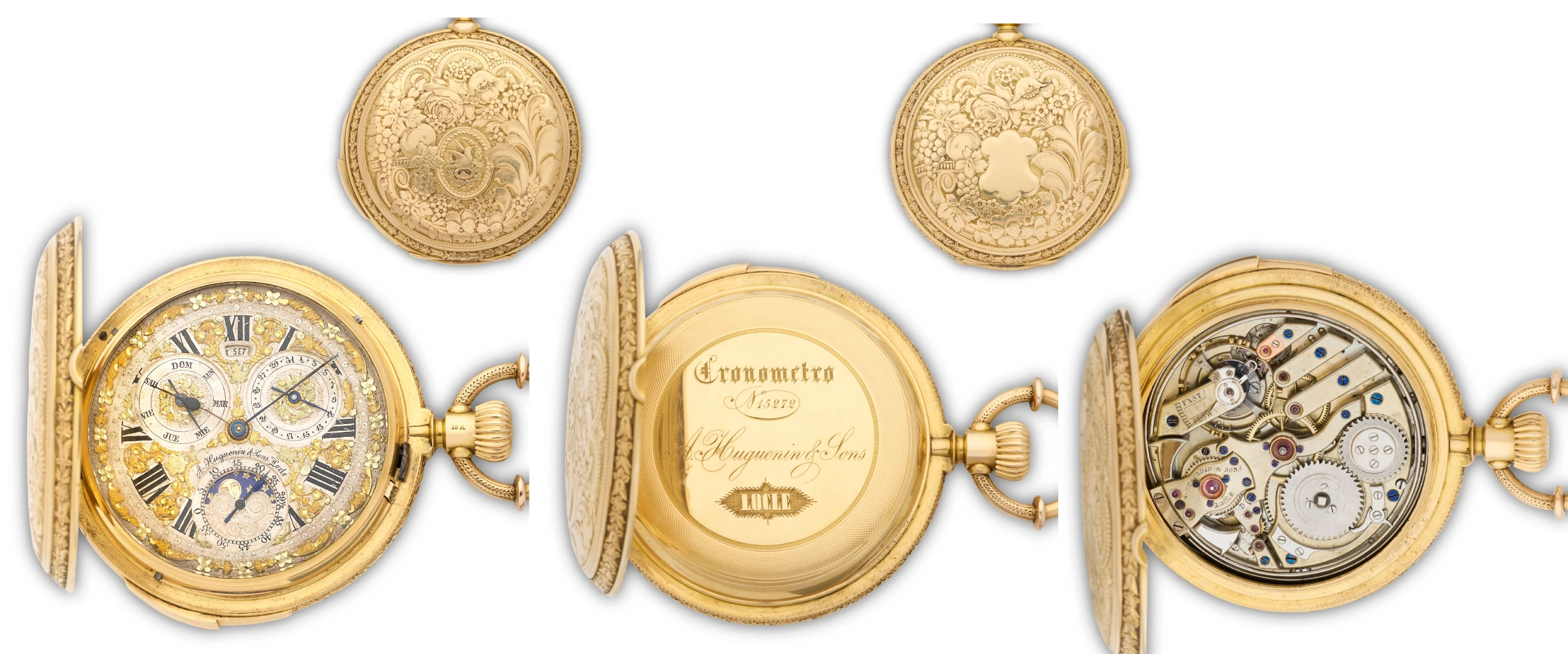
Auguste Huguenin & Sons pocket watch, Le Locle, No. 15272, c. 1875. Intended for the Spanish-speaking market, this highly remarkable and heavy hunter-case quarter-repeating pocket watch with triple calendar and moon phases in 18K yellow gold features a pendant-wind system and hand-set via a side lever and crown. Its hunter case, measuring 54 mm in diameter, features covers entirely and richly engraved with scrollwork, the front cover centered with a rocaille-style cartouche left blank for initials while the back cover is centered with a second cartouche housing a symbolic dove in flight, all complemented by a case band and bezels chiseled with floral motifs, a slide lever on the case band at 6 o'clock, and a gold cuvette mounted on a hinge engraved in Gothic lettering with the inscription "Cronometro" surmounting the manufacturer's signature. On the dial side, the silver dial features an outer track with painted black Roman numerals, a peripheral minute track with silver dots, and subsidiary dials and apertures with indications in Spanish: the day of the week at 12 o'clock ("DÍA"), the date at 3 o'clock ("FECHA"), the month at 9 o'clock ("MES"), and the moon phase combined with the subsidiary seconds at 6 o'clock ("SEGUNDOS"). The center and periphery of the composition are occupied by a sumptuous two-color gold scrollwork and foliage decor applied and stamped in micro-relief, displayed against a silver ground delicately hand-engraved with a burin, the whole swept by elegant blackened-steel "Poiré Stuart" hands. The 19-ligne bridge movement features a Côtes de Genève (fausses côtes) decoration; its gear train is jeweled with single pierced stones, while the escapement is mounted in chatons and the balance staff is equipped with double counter-pivots. This caliber incorporates a straight-line lever escapement, a bimetallic cut compensation balance with screws, and winding wheels with wolf-tooth gearing, featuring a quarter-repeating mechanism striking on a gong via two polished hammers. Hunter case, dial, and movement signed. Photo courtesy and © https://www.bonhams.com

A Family Business

From his union with Julie Nussbaum were born ten children, including several sons who progressively joined the paternal workshops: Fritz Henri (1832), Louis (1835), William Edouard (1838), Henri Tell (1840), Charles Henri (1842), Edouard (1848), and Jules Auguste (1850). This growing family presence was naturally reflected in the evolution of the company name: the original brand A. HUGUENIN / LOCLE, bearing the sole founder’s name, gave way to A. HUGUENIN & SON / LOCLE upon the incorporation of the first sons of working age, before formally constituting itself as A. HUGUENIN & FILS / LOCLE when several of them joined the management of the firm.

1880. Advertising announcement by A. Huguenin & Fils.
Official trademark registration No. 35, filed in 1881. The logo of A. Huguenin & Fils (indicated as A. Huguenin & Sons - Locle on the interlaced ribbon graphic for the export market) is intended for watches and chronometers.

Technical and International Outreach

The firm distinguished itself through a sustained presence at the chronometry competitions of the Neuchâtel Astronomical Observatory between 1871 and 1879, where it regularly submitted pocket watches and marine chronometers with lever, pivoted detent (à bascule), and spring detent escapements, obtaining results that confirmed its technical standard. In 1877, at the Philadelphia Exhibition, the firm presented a remarkable piece: a tourbillon escapement watch whose mechanism was arranged in such a way as to neutralize all variations resulting from changes in the instrument’s position. This demonstration of chronometric mastery was crowned with an Honorable Mention in Paris in 1867. Concurrently, the firm developed a strong international presence, notably maintaining a branch in Melbourne, Australia, specializing in fine and complicated watchmaking, repeaters, and chronograph-counters.

Auguste Huguenin & Sons pocket watch, Le Locle, No. 14947, c. 1876. Intended for the Spanish-speaking market, this very fine, large, and heavy hunter-case pocket chronometer in 18K yellow gold features a pendant-wind system and a hand-set mechanism via a pusher on the case band. Its four-body bassine et filets case features massive covers entirely and richly engraved with scrolls and floral motifs, the front cover centered with a blank cartouche for initials, with a finely guilloché case band and a gold cuvette mounted on a hinge. On the dial side, the "genre Espagne" silver dial features an outer track with painted black Roman numerals and a recessed subsidiary seconds dial at 6 o'clock. The center of the composition is occupied by a magnificent gilt-copper (ormolu) floral motif composed of small stamped forms in micro-relief standing out against a delicately engraved ground, while the outer border is enhanced by a rich matching peripheral gilt-copper garland, the whole swept by elegant blued-steel "fleur-de-lys" hands. The nickel-silver (maillechort) movement features a three-quarter plate architecture with Côtes de Genève (fausses côtes) decoration and has 19 jewels. This high-precision caliber is equipped with a fusee-and-chain transmission system, a spring detent escapement, a bimetallic cut compensation balance with screws, a blued-steel flat balance spring, and screwed gold chatons. Case, dial, and movement signed. Diameter: 55 mm. Photo courtesy and © https://www.antiquorum.swiss/

The “A. Huguenin & Fils” Company and Its Trademark

In November 1880, the company name was officially registered under trademark No. 35: A. Huguenin & Fils, Locle, with its headquarters established at 275 rue de l’Hôtel-de-Ville in Le Locle. Among the sons, William Edouard Huguenin-Bergenat (1838–1888) played a decisive role in the firm’s technical expansion, notably through the acquisition of American patents relating to repeating mechanisms in 1881–1882, reflecting a commercial ambition geared toward Anglo-Saxon markets.

Dissolution

The decline of the firm was precipitated by the successive passing of its driving forces: William Edouard passed away in 1888 and Charles Henri in 1890. From this period onward, all trace of the firm disappears from watchmaking directories. Trademark No. 35 was finally canceled in May 1901 by the Swiss Trademark Office due to non-renewal upon the expiration of the twenty-year legal period—as no heir requested its extension, thus definitively closing the history of this branch of the Huguenin lineage in Le Locle.

Note: The firm A. Huguenin & Fils of Le Locle, founded by Auguste Huguenin-Bergenat, must not be confused with the firm A. Huguenin Fils of Bienne, founded by Alfred Huguenin (Virchaux)—a distinct entity both in its familial origins and its geographical establishment.

GEDEON THOMMEN

His “Genre Espagne” Pocket Watches

The Visionary Who Industrialized the Waldenburg Valley

Historical Context: The Crisis of the Waldenburg Valley

In the mid-19th century, the Swiss Waldenburg valley faced a profound economic and social crisis. The opening of new Swiss railway lines diverted the historical commercial traffic that previously crossed the Upper Hauenstein Pass (Obern Hauenstein), leaving the region completely isolated. This caused mass unemployment, poverty, and an alarming wave of emigration to America. To counter this situation, local authorities founded in 1853 the Société d’Horlogerie à Waldenburg, a municipal project aimed at generating employment through watch manufacturing. However, the disorganization of the hired French-speaking master watchmakers (les Welschen) and the lack of experience turned the initiative into a true financial disaster, accumulating debts that aggravated the local crisis.

Gédéon Thommen pocket watch, 19-ligne, bearing the brand "Gedeon Thommen" engraved on the plate. Victorian "genre Espagne" dial on a silver ground with gold micro-reliefs, featuring a central ground delicately hand-engraved with a burin, and unadorned inter-hour spaces. Poiré Stuart hands, painted black Roman numerals, and stamped dots for the minute track. Pendant wind and hand-set via the pendant located at 3 o'clock. Bridge-plate movement with a jeweled gear train (single pierced stones), except for the center wheel, and double jeweled with counter-pivots for the balance staff. The regulating organ comprises a lever escapement and a simple bimetallic compensation balance with timing screws, equipped with a flat balance spring and an index regulator with a graduated scale. Author's collection.
Gedeon Thommen (1831-1890)

Gedeon Thommen: From Accounting to Industrial Control (1855–1859)

Gedeon Thommen (1831–1890), a young merchant with a solid education and son of the president of the Cantonal Court, was hired in 1855 to straighten out the chaotic accounting books of the deficit-ridden municipal company. Far from limiting himself to his initial assignment, Thommen glimpsed the potential of the manufacture. In 1859, alongside Louis Tschopp, he decided to buy the factory from the municipality by taking over all of its debts. Shortly thereafter, he became the sole owner of the enterprise, renaming it Gedeon Thommen Uhrenfabrikation.

Thommen’s Industrial Revolution

Once at the helm of the company, Thommen implemented radical changes that transformed artisanal production into a semi-industrial model:

  • Mechanization and Interchangeable Components: He designed and implemented precision machinery to manufacture components in series. For the first time in the region, parts were interchangeable, which optimized production times, reduced costs, and increased the reliability of the mechanisms. Around 1870, his factory already employed nearly 400 workers and produced 4,000 watches per year, an infrastructure that laid the foundations enabling the manufacture to reach a production of 200,000 annual units in the 20th century.

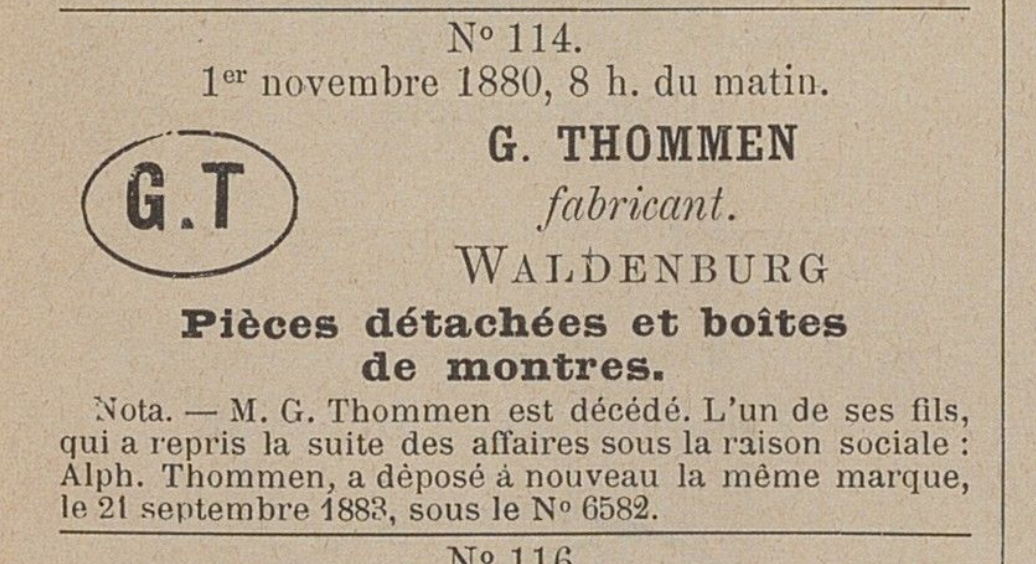
    The Identity Punch (1880): In November 1880, Thommen officially registered his identity trademark: the initials G.T. inscribed within an oval, engraved on the movements and cases of his watches.

    Avant-Garde Patents (1889): Following the entry into force of the Federal Law on Patents in Switzerland, Thommen protected his most critical innovations with serial numbers from the very first era:

    • Dust Protection (Patent CH930A): A device at the pendant level to hermetically seal the interior of the case, a crucial innovation for export watches destined for rural environments or heavy usage (such as the Hispanic market).

    • Improvement of the Pivoted Detent / Rocker (bascule) (Patents CH931A, CH1027A, CH1028A): Mechanical improvements of the spring and bridge of the bascule (pivoted winding mechanism), allowing a smooth transition between winding and hand-setting, thereby preventing the breakage of pinion teeth.

Breaking Isolation: The Waldenburg Railway

Thommen understood that mass production required an efficient logistical solution. To this end, he presided over, financed, and drove the creation of the Waldenburgerbahn, a narrow-gauge railway line (75 cm in width and 13.51 km in length). As confirmed by the document 1883 Gedeon Thommen Waldenburgerbahn-Gesellschaft.jpg, he held the position of president of the company’s board of management. Inaugurated for passenger transport on November 1, 1880, this infrastructure broke the valley’s isolation and allowed watches to quickly reach international markets, notably the Spanish and Hispanic-American markets. The impact of his leadership was such that one of the line’s locomotives was named in his honor.

"G.T." inscribed within a horizontal oval; the Gedeon Thommen trademark

A Rapid Industrial Growth: Key Production Figures

For historians and brand enthusiasts, the evolution of production volumes reflects the spectacular industrial rise of the manufacture. Founded in 1870, the factory of Mr. G. Thommen already displayed a production of over 6,000 watches by 1872. Barely three years later, in 1875, this volume more than tripled to exceed 20,000 pieces. The peak of this growth was reached in 1883, a year in which production rose to 50,000 watches, representing an impressive average pace of 14 dozen timepieces per working day. Faced with this growing distribution, the establishment had to construct a new and vast building equipped with a fifteen-horsepower steam engine to supply the necessary motive power, definitively marking the transition from the traditional workshop to the power of large-scale watchmaking industry.

International Recognition and Trademark

The merit and quality of G. Thommen‘s factory production were officially consecrated by prestigious awards obtained at the Universal Exhibitions of Vienna (1873), Paris (1878), and Amsterdam (1883), as well as at the Zurich National Exhibition (1883). These top-tier distinctions directly contributed to establishing the international reputation of its products, recognized henceforth worldwide under the famous GT trademark.

The Elite of Swiss Watchmaking at the Service of Thommen’s Prestige

The technical prestige of the Waldenburg manufacture reached new heights in the late 1880s, to the extent that the most renowned master watchmakers and traders of the era did not hesitate to submit pieces based on the house’s blank movements (ébauches) and mechanisms to the highly demanding chronometry competitions of the Neuchâtel Observatory. Thus, prestigious firms such as J. Rauschenbach (Schaffhausen), Grosjean & Cie (La Chaux-de-Fonds), Rod. Uhlmann (Geneva), Reichen-Guinand (Les Brenets), Maurice Woog (La Chaux-de-Fonds), Schoechlin & Cie (Bienne), or G. Borel (Neuchâtel) — presenting pieces explicitly “manufactured by A. Thommen, Waldenbourg” — relied on Thommen‘s unique know-how to compete at the highest level of Swiss horological precision.

The Legacy of Revue Thommen

Following Gedeon’s passing in December 1890, his son Alphonse Thommen took the reins of the manufacture in 1893. Under his leadership:

  • The commercial brand “Revue” was developed and widely registered for its own cylinder and lever calibers.

  • In 1905, the family business transformed into a public limited company (société anonyme), formally adopting the name Revue Thommen AG in 1908.

Two Pillars of Global Prestige

Throughout the 20th century, the firm solidified its position in two domains of technical excellence founded on precision micromechanics:

  • Precision Watchmaking: Celebrated for its robust wristwatches, military-issue pieces (notably under the Revue-Sport brand during the Second World War), and mechanical alarm models (such as the famous Cricket caliber, shared in its time with Vulcain).

  • Aeronautical Instrumentation: Starting in 1916, the firm manufactured the first aviation chronograph for the Swiss Air Force. From the 1920s onward, this division developed the production of altimeters, air-speed indicators, and dashboard chronographs, becoming a leading supplier for civil and military aviation on a global scale.

Gedeon Thommen’s Legacy Today

Following the dissolution of the MSR group in the year 2000, Thommen‘s industrial heritage remains fully active through two entirely independent corporate entities:

  • Watchmaking (GT Thommen Watch AG): It operates under an independent production and distribution regime in Switzerland. Following a licensing period with Grovana AG (2001–2014), full circle has been achieved: the brand has officially returned to the founding family under the leadership of Andreas Thommen (representing the fifth generation). Today, it maintains a solid presence on the international market, focused on the revitalization of its flagship aviation collections (Airspeed), diving watches (Diver), and historical mechanical calibers.

  • Aeronautical Instrumentation (Thommen Aircraft Instruments AG): As the direct industrial heir to the original site in Waldenburg, it is today part of TransDigm Group Inc. (an American multinational listed on the New York Stock Exchange). It continues to operate from Switzerland as a leader in the manufacture of high-technology chronological equipment, Air Data Computers, and flight instrumentation systems for aircraft worldwide.

The horological soul of Gedeon Thommen continues to beat on the wrists of collectors, while his technical vision flies on the instrument panels of the world’s most advanced airplanes and helicopters. His history remains the perfect example of how innovation, resilience, and technical rigor can transform a profound crisis into an enduring industrial legacy.

Circular black-and-white seal featuring the name Ramón Campos, researcher of 19th-century Swiss watchmaking and early fountain pens.