His “Genre Espagne” Pocket Watches
The Spanish watchmaker who made history
José Rodríguez de Losada introduced these dial motifs in Spain during the 1840s, whereas Swiss “genre Espagne” production did not become widespread until around 1860. The Helvetic adoption of this aesthetic appears to respond to the high regard enjoyed by the small number of handcrafted pieces signed by Losada on the Spanish-speaking market, thereby meeting the demand unsatisfied by the short production run of the master from León and massively supplying the said market. Losada’s dials are fixed to the plate using three positioning feet, unlike Swiss dials, which employ only two.
Introduction: The Context of an Innovator in Exile
José Rodríguez de Losada, born on March 19, 1801 in Iruela (León, Spain) and died on March 6, 1870 in London, was a Spanish watchmaker, liberal, and entrepreneur “whom the political turbulence of his homeland cast to seek asylum abroad,” in his own words. His life was therefore marked by exile, technical innovation, and a decisive contribution to precision watchmaking in Spain. The son of Miguel Rodríguez and María Conejero, his legacy ranges from marine chronometers to the iconic clock of the Puerta del Sol in Madrid—the symbol of the Spanish New Year’s Eve tradition of the twelve chimes at midnight—as well as his pocket watches, which were his production par excellence.
His journey reflects that of a brilliant self-taught watchmaker, capable of moving from the military to become one of the most respected horologists of his time, earning distinctions such as the Order of Charles III (1854) and the title of Honorary Chronometer Maker to the Spanish Navy (1856). His story is also that of a political exile who, fleeing the absolutist persecution of Ferdinand VII, found in London the ideal setting to develop his mechanical and commercial genius.
Military Career and First Contact with Horology He appears in Madrid, enlisted as an officer in the Spanish army during the Liberal Triennium (1820–1823). His participation during this period earned him the decoration of Knight of the Order of Charles III by royal decree. However, his liberal ideals made him a target of persecution during the decade of Fernandine absolutism, during which J. R. Losada appears to have been involved in various liberal revolts or conspiracies. In 1828, he fled to France and subsequently, in 1830, to London—one of the preferred destinations for Spanish liberal exiles, thanks to the Victorian decree of asylum and the support of the Émigré Relief Committee.
The Historical Recognition and Technical Mastery of José Rodríguez de Losada
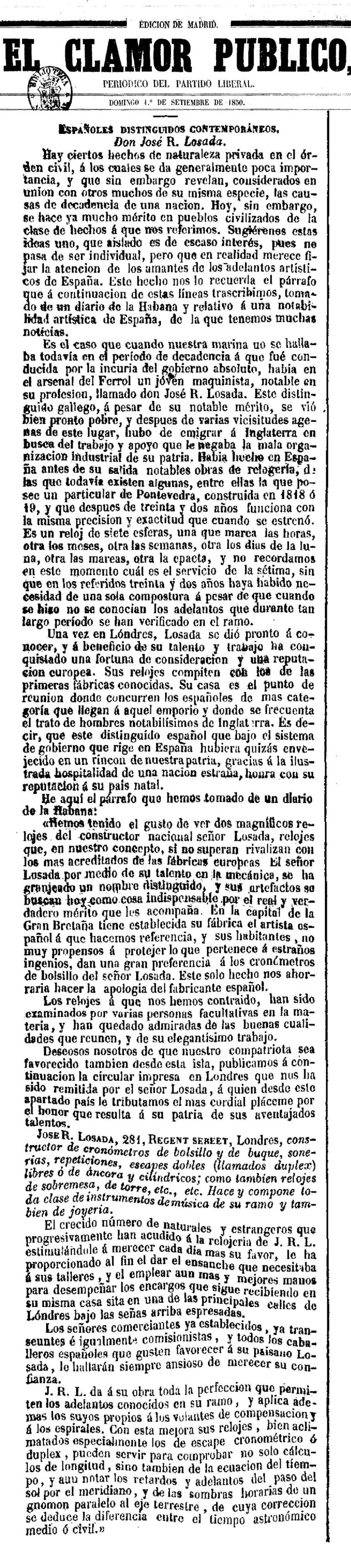
Facing unfounded doubts about the true capability of José Rodríguez de Losada and his role as an authentic artisan of his work, original period sources undeniably demonstrate his status as a master watchmaker and constructor. As early as 1859, contemporary publications such as El Clamor Público—echoing chronicles from Havana—emphasized that the prestigious Galician craftsman, established at 231 Regent Street in London, personally designed, manufactured, and constructed all kinds of precision instruments, ranging from complex pocket and marine chronometers to repeater clocks and tower clocks. These same sources recalled that before exiling himself due to the political turbulence of his homeland, Losada had already built remarkable horological works in Spain, such as that famous seven-dial pendulum clock manufactured in 1818 or 1819, which operated with absolute accuracy after more than three decades without requiring a single repair.
The technical mastery of the Leonese artist was also officially sealed in his relations with the scientific institutions of the Spanish State, as evidenced by the contract formalized in London on May 6, 1865, with the San Fernando Astronomical Observatory. By virtue of this institutional agreement, and at the request of a royal decree issued in 1864, Losada himself committed to supplying fifteen chronometers of his best manufacture—ten eight-day and five two-day run—which were to be subjected to rigorous rating tests for a year and a half in order to guarantee their extreme precision in the calculation of longitudes and timekeeping. Far from being a mere intermediary, José Rodríguez de Losada consolidated a manufacture of European prestige in the British capital, endorsed by scientific rigor and the unanimous recognition of expert panels.
Consolidation: Entrepreneur and Marine Chronometer Maker. Settlement in London and Intellectual Tertulias
In 1835, Losada permanently settled at 105 Regent Street in London under the brand J. R. Losada London. His workshop became a center of innovation and a meeting place for the Spanish liberal diaspora. In the backroom of 105 Regent Street, where the Leonese entrepreneur conducted his business, a tertulia (cenacle) became famous, frequented by figures ranging from Zorrilla to Ramón Cabrera or General Prim, making the establishment a gathering point for prominent Spanish exiles.
Zorrilla, who recounted in Recuerdos del tiempo viejo the conspiracy involving his father and the young Rodríguez Losada, also dedicated the poem “Una repetición de Losada” to the Leonese watchmaker. The creator of the Málaga Cathedral clock also appears, nothing less, in the Episodios Nacionales by Benito Pérez Galdós. It was in 1865 that he presented Madrid with the clock that marks the famous New Year’s midnight chimes. Among his clientele was Europe’s most selective elite, including nobles and kings. His pieces continue to be valued as true jewels.
Contributions to the Spanish Navy and Precision Chronometers
His commercial relations with his country of origin were abundant, allowing his various watches to gain great popularity, receiving orders from private individuals as well as public and private entities. However, his main and most prominent buyer was the Spanish Navy, without whose support this maker would never have achieved such renown.
It is in this context that the Real Instituto y Observatorio de la Armada en San Fernando entered the scene as the military institution responsible for the acquisition, safekeeping, and verification of the Navy’s scientific instruments. Thus, the observatory and the watchmaker worked together until the latter’s death, leaving an unparalleled historical, technical, and documentary legacy.
His reputation grew to the point of being named Honorary Chronometer Maker to the Spanish Navy in 1856. Among his contributions, the following stand out:
1854: Knight’s Medal of the Order of Charles III.
1856: Appointed Honorary Chronometer Maker to the Navy and Watchmaker of the Chamber to Queen Isabella II.
His name is forever associated with the Puerta del Sol clock, a symbol of Madrid and Spain.
Marine chronometers: Essential for calculating geographic longitude during navigation. In 1858, he delivered two dozen chronometers to the Spanish Armada, some of which were transferred to the Real Instituto y Observatorio de la Armada in San Fernando (Cádiz).
Jerez de la Frontera clock (1855): He installed the first street clock in Spain on a lamppost in Jerez, bearing the signature “J. R. Losada 105 Regent St. London“. This four-dial clock experienced initial precision issues, which were ultimately resolved.
1862: He received the official jury medal at the London International Exhibition, consolidating his international stature for his general presentation of chronometers, astronomical clocks, and turret clocks.
Luxury hunter-case watches (savonnettes): His models gained international renown. Among his clients was Queen Isabella II, and one of his pieces was presented to Admiral Méndez Núñez after the Battle of Callao (1866), currently exhibited at the Naval Museum of Madrid.
In 1864, following a competitive tender, the Spanish government purchased eighty chronometers: thirty-eight from J. R. Losada, twenty-nine from Johannsen, and thirteen from Dent.
The Legacy: The Puerta del Sol Clock — Context and Donation
During one of his visits to Spain in the 1860s, Losada noted the malfunction of the existing clock on the building of the Real Casa del Correo (today the seat of the Presidency of the Community of Madrid), which was a source of complaints among the people of Madrid. He then decided to manufacture and donate a new clock to the Madrid City Council. In 1866, this new clock was installed in the turret, where it still operates today, marking the twelve midnight chimes of New Year’s for millions of Spaniards. This high-precision model, designed to withstand the elements and maintain exact time, retains 98% of its original parts despite several restorations.
Technical Characteristics
Losada pocket watches are luxury, high-precision timepieces featuring a fusee system, a compensated and adjusted balance wheel, a finely chased bridge, and a diamond or high-quality gemstone endstone. The serial number and the maker’s signature are always engraved on the movement plate, and from approximately number 1400 onward, the address appears there as well. Losada imparts a distinctive style to his Victorian-style dials and three-lid hunter-case watches (savonnettes). These watches feature richly ornamented, chased gold cases adorned with floral motifs—a rather rare characteristic among English makers. They are presented in silk-lined leather cases, often accompanied by white enamel spare dials, crystals, and spare barrels. They can be classified into three categories:
Simple watches with English lever escapements or duplex escapements in silver or gold hunter-case watches (savonnettes); this constitutes his most abundant production.
Superior quality watches with an Earnshaw-type detent escapement in a gold hunter-case watch (savonnettes). Occasionally featuring a minute repeater or striking mechanism.
- Marine deck chronometers, also known as pocket chronometers (montres d’accompagnement).
- Pendant-winding systems can be observed in some of his later production pieces.
His production reached approximately 6,400 pieces; consequently, movements bearing the highest serial numbers are attributed to the workshop of his nephew and heir.
Personal Life and Death
Losada married Ana Hamilton Sinclair in 1838. Although he spent 40 years in exile, he returned to Spain on three occasions (1855, 1860, and 1868) for visits and discussions with the Spanish Royal Navy. During his final trip, he drew up his will in Malaga on April 3, 1868, which was later revoked and modified by the one granted on January 14, 1870, in London. He passed away in London on March 6, 1870, leaving an estate inherited by his sisters, a nephew, his doctor, and his servants.
Epilogue: A Lasting Legacy
He was also a master to apprentices, as evidenced by his nephews, as well as José Díaz de Colombres, who later became the chief watchmaker of the San Fernando Observatory (Cádiz), and David Glasgow, who subsequently served as vice-president of the British Horological Institute for several years. Furthermore, he began collaborating with renowned goldsmiths, such as Louis Comtesse—featuring the initials “LC”—with whom he worked until around 1851, and Alfred Stram—featuring the initials “AS”—considered the finest English goldsmith of his time. For eight years, until 1864, they formed a perfect duo in the field of watch production.
His “Genre Espagne” Pocket Watches
Joseph Sewill (1814–1895): Master Chronometer Maker and His Spanish Market
Origins and Consolidation of the Liverpool Workshop
Joseph Sewill (1814–1895) was a British horologist and marine chronometer maker who gained international renown for the quality of his instruments, leaving an indelible legacy in both the United Kingdom and Spain, where his name remains inseparably linked to the “genre Espagne” style. His commercial activity began in Liverpool, his native city, in the early 1830s, in partnership with Joseph Raphael at Canning Place, on the corner of South Castle Street, a location he would maintain throughout his professional career. In January 1836, he began a new phase alongside Saul Davis as watchmakers, opticians, and nautical instrument makers under the firm name “Sewill and Davis”. However, this partnership was dissolved in April 1838, at which point Sewill assumed independent and definitive control of his business.
Over time, they operated a retail outlet in Cornhill, London, managed by John Sewill, the eldest son of Joseph, and later another branch in Glasgow, directed by his younger brother, Frank. The Joseph Sewill firm of Liverpool was one of the most renowned makers of watches, chronometers, and nautical instruments in 19th-century Liverpool.
As early as 1839, he was operating as a chronometer and watch maker, offering his products to merchants and shipowners on competitive terms. By 1848, his business had grown sufficiently to require the integration of specialists to meet the expansion of production, thereby demonstrating his capacity to innovate and adapt in such a demanding sector. In 1850, Sewill employed more than 20 people.
Advertising Campaign and Adaptation to the Spanish Market
His first documented visit to Spain dates back to the 1850s, but it was between 1859 and 1868 that he deployed an unprecedented advertising campaign in the country, with over 900 large-format advertisements in cities such as Madrid, Barcelona, Santander, or Murcia, surpassing the brief notices usual in the sector. While he managed this commercial strategy from Liverpool, his sons actively participated in the inspection and manufacture of the watches in the workshops, guaranteeing the quality of each piece destined for the peninsular market. Initially recognized for his pocket and marine chronometers, Sewill was a supplier to the Royal Navy as well as the Spanish Navy, but his commercial vision extended beyond the nautical framework. To adapt to Spanish taste, his watches destined for export featured richly engraved silver or gold cases and cuvettes, adorned with floral motifs or genre scenes, dials with specific typography and numbering, and robust, high-precision movements.
Commercial Strategy: Mail-Order Sales and Depot Network
In 1859, he introduced a pioneering mail-order system: Spanish clients could order their watches by letter, remitting funds via bill of exchange or notes from the Spanish Bank of San Fernando, after which Sewill shipped the watch from Liverpool. This revolutionary method facilitated his expansion into the Spanish market. Beginning in 1862, his commercial strategy evolved with the establishment of a robust network of depots and local representatives in the principal cities of the peninsula. This deployment began in Madrid through Eugenio Couillaut, a watchmaker initially established at Calle de Carretas, and rapidly extended to other key plazas such as Santander with D. Ventura García de la Revilla, San Sebastián with Gabino Murga, Bilbao with Zugasti e hijo, Zaragoza with Valero Hindenlang, Valencia with Fortunato Almela and Pascual Marqués, or Barcelona with Gindraux and Forns. The success of Joseph Sewill in Spain cannot be explained without these marketing channels, through which his watches—which generally bore both the maker’s signature on the movement plate and the mention of the local distributing establishment on the dial or inner cuvette—became synonymous with distinction and chronometric precision.
The Great Commercial Tour of Spain in 1868
To meet the expectations of the nobility and his numerous clients throughout the peninsula, Sewill undertook an ambitious commercial tour of Spain between September and December 1868, publicly announcing his arrival in each city. His itinerary included meticulously scheduled stops in major capitals and commercial enclaves such as Bilbao, Santander, Oviedo, Valladolid, Madrid, Cartagena, Murcia, Córdoba, Malaga, Granada, Seville, Cádiz, Puerto Real, El Puerto de Santa María, Jerez, Alicante, Valencia, Tarragona, Reus, Barcelona, Zaragoza, and Pamplona, where he held his exhibitions and demonstrations in prestigious hotels and inns such as the Hôtel des Princes or the Fonda de las Cuatro Naciones. During this journey, in addition to exhibiting his vast assortment of English watches, he offered direct repair services, foreign exchange operations, and initiatives aimed at establishing local agencies.
Ces tournées constituaient une façon audacieuse d’exporter et de transférer les showrooms exclusifs de leurs installations du 61 de South Castle Street, à Liverpool, jusqu’au moindre recoin de l’Espagne. Fuyant l’exposition de rue, le client de la péninsule — qu’il s’agisse d’un haut dignitaire, d’un marin ou d’une institution — pouvait faire l’expérience directe de l’atmosphère et de la rigueur technique de leurs cabinets britanniques dans une intimité et une sécurité, rapprochant ainsi les standards les plus avancés de la chronométrie européenne.
International Prestige, Greenwich Trials, and Awards
His international prestige was illustrated through commissions of great institutional scope, such as a pocket watch manufactured for the Viceroy of Egypt, decorated in Spain with the Cross of Charles III, or the endowment of chronometers for the vessels of the Spanish Navy and civil navigation, such as the steamer Ciudad de Cádiz, whose navigation relied on his instruments. Throughout the 1870s, 1880s, and 1890s, the Sewill firm, with headquarters in Liverpool and London, maintained a constant and remarkable presence during the rigorous chronometric trials of the Royal Observatory of Greenwich. The firm regularly participated with marine chronometers featuring advanced thermal compensations and auxiliary systems, directly competing with the finest workshops of the era, such as Kullberg, Mercer, or James Poole. The results reflected excellent technical performance, succeeding in recurrently ranking in the top positions and earning honorable mentions in the lists of merit published by leading European horological journals. This prestige was endorsed by the prize medals awarded at the London International Exhibition of 1862, the Paris Exhibition of 1867, and the Philadelphia Exhibition of 1878. Sewill invented and patented his own auxiliary compensation balance, incorporated into his chronometers presented at the Greenwich Observatory.
Royal Orders, Death, and Historical Legacy
Joseph Sewill‘s reputation was consolidated thanks to these distinctions and the favor of major royal and maritime houses, both British and Spanish. His technical excellence earned him the direct patronage of European royalty, including a special warrant conferred by Her Majesty the Queen of Spain, who decorated him with the Cross of the Royal and Distinguished Order of Charles III for his contribution to horology. This tie with Spain was further reflected in the acquisition of two of his marine chronometers by the Spanish Royal Navy.
Joseph Sewill passed away on August 9, 1895, at the age of 81, at Queen’s Gardens in London, leaving an imperishable legacy. His life was marked by his dedication to horology and by his commitment to the Jewish community of the British capital, where he served as president of the Liverpool Hebrew Philanthropic Society, an active member of the Bayswater Synagogue from its opening, a member of its board of directors, and a representative on the council of the United Synagogue, while also collaborating with charitable committees and trusts until his burial at the Willesden Cemetery.
Two hundred years after the beginning of his venture, Sewill‘s marine chronometers and precision pocket watches continue to be collected and studied as eminent examples of Victorian-era British horology, while his name endures as an indispensable reference in the study of the “genre Espagne” and 19th-century precision watchmaking.
Supplementary Note: The Historiographical Connection with Losada
Note: In Chronometer Makers of the World: With Extensive List of Makers and Craftsmen (N.A.G. Press, 2004), Tony Mercer mentions that Miguel del Riego y Rodríguez de Losada was the uncle of Joseph Sewill, a claim that has been contested due to its anachronism. However, this family connection could be substantiated if it referred to Joseph Sefton Sewill (1868–1924), grandson of Joseph Sewill (1814–1895). Given the commercial parallelism between Losada and Sewill, this line of research represents an interesting horological intrahistory, and it is hoped that the future will reveal further information regarding this potential relationship.