AUGUSTIN PERRET

His Production Genre Espagne

Artisanal Fine Watchmaking of Le Locle

To evoke Augustin Perret (1810–1900), a member of a long-established family of watchmakers and son of Gédéon Perret, in nineteenth-century Neuchâtel, is to recall one of the emblematic figures of the old guard of Swiss mountain watchmaking. These men regarded their craft as an absolute art, while also taking an active role in the civic, republican and musical life of their community.

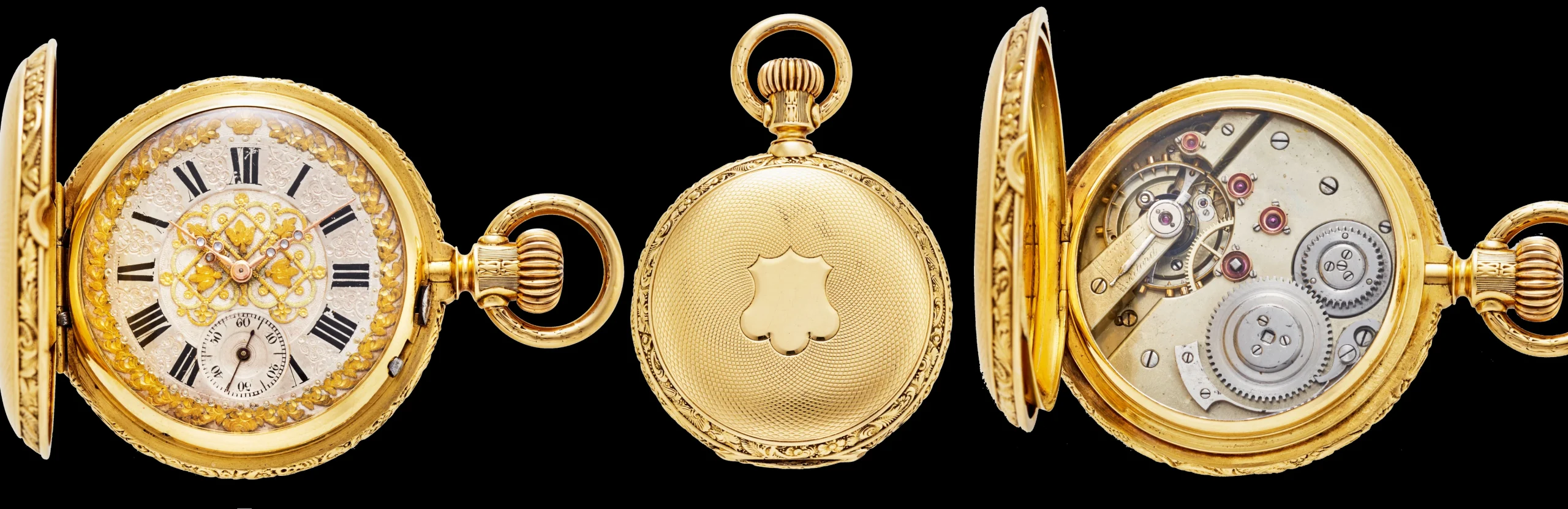
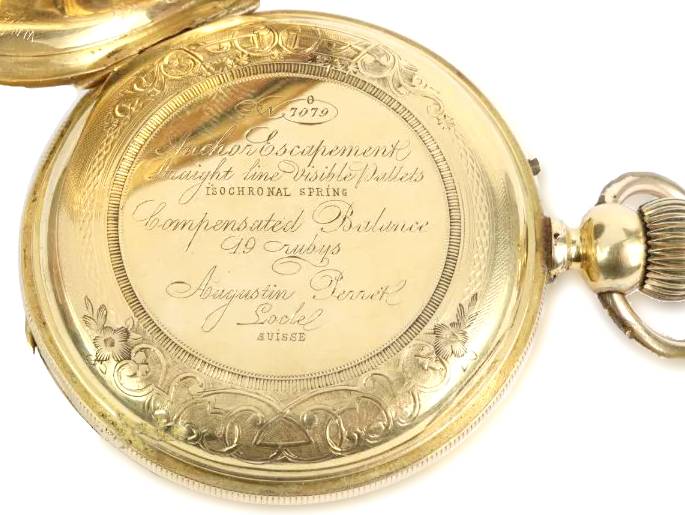
18-carat yellow-gold dust cover of Augustin Perret’s pocket watch No. 7079 (Le Locle), circa 1880. The 19-line movement, with stem winding, is fitted with a straight-line lever escapement with visible pallets, a compensated bimetallic balance with an isochronous hairspring, and 19 jewels protecting the pivots. Photo courtesy and © https://everywatch.com.

From Les Brenets to Le Locle: The Formation of a Character

Born in Vauladray, in the municipality of Les Brenets, on 1 July 1810, Augustin Perret lived there until 1848, the year a devastating fire ravaged much of the village. Following this catastrophe, he settled permanently in Le Locle, where he divided his time between his workshops and public life. In 1877, he was elected to the General Council.

Far from the stereotype of the reclusive craftsman, “Papa Augustin”, as he was affectionately known in his later years, was a legendary figure:

  • Le Locle’s clarinetist: His musical skill and his inseparable clarinet were famous throughout French-speaking Switzerland.
  • The republican orator: Politically engaged from his youth in the tensions and ideals of the Radical Party, he took part in the 1 March celebrations (a symbolic date for Neuchâtel republicans) and in political assemblies. There, he stood out for his humorous and incisive interventions, never hesitating to stand up to the “potentates of this world.”

Watchmaking Excellence: A Workshop Dedicated to High Precision

After mastering the delicate art of assembling lever escapements over two decades, Augustin Perret raised his expertise to the highest standards of chronometry.

Formally established as a watchmaking workshop in Le Locle, Perret focused on high precision and complications. His recurring advertisements sought advanced movements or watches fitted with a tourbillon escapement, reflecting his commitment to technical excellence.

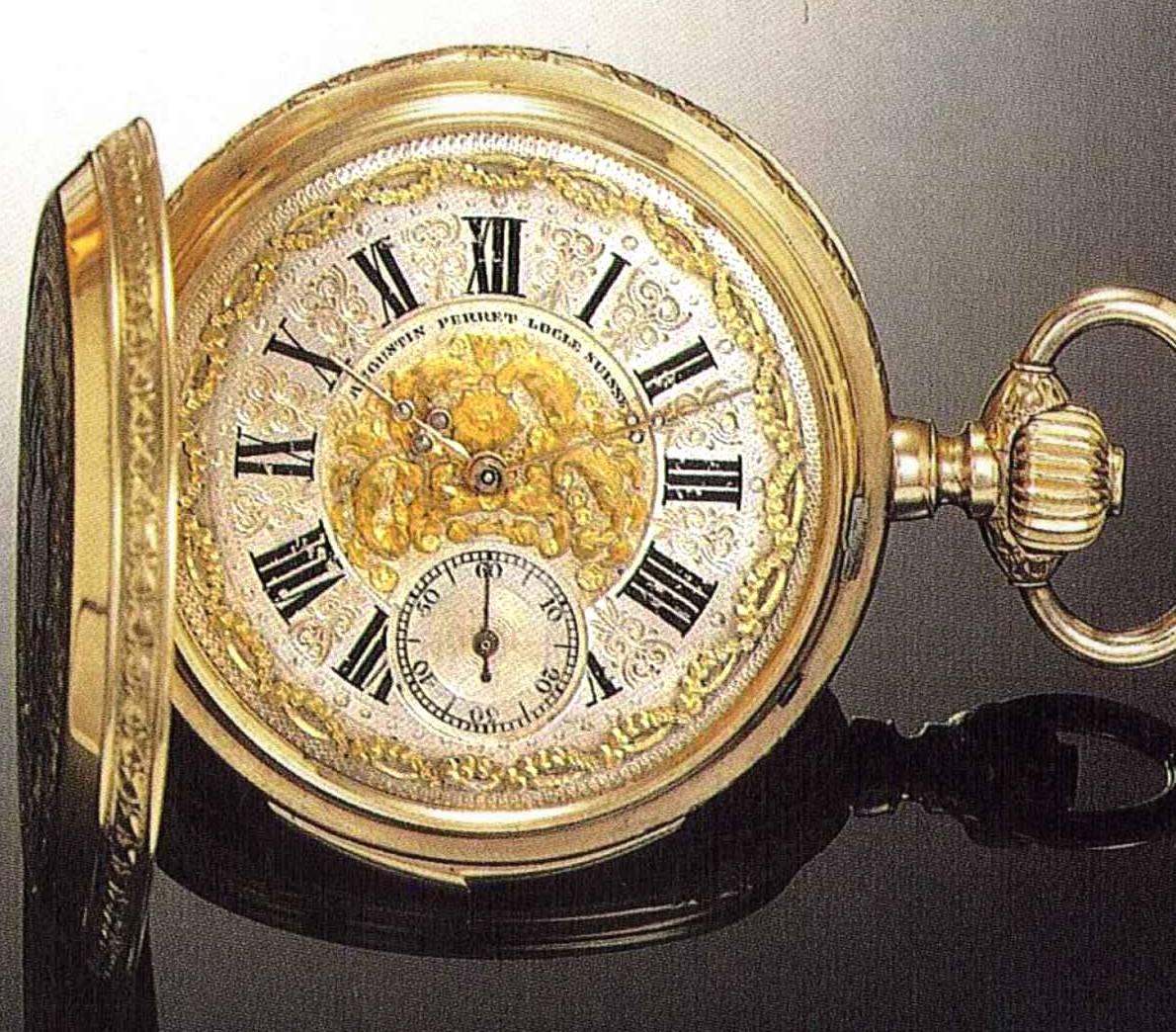
Right: 18-carat gold hunter-cased pocket watch by Augustin Perret, “genre Espagne,” circa 1880. Four-piece case, “bassine et filets,” entirely engraved with scrollwork and flowers, the cover featuring a blank cartouche framed by griffin heads. Gold dust cover engraved with the technical details. The movement is protected by an additional glazed dust cover with a raised rim. 19-line, nickel-plated movement with “à vagues” decoration, 19 jewels, straight-line lever escapement with counterweight and visible pallets, cut compensated bimetallic balance, and Breguet hairspring. Minute repeater on gongs, with visible mechanism and a locking slide on the rear case band. Signed on the dust cover.
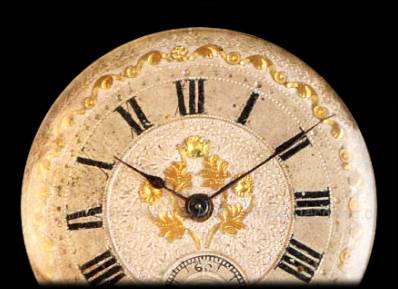
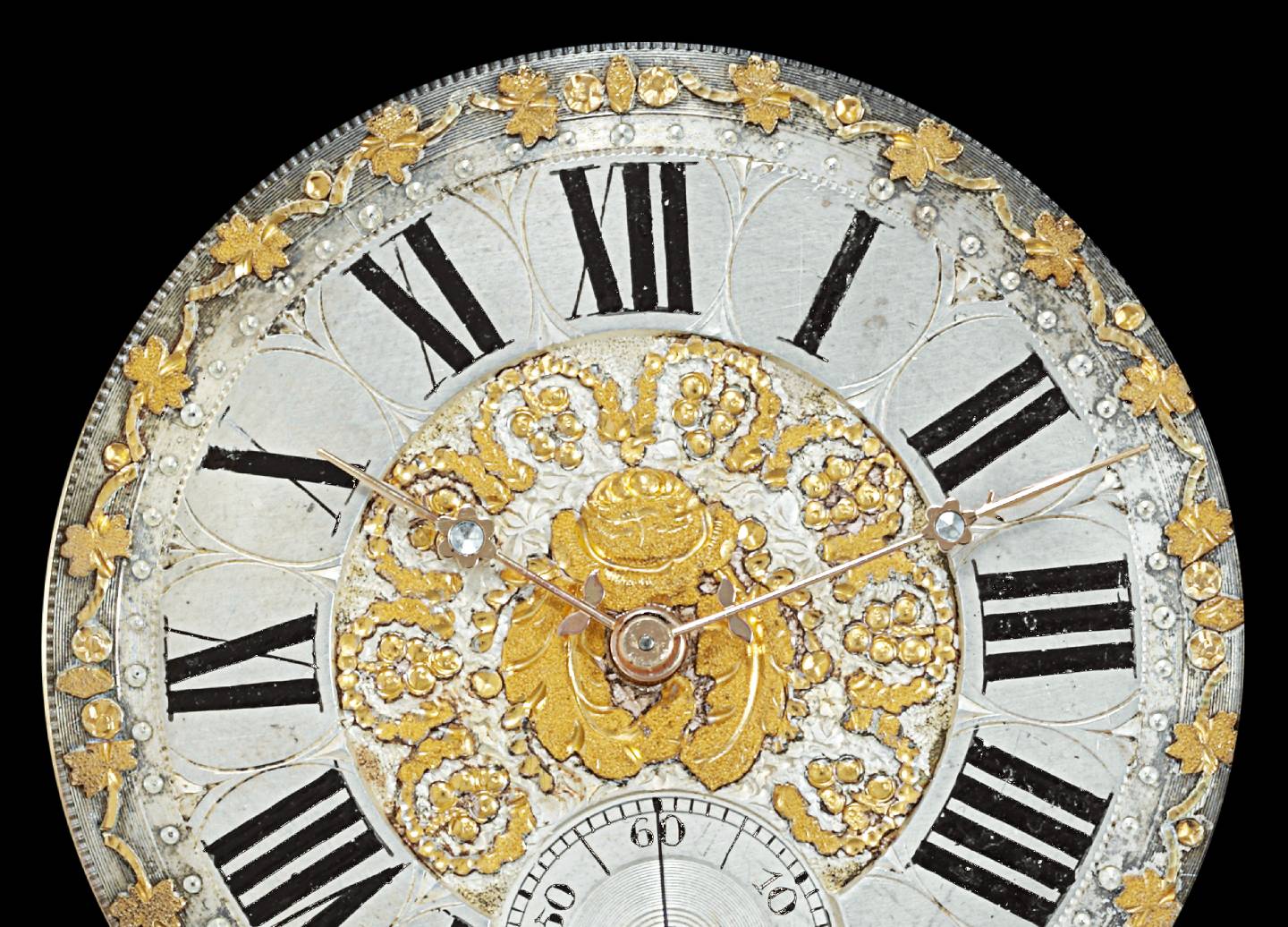
Typical silvered “genre Espagne” dial. The centre of the composition is occupied by small gilded motifs in varied tones and textures, executed in micro-relief stamping. Following the contours of the central decoration is the inscription “AUGUSTIN PERRET LOCLE SUISSE.” The hour chapter features hand-painted Roman numerals executed in lampblack. The spaces between the hour numerals are engraved with a dotted burin technique. Regular concave pearls form the minute track. The periphery is bordered by a floral garland of gilded forms in varied tones and textures, executed in micro-relief. The small-seconds subdial, with hand-painted numerals, features circular guilloché centred on the hand pivot. Gilt fancy hands set with stones complete the dial. Photo courtesy and © https://www.bonhams.com/

Pioneer and Veteran of the Observatory Competitions

His chronometric excellence became part of the history of the Swiss observatories through an exceptional career spanning four decades:

  • At the origins of the competitions: As early as 1862, a chronometer bearing his name (No. 5862, fitted with a detent escapement) was recorded with remarkable results in the daily-rate variation tables of the Observatory competition.
  • An octogenarian’s consistency: Perret maintained an active participation to a remarkable age. His name continued to appear in the official bulletins and observatory registers in the early 1890s and 1891, when he had already passed the age of eighty. His calibres were submitted with flat hairsprings and Phillips curves, adjusted by the renowned specialist J. Vogel-Jacot.

Technical Mastery: Pocket Chronometer No. 10,498

An emblematic example of his technical standards is the pocket chronometer signed “Augustin Perret à Genève No. 10,498”:

  • Aesthetics and case: It is fitted with a solid hunter case, decorated with engraving and guilloché work. The silver dial features gold motifs, gilt hands, and details of Spanish inspiration.
  • Mechanism and protection: Its nickel bridge movement, fitted with 19 jewels, is fusee-less. It is distinguished by a balance fitted with a cylindrical blue-steel hairspring, as well as a pivoted detent escapement.

Anti-gallop innovation: To prevent disturbances caused by everyday shocks (the “gallop” phenomenon, which affects the oscillation of the balance), this timepiece incorporates an ingenious right-angled steel hook, welded directly to the first coil of the cylindrical hairspring. When the balance amplitude becomes excessive, this hook acts as a safety stop, coming into contact with a vertical pin located on the lower arm of the balance.

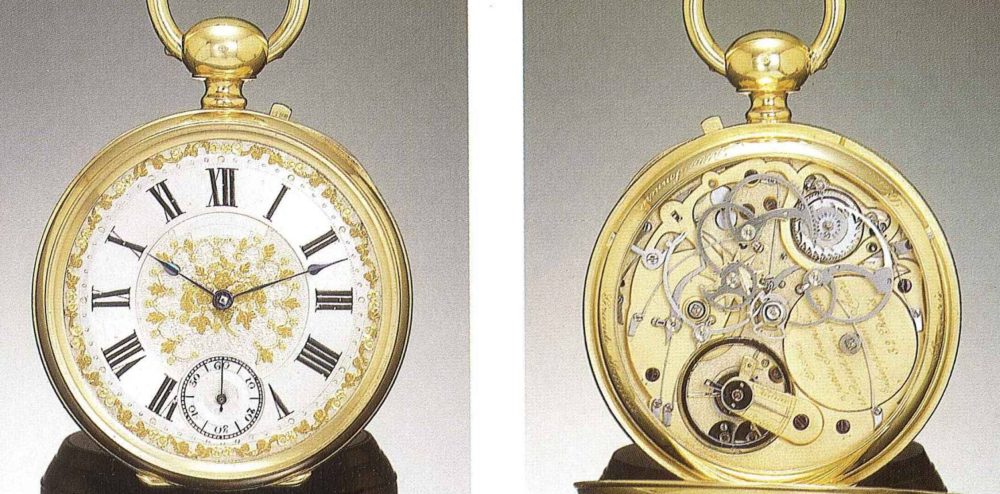
Augustin Perret No. 10,498, 18K yellow-gold hunter-cased pocket watch, circa 1890. Silvered “genre Espagne” dial. The fancy gold hands, set with transparent stones, indicate the time against the Roman-numeral dial. Chronometer movement with stem winding and crown-operated time setting by pulling the slide, fitted with a detent escapement and a cut compensated bimetallic balance with a cylindrical blue-steel hairspring and pierced jewels, supplemented by an endstone for the balance staff, with jewels set in gold chatons from the centre wheel through to the escapement. Bibliographical note: This watch is illustrated and discussed in Dispositifs anti-galop dans les chronomètres de poche, Adolphe Chapiro, Bulletin ANCAHA, No. 57, Spring 1990.

The Problem of “Gallop” and Augustin Perret’s Solution

When carried in the pocket, a chronometer is subject to shocks that can cause positive or negative impulses on the balance during its oscillation. It is the positive impulses (accelerations) that are the most harmful: they can cause the balance to exceed its normal amplitude, thereby disturbing the escapement’s unlocking and impulse functions. This results in a series of erratic shocks and may cause a second tooth to pass, producing a second impulse at the end of the balance’s travel.

Perret’s solution to counter this phenomenon was based on an anti-gallop device, comprising:

  • A pivoted detent escapement,
  • A hook welded to the hairspring,
  • A pin with its safety clearance,
  • A stop pin on the balance arm.
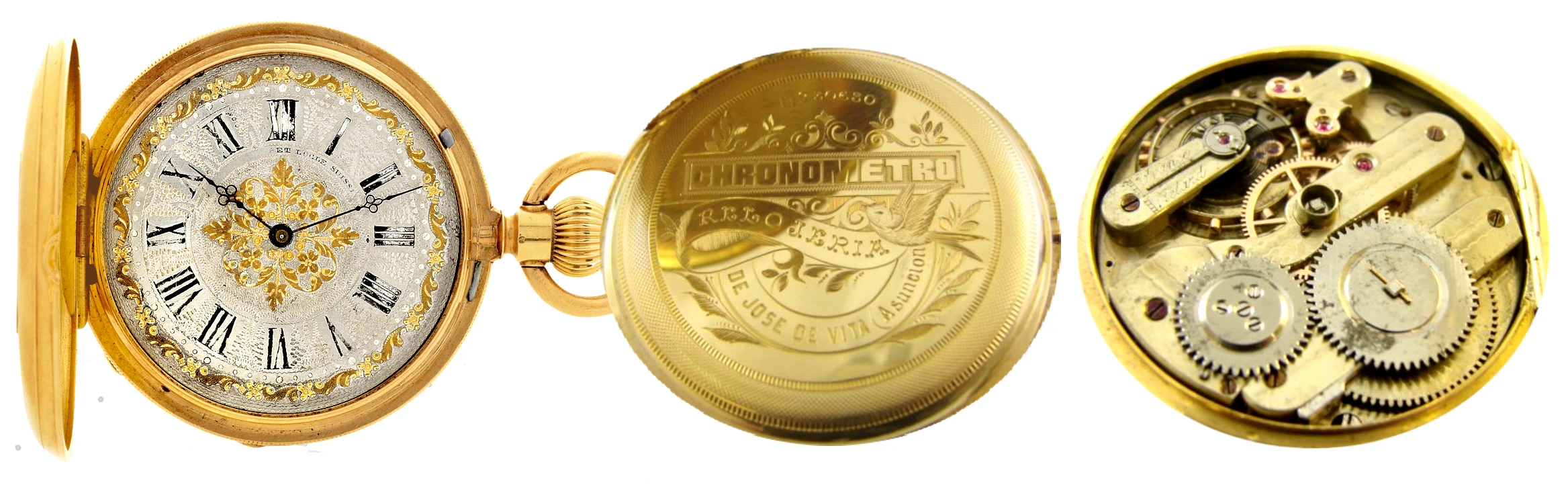
Augustin Perret No. 30,630 (Le Locle), circa 1900, 53 mm in diameter, made for the Relojería de José de Vita in Asunción, Paraguay. The solid four-piece 18K yellow-gold case, in the “bassine et filets” style, features fully guilloché hinged covers and an engraved gold dust cover, with a “genre Espagne” dial. A privileged witness to the dissemination of Swiss high watchmaking in Latin America, this watch forms part of the commercial network of the Le Locle firm, strengthened by the presence of Frédéric-Augustin Perret, the watchmaker’s son, who served as Swiss consul in Asunción for two decades.

The End of an Era

Augustin Perret died in January 1900, at the respectable age of 89, and was remembered by his neighbors as a true mountain man. Several months after his death, his historic business in Le Locle was officially removed from the registers for lack of continuity, bringing to an end the career of an irreplaceable artisanal watchmaker. His legacy, however, lives on through his exceptional chronometers, which left their mark on the second half of the nineteenth century and on the history of Swiss watchmaking.

Montre de poche savonnette « genre Espagne » en or 18K, Augustin Perret (Le Locle). À répétition des quarts et « grande et petite sonnerie ». Son boîtier trois pièces de style « pommes et filets » présente une carrure guillochée et un fond plat. Sous verre, le mouvement de 22 lignes, doré mat, à 32 rubis, dispose de deux barillets. Le mécanisme de sonnerie et de répétition est commandé par un poussoir à la carrure et par des leviers de sonnerie/silence et de grande/petite sonnerie disposés sur la lunette.
18K gold “genre Espagne” hunter-cased pocket watch by Augustin Perret (Le Locle). Quarter repeater with “grande et petite sonnerie”. Its three-piece case in the “pommes et filets” style features a guilloché case band and a flat back. Under glass, the 22-line, matt-gilt movement, with 32 jewels, is fitted with two barrels. The striking and repeating mechanism is operated by a case-band push-piece and by striking/silent and grande/petite sonnerie levers positioned on the bezel.

PERRET & FILS

Their Production Genre Espagne

PERRET & FILS | PERRET FILS | PERRET FILS, SUCCESSORS TO PERRET FILS | «LA PALME», PERRET FILS, SUCCESSORS TO PERRET FILS

At the heart of the Neuchâtel mountains, where time seemed to stand still among forests and lakes, the Perret family saga began to forge its legacy at the end of the 18th century. Gédéon Perret, born in 1778, and his wife, Marie Charlotte Perret-Gentil, born in 1785, laid the foundations of a lineage that, over the decades, would become synonymous with watchmaking excellence. From their descendants came Frédéric-Auguste Perret, born in 1815, who, together with his wife Alixe Célina Droz (Busset), born in 1816, would shape a dynasty that would leave its mark on the history of Les Brenets.

Frédéric-Auguste, after completing his apprenticeship and specialization alongside his father and having worked as a watchmaker since 1843, was a visionary and entrepreneur. In 1867, when his son Fritz-Albin (1843–1927) came of age, he founded the firm Perret & Fils, dedicated to the manufacture of high-precision pocket watches, featuring mechanical complications and refined escapements. But his ambition extended beyond the workshops: from its early years, the firm distinguished itself in the Neuchâtel chronometer competitions, where Perret & Fils became a regular and successful participant. In 1868, its watches, such as No. 25,628 (with a lever escapement and stem winding), took 11th place, but this was only the beginning. That same year, chronometer No. 25,627 ranked 12th, while No. 25,111 took 32nd place, demonstrating a consistency that would soon lead them to the top. In 1869, model No. 26,660 (with a Philipps escapement and stem winding) reached 10th place, while No. 26,359 took 9th, consolidating their reputation among the leading watchmakers of the period.

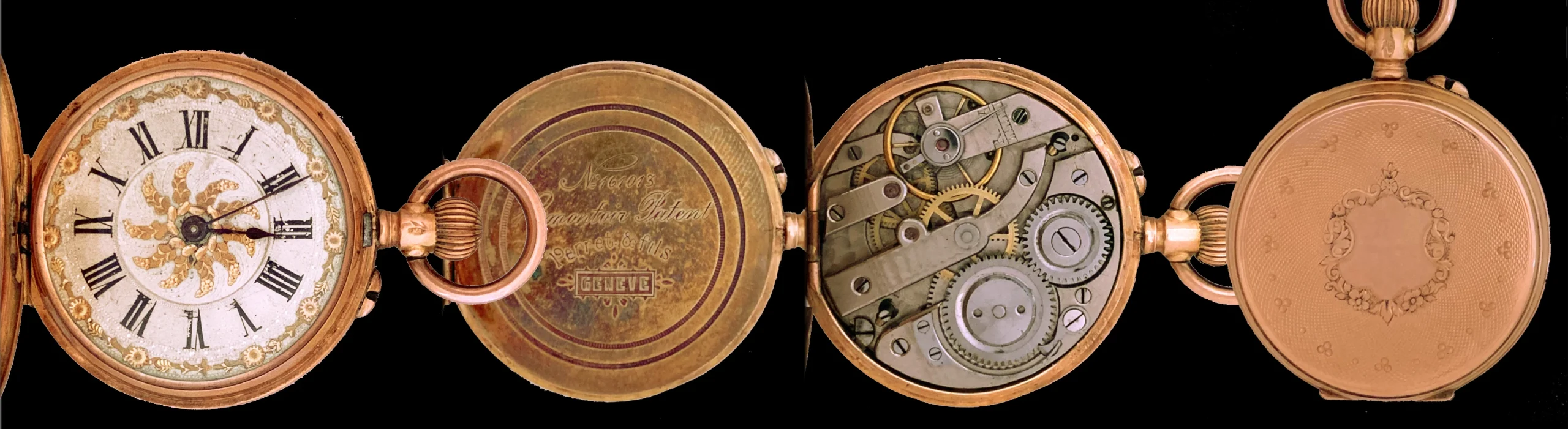
Montre de poche savonnette Perret Fils nº 161013
“Genre Espagne” hunter-cased pocket watch by Perret & Fils, Geneva, No. 161,013.

Frédéric-Auguste, after completing his apprenticeship and specialization alongside his father and having worked as a watchmaker since 1843, was a visionary and entrepreneur. In 1867, when his son Fritz-Albin (1843–1927) came of age, he founded the firm Perret & Fils, dedicated to the manufacture of high-precision pocket watches, featuring mechanical complications and refined escapements. But his ambition extended beyond the workshops: from its early years, the firm distinguished itself in the Neuchâtel chronometer competitions, where Perret & Fils became a regular and successful participant. In 1868, its watches, such as No. 25,628 (with a lever escapement and stem winding), took 11th place, but this was only the beginning. That same year, chronometer No. 25,627 ranked 12th, while No. 25,111 took 32nd place, demonstrating a consistency that would soon lead them to the top. In 1869, model No. 26,660 (with a Philipps escapement and stem winding) reached 10th place, while No. 26,359 took 9th, consolidating their reputation among the leading watchmakers of the period.

The Era of Consolidation and Awards

While Frédéric-Auguste and his son Fritz-Albin were at the helm of the company, successes in the competitions multiplied. In 1871, chronometer No. 31,242 took 7th place, and the following year, in 1872, the firm won its first 1st prize with model No. 34,374, a milestone that would mark the beginning of a series of victories. That same year, No. 35,037 (with a cylindrical rocking escapement and fusee) took 7th place, No. 31,689 took 6th place, while No. 36,802 also took 7th place. The precision of their mechanisms, many of which were regulated by masters such as Kaurup or Borgstedt, placed them among the favorites of the judging panels.

In 1873, chronometer No. 35,592 took 8th place, and in 1874, No. 39,591 took 9th, while No. 41,161 came 54th. But it was in 1876 that Perret & Fils demonstrated its mastery: No. 43,564 took 17th place, and No. 44,069 22nd, both regulated by Kaurup, a name that would appear repeatedly among their successes. In 1878, No. 41,272 (regulated by Borgstedt) reached 22nd place, No. 47,546 (also regulated by Kaurup) took 40th, while No. 47,822 (with a Breguet escapement and key winding) ranked 27th. That year, they also presented a chronograph regulated by Borgstedt, No. 48,118, demonstrating their versatility.
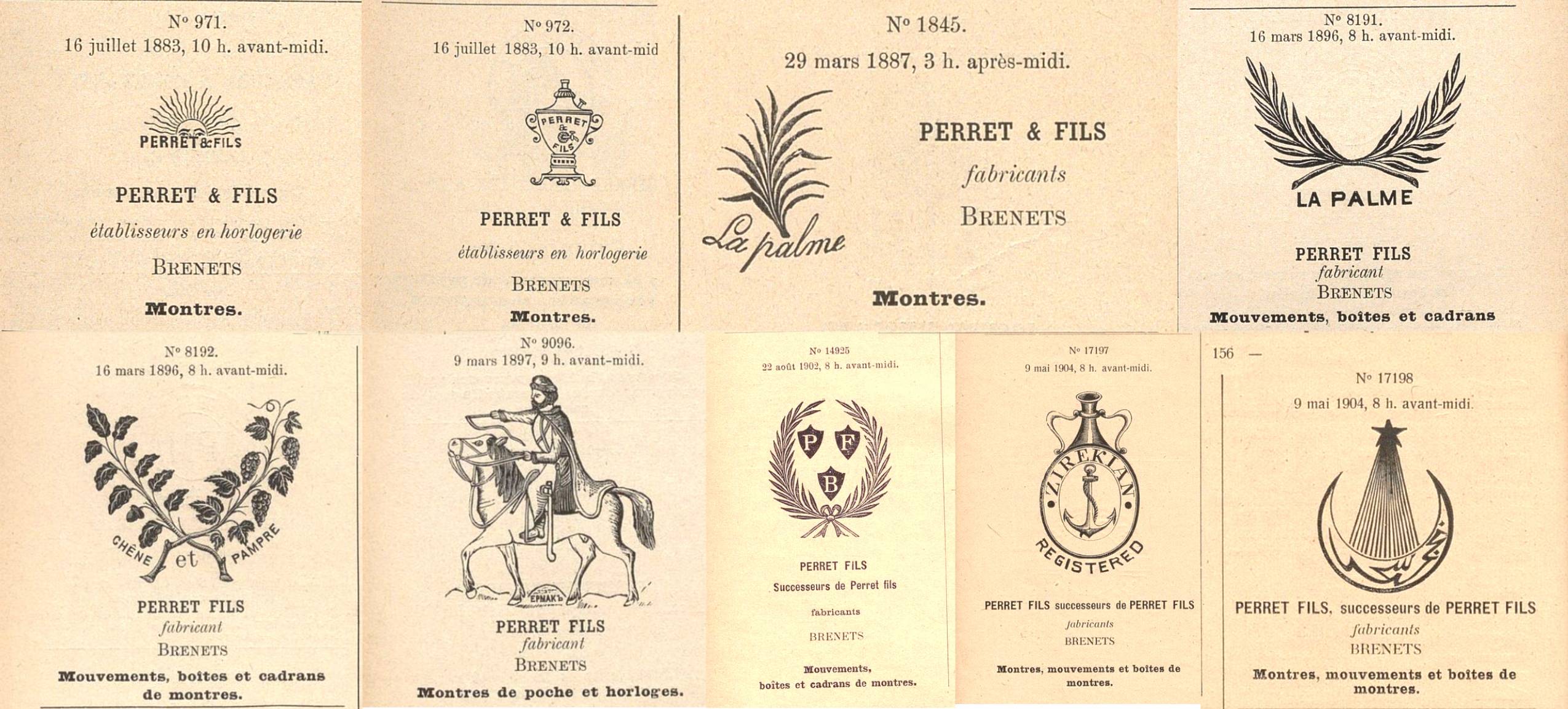
Perret & Fils, Brenets. Marques de fabrique.
Official registered trademarks of the Perret & Fils / Perret Fils / Perret Fils, Successors to Perret Fils manufacture (Les Brenets), registered between 1883 and 1904, including: the radiant sun (No. 971); the urn/vase (No. 972); the palm, “La Palme” (Nos. 1,845 and 8,191); the oak-leaf and vine-scroll crown, “Chêne et Pampre” (No. 8,192); the Oriental rider/Cossack, “Ermak” (No. 9,096); the “P.F.B.” shield between laurel branches (No. 14,925); the canteen/anchor, “Zirekian” (No. 17,197); and the crescent moon with radiant star (No. 17,198).

The Transition to the Second Generation

With the arrival of the 1880s, Fritz-Albin Perret took the reins of the company, but the tradition of excellence in the competitions continued unabated. In 1880, chronometers Nos. 51,152, 51,999 and 51,108 took 4th, 7th and 16th place, respectively. In 1882, No. 17,027 was regulated by the controversial Paul Perret, of La Chaux-de-Fonds.

In 1889, the firm distinguished itself once again: No. 58,194 (regulated by Numa Perret & Cie) ranked 63rd, followed by Nos. 58,196 and 58,197, both regulated by the same firm. That same year, chronometer No. 1,969 by Augustin Perret, of Le Locle, also distinguished itself, demonstrating that watchmaking talent was a family legacy.

The Era of Innovation and International Recognition

Under the direction of Fritz-Albin, the company not only maintained its prestige in the competitions but also extended it. In 1893, Albin Perret (in Les Brenets) presented chronometer No. 43,534, and in 1895, models No. 70,765 (regulated by U. Wehrli) and No. 70,227 took 25th and 45th place, respectively. In 1897, Nos. 69,135 and 69,823 continued the tradition, while in 1898, No. 78,039 (regulated by Wehrli) and No. 78,040 (regulated by J. Vogel-Jacot, of Le Locle) reached 13th and 19th place.

In 1890, at the Zurich National Exhibition, they presented a silver bird-shaped jewel watch, with pearl eggs and ruby grains of food, a masterpiece that amazed the world.

From Perret & Fils to Perret Fils (1892)

The retirement from active work of the founder, Frédéric-Auguste Perret, in 1892 led to the dissolution of the original Perret & Fils firm. His son, Fritz-Albin Perret, then took sole control of the company. As his father was no longer an active partner, Swiss law prohibited the retention of the “&”, which denoted joint ownership, and the company adopted the name Perret Fils, thereby preserving its accumulated prestige.

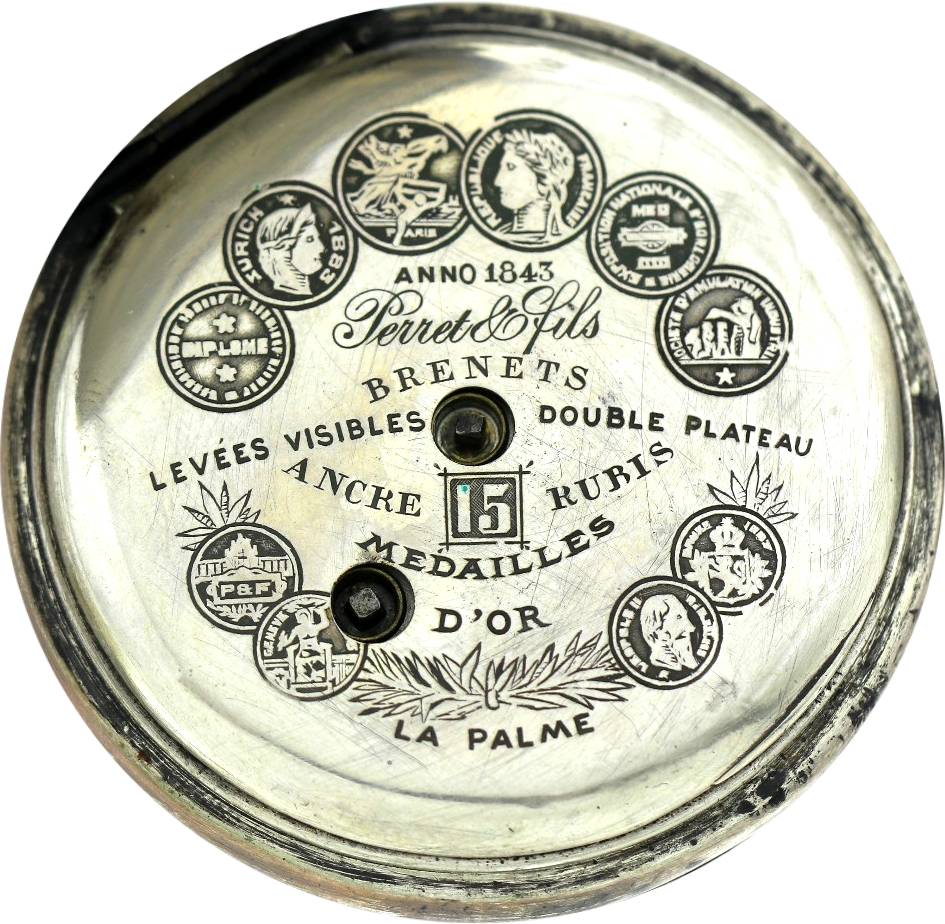
Engraved dust cover of a Perret & Fils pocket watch (Les Brenets), produced after 1896, displaying the manufacture’s complete record of distinctions: the Silver Medal of Paris (1878), the Diploma of Honour of Zurich (1883), the Silver Medal of Geneva (1896), the Grand International Competition of Brussels (1888) with the effigy of Leopold II, the seal of the Société d’Émulation Industrielle of La Chaux-de-Fonds, as well as the “La Palme” trademark registration.

From Perret & Fils to Perret Fils (1892)

The retirement from active work of the founder, Frédéric-Auguste Perret, in 1892 led to the dissolution of the original Perret & Fils firm. His son, Fritz-Albin Perret, then took sole control of the company. As his father was no longer an active partner, Swiss law prohibited the retention of the “&”, which denoted joint ownership, and the company adopted the name Perret Fils, thereby preserving its accumulated prestige.

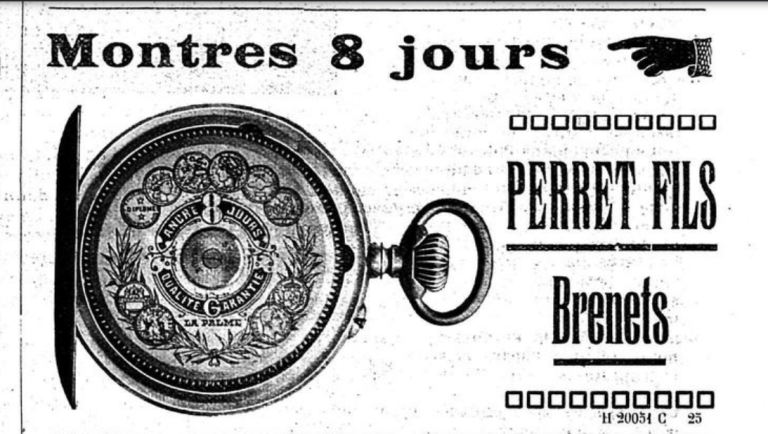
1912 advertisement for the Perret Fils firm (Les Brenets), highlighting its pocket watches with an 8-day power reserve. The illustration shows the case back engraved with the characteristic arrangement of exhibition medals, the wording “Qualité Garantie”, and the “La Palme” trademark registration.

The Third Generation and the Legacy

Frédéric-Auguste Perret died in 1897.

With the arrival of the third generation, Louis-Ali Perret (born in 1866) and Frédéric Jean Perret (1879–1971), at the helm, Perret Fils, Successors to Perret Fils entered a new phase of innovation while maintaining its prestige, despite increasingly less frequent participation in competitions. Beyond their excellence in watchmaking, the family played an active role in the political, social and economic life of Les Brenets, making a significant contribution to local development.

In 1900, they adopted the legal designation “Perret Fils, Successors to Perret Fils”, capitalizing on more than fifty years of awards won at observatory competitions and world’s fairs by their father and grandfather, while retaining the rights to their inherited patents and trademarks.

The turn of the century brought a new wave of successes. In 1900, chronometers Nos. 83,988, 83,836, 83,834 and 83,835 took 1st, 8th, 14th and 30th place, respectively, all regulated by J. Vogel-Jacot, further consolidating the firm’s reputation as one of the most highly awarded of its time.

On 30 December 1912, the company expanded its corporate name to “La Palme”, Perret Fils, Successors to Perret Fils.

The Decline of a Dynasty

The final years of the 19th century and the early decades of the 20th century saw the Perret family consolidate its legacy through patents, registered trademarks and international awards, including the Silver Medal at the Paris Universal Exhibition in 1878, the Diploma of Honour at the Swiss National Exhibition in Zurich in 1883, the Silver Medal at the Swiss National Exhibition in Geneva in 1896, as well as distinctions at the Grand International Competition of Brussels in 1888 and from the Société d’Émulation Industrielle of La Chaux-de-Fonds.

However, in 1941, the firm was sold to Gilbert and Fernand Zibach, and the manufacture was transferred to La Chaux-de-Fonds, where it continued under the name Zibach & Cie.

Thus, between the sound of award-winning chronometers and the murmur of trains, the Perret family saga became part of the history of Switzerland, leaving a legacy of precision, innovation and passion that has endured beyond the passage of time. Their watches, now collectors’ pieces, remain silent witnesses to an era when the name Perret was synonymous with excellence in Swiss watchmaking.

Additional Note:

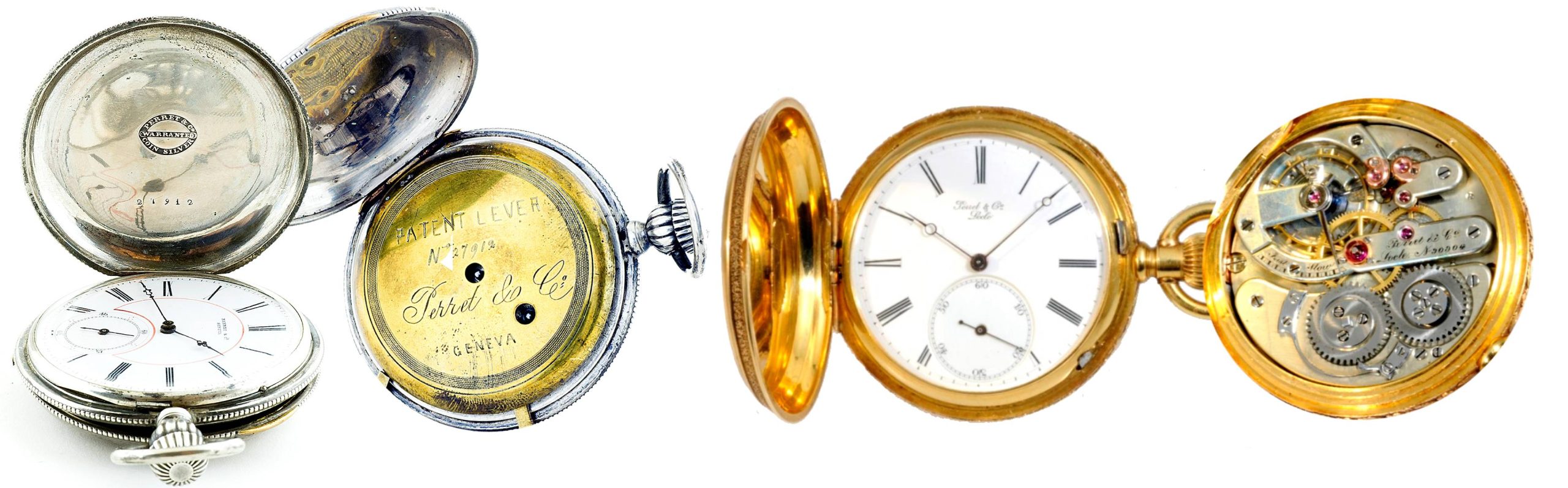
It is worth noting the existence of other pocket watches from this period, signed “Perret & Co.” or “Perret & Cie” (Geneva) — two variants that in fact refer to the same firm — as well as pieces bearing the mark “Perret & Cie”, Le Locle. However, to date, our research has not uncovered any documentary source establishing a direct connection between these companies and the Perret Fils firm of Les Brenets. These entities constitute a fascinating parallel chapter in the Perret family saga, and it is to be hoped that future archival discoveries will one day shed light on their precise role.

Left: Silver pocket watch signed “Perret & Cie,” Geneva (dial) and “Perret & Co.” (gilt dust cover and inside of the case). Right: Pocket watch signed “Perret & Co.,” Le Locle.
Circular black-and-white seal featuring the name Ramón Campos, researcher of 19th-century Swiss watchmaking and early fountain pens.
error: Le ayudaremos si usted desea compartir esta u otras imágenes. Por favor, contacte previamente con nosotros. Gracias. We will help you if you want to share this or other ParkerSheaffer´S images. Please contact us in advance. Thank you.