LONGINES

Their “Genre Espagne” Pocket Watches

Longines: From the Traditional Workshop to Industrial Excellence (1867–1929)

18k Gold Hunter-Case Pocket Watch (montre de poche savonnette), Longines, serial number 455810, circa 1885. 15-ligne. Pendant wind and hand-set via the crown with the pull-out tirette lever located at 4 o'clock. Silvered dial typical of the "genre Espagne" style. The center of the composition features small gold elements in varied colors and textures, stamped in micro-relief to form a floral motif that stands out against a silver background finely stippled and engraved with a burin. The circular hour track displays hand-painted black Roman numerals rendered in lampblack. The inter-hour spaces situated between the numerals are likewise embellished with gold micro-relief motifs. The periphery is bordered by a row of regular concave beads marking the minute track. Blued-steel Poiré Stuart hands crown this piece. Photo courtesy and © https://www.ansorena.com.

The Agassiz Agency: The Origins

The history of Longines cannot be complete without mentioning the Agassiz Agency (comptoir Agassiz), which constitutes its very beginnings. Auguste Agassiz, brother of the famous naturalist Louis Agassiz, partnered in 1833 with the watchmaking merchant Henri Raiguel and Florian Morel in Saint-Imier. Their enterprise, an établissage agency, purchased components and had watches assembled in family workshops or at home. Although dependent on trade fairs and often perilous travels, the business prospered. In 1846, Agassiz became the sole director after Raiguel‘s departure.

At that time, Saint-Imier produced crown-wheel watches—though surpassed by Lépine bridge calibers—as well as Lépine watches with cylinder escapements. The Agassiz Agency also disposed of older verge-and-crown-wheel timepieces typical of the region. In 1846, a first collaboration was established with Auguste Mayor, a Swiss merchant emigrated to New York, marking the beginning of relations with the United States. However, the economic crisis of 1848, tied to the political upheavals in Europe, compelled Agassiz to focus entirely on his enterprise. Stricken by illness, he moved to Lausanne, from where he continued to direct the agency with the help of two employees.

Ernest Francillon: Visionary and Modernizer, from the Agassiz Heritage to the Mechanical Era

In 1852, Ernest Francillon, nephew of Auguste Agassiz, arrived in Saint-Imier to take over the family business. After completing his commercial and economic training in Germany, he learned watch manufacturing in Môtiers (Val-de-Travers). Upon returning to Saint-Imier, he traveled to Paris, Vienna, and various German cities, while maintaining close ties with the American market. In 1856, a fire destroyed the agency building, but Francillon, assisted by Edouard Savoye, saved the tools and merchandise, transferring operations to a house built by Agassiz.

In 1861, Francillon took full control of the company, which was then facing financial difficulties. He modernized production: he abandoned crown-wheel watches, focused on Lépine cylinder calibers (initially key-wound, later keyless-wound), and reorganized the assembly workshop using efficient methods. To expand, he acquired a plot of land in 1866 at Les Longines, along the banks of the Suze, where he constructed a factory equipped with a 10-horsepower turbine powered by a waterfall.

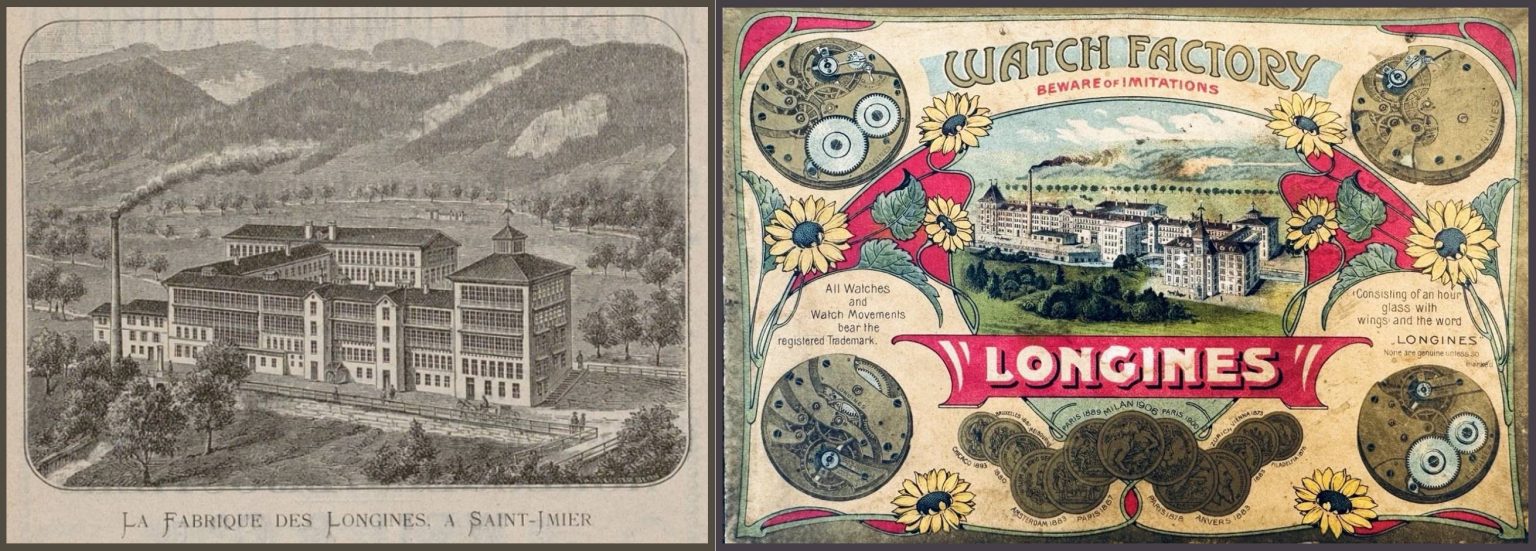
Left: The Longines Factory in Saint-Imier, April 1900. Right: Longines Watch Factory advertisement, circa 1912.

He hired Jacques David, a mechanical engineer and relative who, after studying at the École centrale des arts et manufactures de Paris, trained in watchmaking. Together with the watchmaker Edouard Châtelain, they designed and manufactured innovative machinery, laying the foundations for a modern manufacture. By 1867, the factory was under roof. The first samples of mechanical watches exhibited flaws: the escapement designed by Châtelain did not function, forcing a return to the classic lever (ancre) system. Despite this, quality and robustness ultimately convinced the market. Longines became a benchmark, adopting the winged hourglass symbol to combat counterfeits.

Critical Years: Longines Facing Competition (1875–1899)

In 1875, Swiss watchmaking was undergoing a severe crisis: American competition, characterized by mechanized production and component interchangeability, threatened its dominance. The Philadelphia Exposition of 1876, organized for the centenary of American independence, marked a turning point. Jacques David, sent as an observer, studied American methods and drafted a report that transformed Swiss watchmaking. Longines, already advanced in mechanization, overcame these difficulties. Following the death of Auguste Agassiz, Francillon maintained the support of his heirs, and by 1878, the factory recorded its first profitable financial year.

Longines movement number 450125, circa 1885. 19-ligne. Spanish-style dial, marked FEDC on its reverse side, remarkable for its stamping of gold motifs in micro-relief—not only in the center and on the peripheral garland, but also within the inter-hour spaces, which distinguishes it from traditional dials where these motifs are generally limited to the central and outer zones. Author's collection.

Demand surged, notably in the United States, where the local representative, Auguste Mayor, boosted sales. In 1895, Francillon transformed the enterprise into a limited partnership by shares (société en commandite par actions), associating his son and collaborators such as Jacques David. In 1896, Switzerland exported five million watches, and Longines stood out for its quality. Alfred Pfister designed a 9-line caliber with a lever escapement for ladies’ watches, achieving commercial success. Expansion continued with the construction of the Île du Diable in 1896, an extension of the factory.

The accidental death of Ernest Étienne Francillon in 1899 (from a riding accident) did not halt growth. That same year, a polar expedition led by the Duke of the Abruzzi took Longines chronometers into the Far North, proving their precision under extreme conditions. In 1900, Longines won the Grand Prix at the Paris Universal Exposition.

1900–1915: The Rise of Longines Between Global Expansion and Social Challenges

Following the death of Ernest Francillon in 1900, Jacques David, Baptiste Savoye, and Louis Gagnebin managed the company, developing new calibers and improving tooling. In 1902, Longines won 3rd and 5th places with two of its pocket chronometers at the Neuchâtel Cantonal Observatory Competition, and then in 1905, the brand won the first prize of this observatory, proving that mechanical production could achieve maximum precision.

Production surged from 39,000 to 122,000 pieces in a decade, supported by 800 workers. New buildings were constructed between 1905 and 1906. In 1907, Adrien Francillon, nephew of the founder, joined the company. That same year, a financial crisis in the United States affected Wittnauer, distributor of Longines, but the factory responded with an aggressive advertising campaign highlighting its observatory awards.

In 1910, a social conflict in Saint-Imier paralyzed the factory for five weeks. Seven workers, hired for an Italian Railways order, refused to join the union, triggering a strike. A final agreement on November 7, 1910, removed anti-union clauses from employment contracts.

The wristwatch gained popularity, stimulating sales, particularly for women’s models. Longines also manufactured electric chronographs for sports competitions. In 1912, Jacques David passed away, leaving his technical legacy to Alfred Pfister.

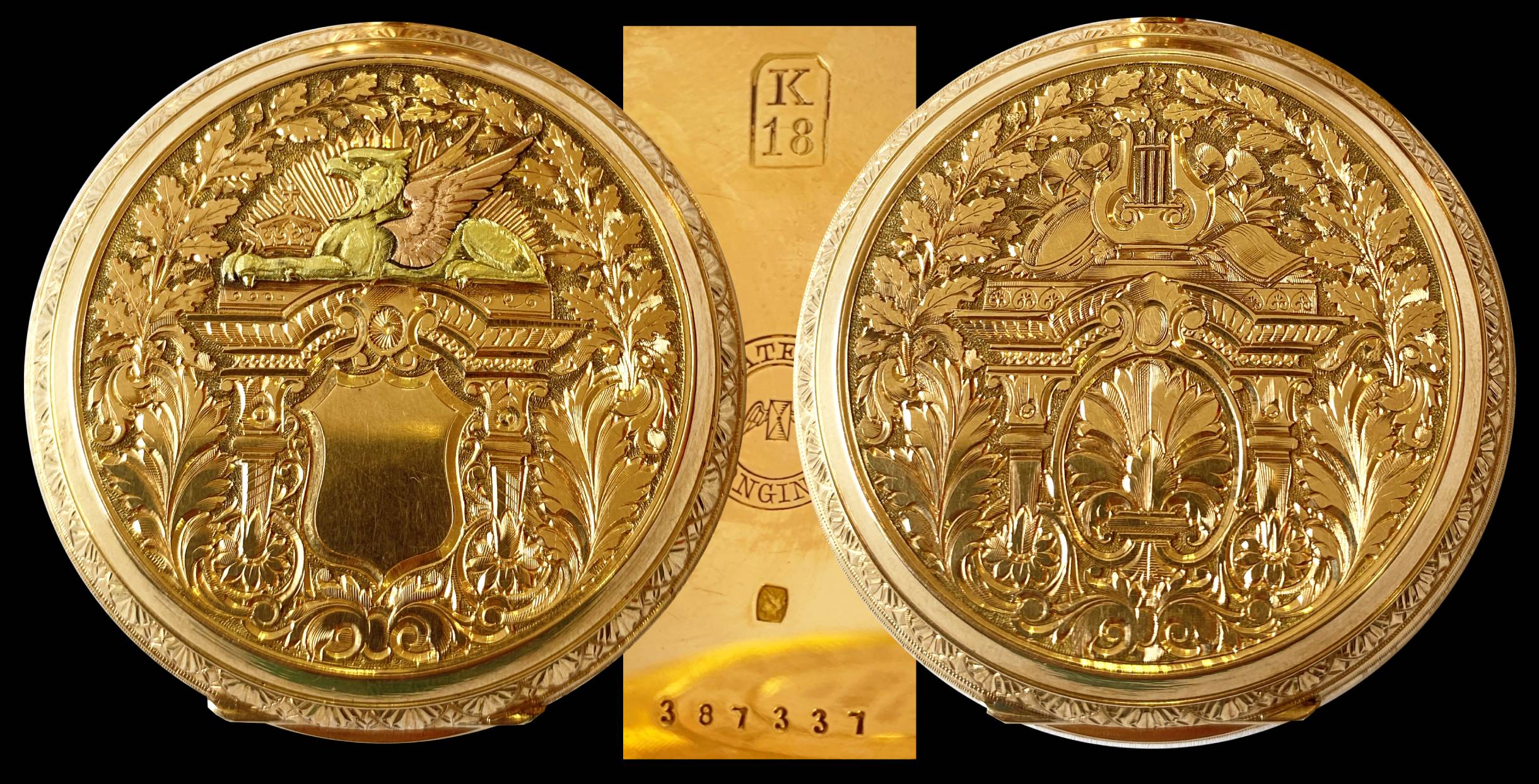
18k Gold Hunter-Case Pocket Watch (montre de poche savonnette), Longines, serial number 387337, adorned with fine and elaborate engravings, featuring a magnificent central lyre surrounded by foliage and surmounted by a winged griffin, symbols of harmony and protection. The monumental arch framing the composition is itself sculpted with refined motifs evoking the musical and artistic universe, reinforcing the allegorical theme of the whole. The inner cuvette reveals the prestigious heritage of the brand, bearing inscriptions celebrating its awarded prizes: a Grand Diploma of Honor in Antwerp in 1885 and a Gold Medal in Paris in 1878. Photo courtesy and © https://www.subastassegre.es/
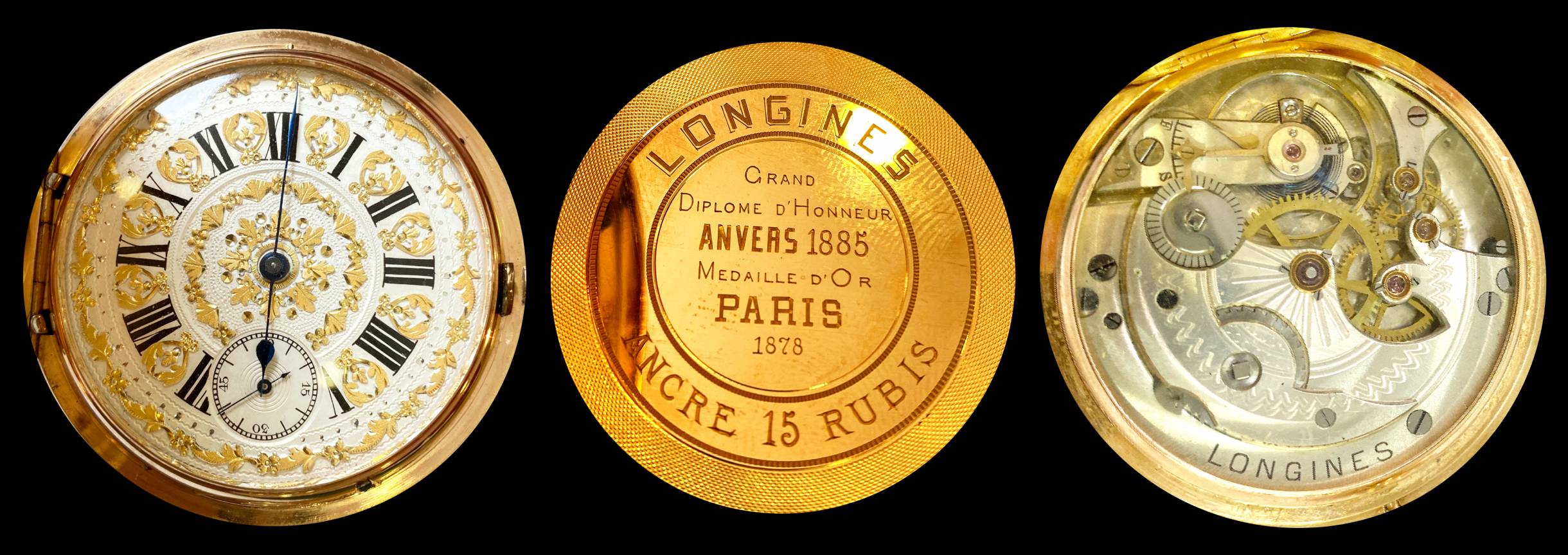
Dial, cuvette, and movement of the Longines hunter-case pocket watch (montre de poche savonnette), serial number 387337. The dial, in the "genre Espagne" style, is distinguished by stamped gold micro-reliefs within the inter-hour spaces, departing from traditional executions that are usually plain or burin-engraved. The movement integrates a Francillon-Longines precision regulator featuring a helical groove cam housed in a lateral recess of the balance cock. This mechanism allows for a direct, backlash-free drive of the regulator in both directions of rotation via two pins engaged in the groove, thereby eliminating any need for a return spring. Photo courtesy and © https://www.subastassegre.es/

Distinctions and International Awards at Universal Exhibitions (1867–1914)

The international rise of Longines is illustrated by a remarkable succession of accolades earned at universal and national exhibitions: a bronze medal in Paris in 1867, a medal of merit in Vienna in 1873, a medal in Philadelphia in 1876, followed by gold medals in Paris (1878), Melbourne (1880), and Amsterdam (1883). The brand also secured a silver medal in La Chaux-de-Fonds (1881), a diploma in Zurich (1883), and a diploma of honor in Antwerp in 1885.

Longines subsequently ascended to the highest tier of recognition with the Grand Prix in Paris in 1889, a medal in Chicago in 1893, and Grands Prix in Brussels (1897), Paris (1900), Milan (1906), as well as in Geneva and Bern in 1914, alongside a gold medal in Nuremberg in 1903. This acknowledgment of excellence was further consecrated by its service as a member of the jury at the exhibitions of Geneva in 1896 and Thun in 1899.

1915–1929: War, Innovation, and Crisis

In 1915, Longines became a public limited company (société anonyme), with Baptiste Savoye as president. World War I necessitated adjustments to production: compasses were manufactured for England and the United States, alongside the Chasseral electric counter (1917). Following the war, the Spanish flu (1918) paralyzed the workshops with 300 absences. The general strike of that same year ultimately improved working conditions.

In 1918, Longines established a subsidiary to manufacture Chasseral counters, managed by Jean David. However, in 1922, the devaluation of the Italian and Spanish currencies—its primary markets—led to its dissolution.

In 1921, a new economic crisis forced the factory to close three days a week and reduce wages, triggering a three-month conflict. After renegotiating the collective bargaining agreement, production resumed. Longines continued to excel in observatory competitions (Neuchâtel, Geneva, Washington, Teddington) and at exhibitions (Paris 1925, Philadelphia 1926). Its timepieces were utilized in aviation, polar expeditions, and scientific research. Charles Lindbergh, following his transatlantic flight (1927), commissioned a special watch indicating Greenwich Mean Time and hour angles.

During the Roaring Twenties (1922–1929), Longines experienced unprecedented prosperity, particularly in the United States and Canada, where the Longines exact-time service proved a successful advertising strategy. However, this prosperity was artificial: the crash of October 1929 exposed its fragility, plunging the company into the Great Depression.

Later Innovations: Longines at the Vanguard of Precision

In 1945, Longines launched its first automatic-winding watch. In 1952, it became the official timekeeper of the Oslo Winter Olympic Games. In 1960, it developed the thinnest electromagnetic movement in its class. In 1967, it introduced the Ultra-Chron (36,000 vibrations per hour), followed in 1969 by the Ultra-Quartz. During the 1980s, the quartz crisis led Longines to join the SMH Group (now the Swatch Group).

BENJAMIN HAAS JEUNE

Their “Genre Espagne” Pocket Watches

L’héritage de B. Haas Jeune : une odyssée horlogère

Benjamin Haas (1828–1925). Watchmaker. Contemporary artistic creation.

Founded in 1848 by Benjamin Haas Jeune (1828–1925), the sole unlimited partner, B. Haas Jeune quickly established itself as a benchmark in exceptional watchmaking. Located in Paris at 104 Boulevard Sébastopol, the firm expanded its influence with factories in Besançon and a branch in Geneva, managed by Léopold Haas, opened in 1884 at 5 Quai du Mont-Blanc. The integration of René Toussaint Albert Nivert as a limited partner (associé commanditaire) with a capital of 300,000 francs marked a key milestone in its expansion.

A Diplomatic and Technical Vision

Benjamin Haas, serving as the consul for Costa Rica in Geneva and subsequently for El Salvador starting in 1885, leveraged his diplomatic role to master international markets and export routes to Latin America. Through rigorous management of customs, official invoicing, and shipment visaing, Haas & Cie was able to oversee commercial flows, trademarks, weight, and the value of its haute horlogerie timepieces with unmatched precision, thereby consolidating a lasting competitive advantage.

18k gold hunter-case pocket watch, B. Haas Jeune no. 15306, circa 1884. Minute repeater striking on two steel gongs via two hammers (activated by the slide located on the case band at 6 o'clock). Pendant-set with stem winding and time-setting via crown combined with a push-piece lever (tirette) at 4 o'clock. Typical silvered "genre Espagne" dial. The center of the composition features small gold motifs of varied tones and textures, stamped in micro-relief, forming a floral decor that stands out against a finely burin-engraved stippled silver background. The chapter ring features hand-painted Roman numerals in lampblack. The inter-hour spaces between the numerals are entirely burin-engraved with opposing foliate scrolls (rinceaux). Regular concave pearls form the minute track. The periphery is bordered by a floral garland of varied-texture gold elements, crafted in micro-relief, leaving empty spaces to mark multiples of 5 minutes and echoing the central motif. Finally, the dial features a raised beaded-edge stamping along its outer border. The subsidiary seconds sub-dial, with hand-painted numerals, features circular guilloching centered on the hand pivot. The ensemble is punctuated by blued-steel pear-shaped hands (aiguilles poire Stuart).

Operating under the names B. Haas Jne & Cie, the firm gained international recognition for its exceptional precision. True to a philosophy combining simplicity, technique, and elegance, it gave birth to iconic pieces: split-seconds chronographs, pocket watches, and avant-garde wristwatches. These impeccable standards earned it the status of purveyor to European royal courts, including the prestigious title of “Breveted Purveyor to H.M. Emperor Napoleon III” in 1868.

Innovations and Accolades

The technical rigor of B. Haas Jeune rested on major figures such as Léopold Haas, a specialist in extra-flat calibers and complex movements, and Benjamin Haas himself, who directed the house for over seven decades. Among its most striking innovations are the detached remontoir d’égalité (1867 and 1873), a perpetual calendar (1872), and the first ultra-flat movement (circa 1896). In 1867, Benjamin Haas patented an ingenious mechanism: a detached remontoir d’égalité actuated by closing the case cover, transmitting energy via two levers to a ratchet wheel on the barrel arbor, equipped with a safety device. Perfected in the 1890s, this system provided 36 hours of power reserve with only twelve closures. Universal and national exhibitions crowned its excellence with numerous medals, including:

Leopold Haas (1827–1915). Watchmaker. Contemporary artistic creation.

1867, Paris: Bronze medal 1873, Vienna: Hors Concours and gold medal 1896, Geneva: Gold medal 1914, Bern: Grand Prix

1880 advertisement for the B. Haas Jne & Cie manufacture, illustrating its production of gold and silver watches, its invention patents (notably for the so-called perpetual watch and the independent perpetual calendar), as well as the addresses of its offices in Paris, Geneva, and Besançon.

The Golden Age and 20th-Century Challenges

The 1870s marked the beginning of its participation in the competitions of the Geneva Astronomical Observatory, where it distinguished itself on several occasions.

In 1884, René Toussaint Albert Nivert, limited partner (associé commanditaire), deputy mayor of the 17th arrondissement of Paris, and officer of the Legion of Honour, briefly reorganized the company under the name Nivert & Co, before it became, four months later, the joint-stock company (société anonyme par actions) Maison B. Haas Jeune, managed by Benjamin as director in Paris and Léopold in Geneva, with a capital of 630,000 francs.

In 1887, Benjamin Haas acquired a tiara for 160,000 francs at the historic auction of the French Crown Jewels, illustrating the influence of the Haas family within the exclusive circle of high jewelry, linked to their family network with the Lévys.

In 1895, Maison B. Haas Jeune was declared dissolved. The integration of the founders’ nephews—Emil (Solomon) Haas, Nathan Haas, Gaston Haas, and the merchant Salomon, known as Léon Novochelski—led to the creation of Haas Neveux & Cie, with Benjamin Haas acting as a limited partner (associé commanditaire) for the sum of 525,000 francs.

The Swiss National Exhibition in Geneva (1896), where the firm won a gold medal, illustrated its mastery of grand complication watchmaking, featuring pieces combining minute repeaters, perpetual calendars, moon phases, and split-seconds chronographs, all within dimensions comparable to those of simple watches. The exhibition also highlighted decorated ladies’ watches, such as a rare rosebud-shaped pendant watch, alongside advancements in extra-flat movements, including a 17-line caliber accompanied by a giant hand-crafted 85-line model.

In 1902, the firm won its First Prize and obtained the Geneva Seal (Poinçon de Genève) for its movements. Its zenith was reached in 1914, with the establishment of the Observatory’s absolute record: 878.8 points (with the adjuster Wehrli brothers), an unmatched feat for nearly 20 years. In the 1920s, it innovated with jumping-hour mechanisms and a digital minute display, documenting needle-free movements as early as 1927.

18k gold hunter-case (savonnette) pocket watch, B. Haas Jeune, circa 1870, featuring a "genre Espagne" dial. Separate bridge movement with a straight-line lever escapement featuring visible pallets. Pendant winding and time-setting via the crown combined with a push-piece (poussette) on the case band at 4 o'clock. Equipped with a wolf-tooth winding train secured by 7 screws, ensuring smooth and robust power transmission. The pivots are protected by pierced jewels, complemented by endstones (contre-pivots) for the balance wheel and lever axes. The regulating organ features a cut bimetallic compensated balance with gilded timing screws, regulating the oscillations of a blued-steel hairspring adjusted via a regulator index. Barrel retention is ensured by a long, curved spring-click (cliquet-ressort). 18k gold hunter-case hallmarks and markings of Neuchâtel provenance, case serial number ("46046"), and the last three digits of the movement number ("752").
B. Haas Jeune & Cie. pocket watch.

A Timeless Legacy

The turbulence of the 20th century plunged the brand into a period of latency, but its heritage endures in prestigious institutions such as the Patek Philippe Museum, the British Museum, and the Louvre. Exceptional pieces—such as 18-karat gold minute-repeater pocket watches, 19-line calibers with fausses côtes decoration, 31 jewels, a straight-line lever escapement, and compensated balance wheels fitted with Breguet hairsprings (manufactured circa 1885)—testify to its masterful craftsmanship.

Publicité de 1913 de la maison Haas Neveux & Cie (successeurs de B. Haas Jne), mettant en avant ses adresses internationales (Paris, Genève, Besançon et New York), ses récompenses aux expositions, son premier prix au concours de réglage de l'Observatoire de Genève en 1902, ainsi que ses spécialités en tant que créateurs de la montre plate, chronomètres, chronographes, complications et montres de dames décorées.
1913 advertisement for the firm Haas Neveux & Cie (successors to B. Haas Jne).

Between 1987 and 1996, an attempt to revive the brand was led by a former director of Patek Philippe, resulting in the production of high-quality wristwatches. In 1998, Nouvelle Piquerez S.A. (Bassecourt) acquired the brand and embarked on the manufacturing of quartz watches, before being dissolved in 2008.

Today, an independent project seeks to revive the brand, dedicating itself to archiving its classic designs and developing movements inspired by its original patents, thus perpetuating a tradition of horological excellence.

Circular black-and-white seal featuring the name Ramón Campos, researcher of 19th-century Swiss watchmaking and early fountain pens.