The Victorian Dial: An Integrated Core
2.1 Definition and Technical Characteristics
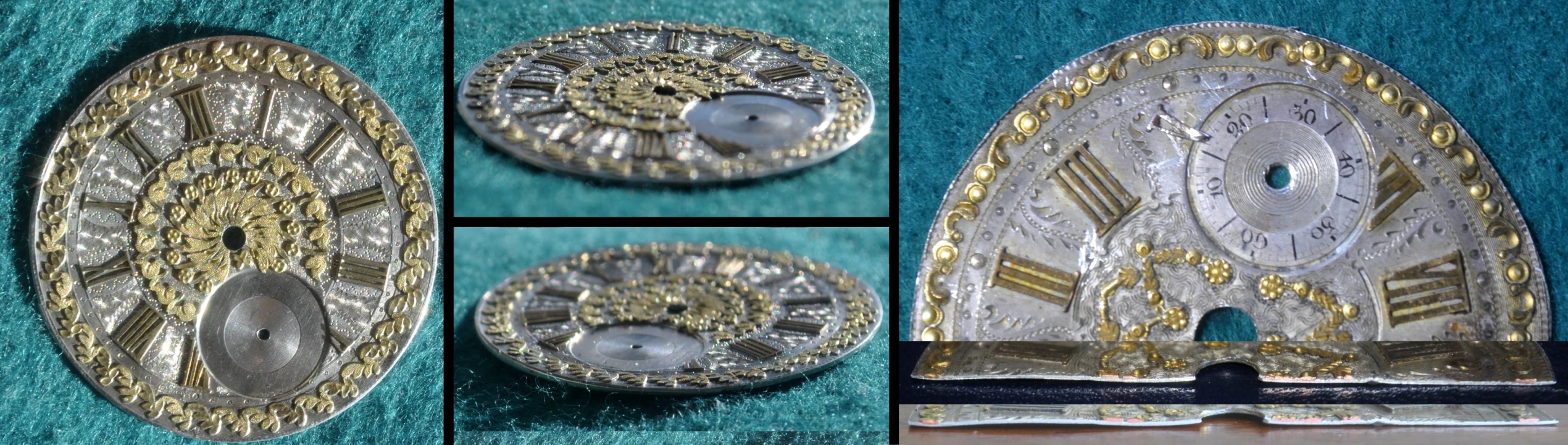
Victorian dials should be understood as an integrated system in which the metal base, relief work, textures, and gilded applications function in coordination. They are not simply a superposition of individual elements, but rather a design that combines aesthetics, legibility, and craftsmanship, reflecting a high degree of technical mastery in microfabrication.
Technical composition:
- Organic relief work
- Garlands, branches, and floral motifs in microrelief, arranged both around the perimeter and in the central area. These elements provide the dial with its visual structure and enhance legibility through contrasts of light.
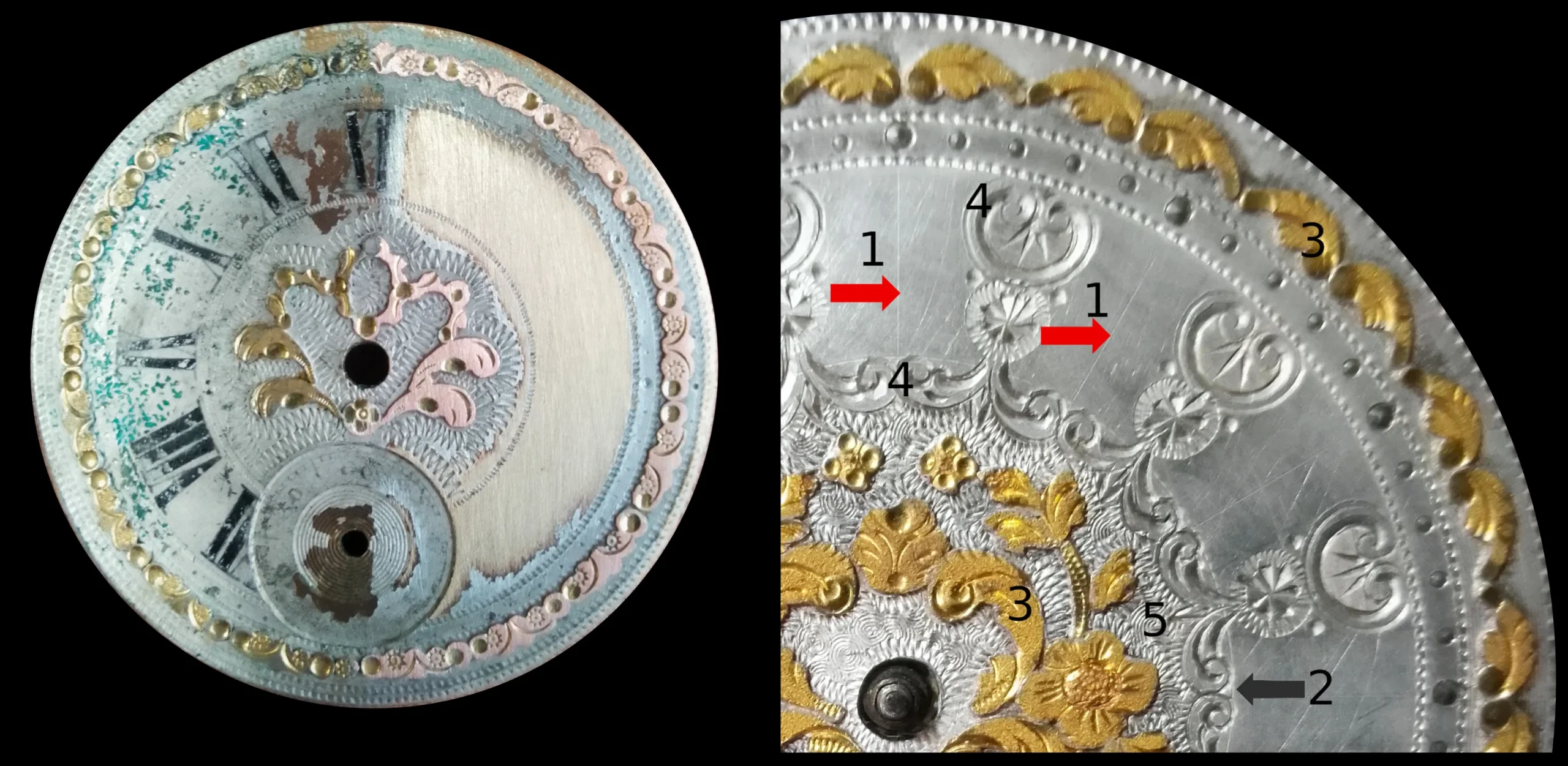
- Guilloché and engraved textures
- Repetitive patterns generated mechanically and refined by hand. These textures control the reflection of light and provide a surface against which the gilded elements stand out.
- Selective gilding of the microrelief
- Applied using mercury gilding to copper elements previously integrated into the surface. Variations in tone—from warm yellow to orange hues—allow the motifs to be visually differentiated without resorting to the extensive use of solid gold.
Most of these dials were intended for Hunter cases (with a cover), although some variants had only two covers, leaving the dial visible—what are known as Lépine cases.
Diameters range from 10 to 22 lignes (approximately 22.5 mm to 49.6 mm), with the absence of a seconds hand being common in smaller calibers.
2.2 Stages of the Manufacturing Process
Phase 1. Preparation of the Base Disc
The process begins with the manufacture of the metal substrate on which the entire dial will be developed. Three main configurations have been identified:
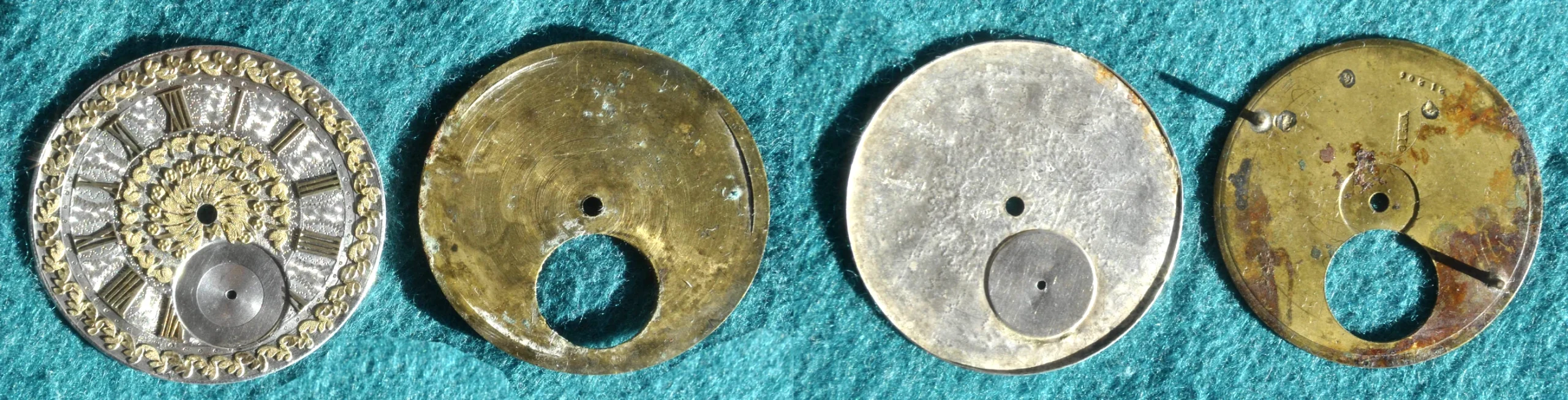
Silver-plated brass disc
The brass is coated with chemically applied silver, producing the characteristic white surface. In many examples, examination of the edge reveals accumulations or irregularities typical of this process.
Silver sheet on brass
A thin sheet of silver is applied to a brass substrate, combining a finished surface with structural stability.
Solid silver dials
Reserved for higher-quality pieces.
In all cases, this base forms the definitive foundation on which the decorative processes are carried out. The silver-plated back could be produced either by applying a sheet of silver or by chemically plating the brass, a process already described in applied metallurgy treatises in the 1880s.
Phase 2. Stamping and Structural Forming
The functional elements of the disc are defined using dies:
- Recessed seconds aperture
- Chronometry point markings
- Texturing of the peripheral area
At the end of this phase, the dial is structured into different levels and temporal reference points.
Phase 3. Integration of the Ornamental Elements
The decorative motifs, previously cut from copper, are arranged on the disc and secured by means of pressure and controlled heat. This process allows them to be inserted precisely into the surface, creating a stable and continuous microrelief.
The result is a structurally integrated decoration, rather than a superimposed layer, producing characteristic light effects under different lighting conditions.
Phase 4. Main Composition
In the central area, the decorative density is increased by the manual arrangement of several small elements, forming complex compositions that, after heat treatment, are fixed with great precision.
Phase 5. Surface Treatment
Through the use of stippling and microtextures, the reflection of light is controlled, intensifying the brilliance of the gilding without requiring an increase in the thickness of the applied metal.
Phase 6. Mercury Gilding
An amalgam of gold and mercury is applied to the copper elements, followed by heating to eliminate the mercury and fix the gold.
Variations in color are achieved by adjusting the composition of the amalgam and through subsequent treatments, producing different tones within the same decorative ensemble.
Phase 7. Final Chasing
Manual work is carried out to:
- Define the contours
- Reinforce the separations between areas
- Add complementary textures
At this stage, the lines that visually structure the dial are consolidated: the central area, hour chapter, and perimeter.
Phase 8. Application of the Hour Markers
At this stage, the elements that define the time display are applied.
Painted numerals
A mixture of carbon black, lavender oil, and copal varnish is used and applied with very fine brushes. The pigment is fixed by heat, producing brushstrokes with a slight relief.
The slight variations in thickness or alignment observed on many examples demonstrate the manual execution of the process and give each dial its individual character.
Applied metal numerals
In some cases, the numerals are produced by cutting them from metal sheets. They are secured by means of silver solder applied to the reverse and activated through controlled heating.
Although Roman numerals predominate, examples with Arabic numerals are also documented.
Phase 9. Marking the Seconds Subdial
The seconds subdial is completed by manually applying its scale.
This includes:
- Reference numerals (10, 20, 30… or 15, 30, 45, 60)
- Intermediate divisions marked by lines or dots
The same pigment compound described in the preceding phase is used and then fixed with gentle heat.
Phase 10. Soldering and Positioning of the Spherical Feet
The final phase consists of attaching the feet used to secure the dial to the movement.
Two soldered feet are generally positioned on the reverse, unlike some contemporary English productions, which used three. The soldering is carried out with careful temperature control to avoid altering the decoration on the front.
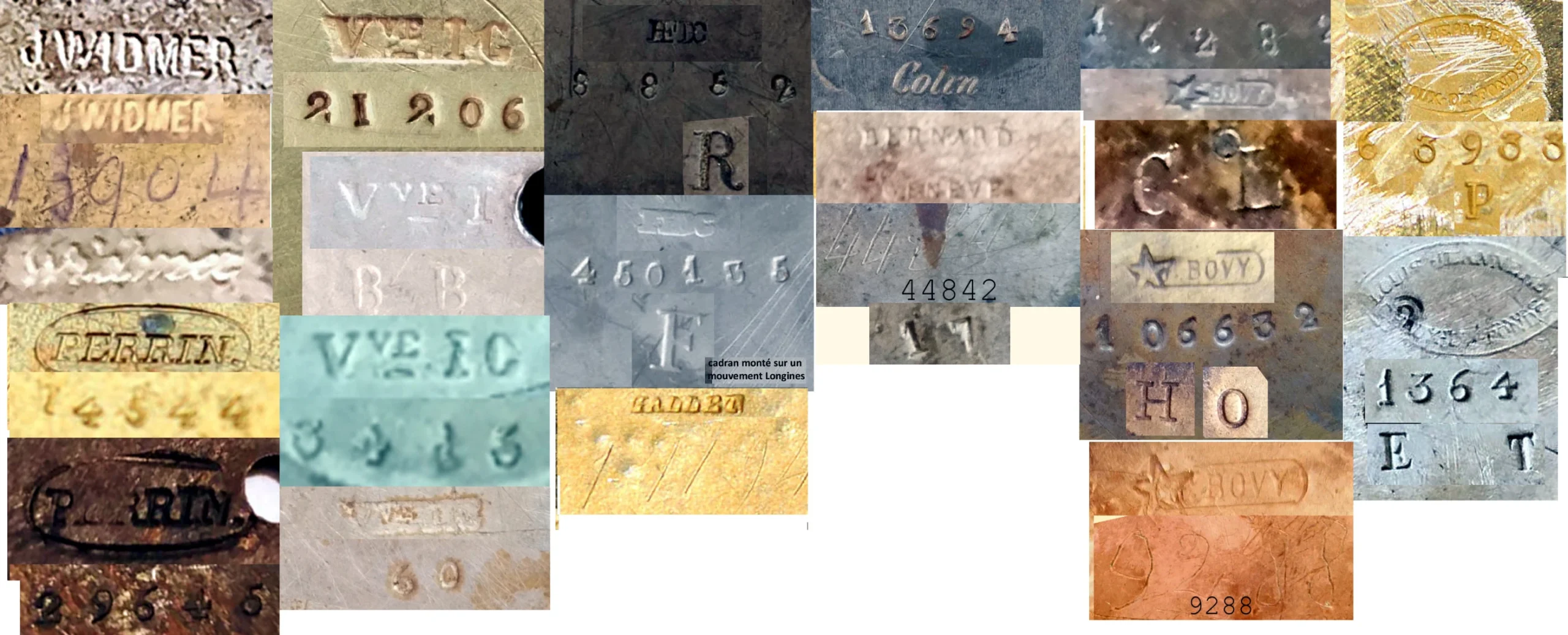
The position of these elements must correspond to the attachment points on the movement, suggesting that their alignment was verified during assembly. In some examples, matching numbering on the dial and movement further reinforces this functional correspondence.
2.3 Final Result
The dial reaches its final state while preserving the integrity of the silver-plated base established during the initial stages. The completed assembly combines:
- Continuous silver-colored background
- Copper microreliefs gilded with mercury gilding
- Engraved and chased textures
- Applied or painted numerals
- A secondary disc marked by hand
The contrast between the background and the gilded reliefs is the central visual principle. Each piece displays small variations resulting from the manual work, making it a unique object as well as a functional component of the movement.
The result is a miniature work of craftsmanship in which the mechanical precision of stamping and soldering is combined with the artisanal skills of gilding and lettering, creating an authentic example of micro-ornamental metalwork applied to watchmaking.
The hands follow an aesthetic and functional convention: poire-style hour hands and simple straight minute hands, ensuring clarity and harmony with the central relief decoration. In exceptional cases, Breguet-style hands were used, some set with tiny gemstones.
The finished dial combines precision, functionality, and symbolic value. The interaction between light, relief, and color creates a dynamic visual effect that immediately communicates the watch’s indications, regardless of the caliber or case type. In this way, the Victorian dial became an unmistakable indicator of quality and prestige in Swiss watchmaking intended for the Spanish and Spanish-speaking markets.
Practically all dial makers in La Chaux-de-Fonds, as well as other specialized workshops, participated in the production of these dials. Among the identified makers are:
Veuve Imer-Gallet | Gallet | Widmer | Bovy | Perrin | Bernard | Albert Paris | Louis Jeanneret | Colin | FEDC — Fabrique d’Ébauches de Cortébert?
Regarding the movements, it can generally be stated that virtually all Jura watchmakers were represented in this market. For this study, approximately three hundred movements and dust covers associated with this type of movement were examined.
A significant proportion of the movements analyzed do not bear the watchmaker’s name engraved on them, either because they were produced under private-label brands, or because the inscription of the movement specifications and manufacturer on the dust cover, a common practice at the time, was considered sufficient.
As for the identified and analyzed examples, they can be classified according to their frequency of use, from most common to rarest, as follows:
| WATCHMAKER | POCKET WATCHES | |
| Boch, Paul | Chaux-de-Fonds | 5 |
| Borel & Courvoisier | Neuchâtel | 2 |
| Borel-Huguenin | Neuchâtel | 2 |
| Calame-Robert, Jules | Chaux-de-Fonds | 3 |
| Chatelain, Ariste | Tramelan | 1 |
| Chatelain, Edouard | Tramelan | 3 |
| Chavin Fils & Prost | Morez du Jura | 3 |
| Couillaut, Eugenio | Madrid | Geneve | 3 |
| Courvoisier Fréres | Chaux-de-Fonds | 3 |
| Dracip, Noel | Geneve | 3 |
| Droz, Fritz-Arnold | Chaux-de-Fonds | 2 |
| Elias Frères | Geneve | 3 |
| Favre-Fallet, James | Saint-Imier | 2 |
| Girard Perregaux | Chaux-de-Fonds | 3 |
| Girard-Othenin & Co | Gèneve | 3 |
| Grandjean, Henri | Locle | 9 |
| Grosclaude, Charles Henri | Fleurier | 16 |
| Guye, Guillaume Henri | Aux Verrieres | 2 |
| Haas & Privat | Chaux-de-Fonds | 10 |
| Haas Jeune, Benjamín | Genéve | 3 |
| Huguenin, Auguste | Locle | 2 |
| Huguenin, Gustave-Adolphe & Fils | Ponts-Martel | 30 |
| Huguenin-Tissot | San Sebastian/P.Martel | 2 |
| Japy Fréres | Chaux-de-Fonds | 2 |
| Jeannot Paul | Barcelona/Geneve | 26 |
| Jeannot Victor | Barcelona/Geneve | 9 |
| Juillard-Morel, Albert | Cortébert | 2 |
| Lardet, Charles Edouard | Madrid/Fleurier | 21 |
| Le Coultre, Antoine | Sentier | 3 |
| Longines | Saint-Imier | 2 |
| Losada, José Rodriguez | London | 10 |
| Maret, Robert | Neuchâtel | 3 |
| Montandon Fréres | Locle | 2 |
| Nardin, Ulysse | Geneve | 3 |
| Nojeant | Geneve | 2 |
| Perret, Augustin | Locle | 2 |
| Perret Fils | Brenets | 2 |
| Robert-Maret, Louis Philippe | Neuchâtel | 2 |
| Rossel, Jean Samuel | Gèneve | 3 |
| Thiebaud, Henri | Fleurier | 4 |
| Thommen, Gedeon | Waldenburg | 2 |
| ANALISÉ | 215 |
2.4 Visual Uniformity Versus Mechanical Diversity
The market for Victorian-dial watches presents a paradox: while the exterior aesthetic was almost monolithic—a “prestige code” for the Spanish consumer—the movements concealed the full diversity of the Swiss watchmaking industry in the late nineteenth century.
1. Technical Heterogeneity
The movements incorporated a wide range of technical solutions:
Bridges: traditional Lépine configurations with curved, stylized bridges.
Finishing: from simple gilt brass to sophisticated Côtes de Genève decoration.
Precision configurations: standard escapements and mechanisms coexisted with movements equipped with gold chatons and high-precision regulators, all beneath the same aesthetic exterior.
Independence of origin: the dial functioned as a cross-manufacturer visual standard, allowing different manufacturers to share the same prestigious visual language.
2. The Dial as an Interface of Trust
Hierarchy of reliefs: a peripheral garland and a central gold medallion in microrelief, consistently present across the different models.
Functional adaptation: integration of the microrelief with the seconds hand when a seconds indication was present.
Chromatic identity: the silver-and-gold contrast reinforced the perception of distinction and tradition associated with Losada.
3. Conclusion
The Victorian dial acted as a prestige equalizer, standardizing the buyer’s experience and concealing the underlying technical diversity beneath a recognizable aesthetic code.
2.5 Marketing in Spain: Geographic Distribution and Centers of Influence
Even before the consolidation of nineteenth-century commercial networks, the earliest signs of the presence and activity of Swiss watchmakers in Spain can already be traced. In this context, Pierre Jaquet-Droz stands out, renowned for his sophisticated clocks and popular automata—such as The Writer, The Draughtsman, and The Musician—which he presented at various European courts, attracting the interest of the monarchy.
The young worker who accompanied him during his visit to Ferdinand VII in the mid-eighteenth century, Jacques Gevril, stayed in Madrid with a renowned specialist, Lantheoum, whose workshop employed several Neuchâtel watchmakers: Perret, Ducommun-dit-Boudry, Huguenin, and Rognon.
The export of Swiss watches to Spain developed particularly after the Napoleonic Wars, when these products were also reaching South America. The expansion of transportation and communication routes facilitated this trade.
Swiss manufacturing houses established operations in the principal cities. Thus, a house from Les Brenets (Canton of Neuchâtel), Jeannot’s, as well as several Geneva firms, established a presence in Barcelona during this period. Fleurier, in the Val-de-Travers, counted Spain among its principal markets, alongside China and England. Several firms from the town worked specifically for Madrid, including the Lardets, Guyes, and Grosclaudes.
The principal Swiss watchmaking centers followed suit. Merchants traveled to the Iberian Peninsula, particularly as the Beaucaire fairs, which had served as intermediaries, declined in importance following the expansion of the railway network.
For Spain, most imports in 1870 were handled through Ch.-Ed. Lardet of Fleurier, established in Madrid, where he served for many years as Swiss consul. The Spanish market had already been reached by 1867. At that time, another brother-in-law of Jules Borel, Jean Courvoisier, the younger brother of Paul, joined the firm and became a partner two years later. He took a particular interest in Spain, where he traveled extensively; his letters from Madrid, Barcelona, and Murcia are preserved in a family book. After eight years, Jean Courvoisier left the firm to become Director of Finance of Neuchâtel.
The widespread presence of these watches throughout Spain reveals the existence of a highly developed distribution network, capable of reaching major capitals and urban centers associated with an emerging bourgeoisie. This was not simply an export model, but rather a system of two-way commercial exchange between Swiss manufacturers and Spanish agents and watchmakers.
On the one hand, some establishments were supported by Swiss intermediaries residing on the Iberian Peninsula—such as Lardet, Grosclaude, Coillaut, Gindrat, Jeannot, and Huguenin-Tissot—who acted as commercial hubs, facilitating contacts, distribution, and adaptation to the local market. However, the documentation shows that this network was not exclusive. Swiss manufacturers could also operate directly, as demonstrated by Lardet’s reports to the Swiss watchmaking industry, which warned about the solvency of Spanish buyers or documented the journeys of watchmaking families traveling for business or collecting purposes, such as Philemon Huguenin.
Conversely, the commercial flow also operated from Spain toward Switzerland. Spanish merchants and watchmakers—such as Jaime Trilla in Barcelona and Ghiara in Málaga—commonly negotiated the direct acquisition of watches. This dynamic market relied on personal relationships, commercial credit, and mutual knowledge, rather than rigid organizational structures.
1. Madrid, Barcelona, and San Sebastián as Central Hubs
Madrid functioned as a major receiving and redistribution center through Swiss watchmaking families such as Lardet, Couillaut, and Grosclaude, who operated as établisseurs:
- They managed imports and supervised aesthetic consistency.
- They distributed watches to provincial brand manufacturers and jewelers, maintaining the uniformity of the “Swiss prestige brand.”
2. Geographic Distribution
These watches are found throughout the Iberian Peninsula (Spain and Portugal) as well as in Latin America.
Barcelona: a principal point of entry and a market with considerable purchasing power, generating demand for visual sophistication.
South (Seville, Málaga, Cádiz): significant presence among commercial and agricultural bourgeois circles.
Levante and Central Spain (Valencia, Murcia, Toledo): adopted by emerging middle classes seeking to emulate the success of Losada through Swiss products.
3. A Swiss-Made Spanish Brand
The immediate recognition of the gilded microrelief and silver-colored background ensured the perception of a reliable investment and refined taste, functioning as a national mark of trust, regardless of the point of sale.
2.6 Industrial Coordination: Brands, Ébauches, and Agents
The visual uniformity of these watches was achieved through a coordinated system involving several different actors:
Local brands and watchmakers: supervised imported watches and components to ensure that they conformed to the required aesthetic standards, carrying out adjustments and finishing work when necessary.
Ébauche makers and Swiss manufacturers: supplied partially completed or finished movements, incorporating technical innovations while working to the specifications established by agents such as Lardet.
Agents and commission agents: based primarily in Madrid and operating in other cities, they coordinated orders, quality control, and shipments, while also serving as information and commercial links between the Spanish market and the Swiss watchmaking industry.
Synergy: the interaction among these different actors brought together technical production, decoration, and marketing, helping establish the Victorian dial as a recognizable symbol of prestige and reliability.