History of Swiss "Genre Espagne" Pocket Watches for the Spanish Market

Swiss Pocket Watches with Victorian Dials in Spain

A preliminary approach to their study, by Ramón Campos

  1. Introduction

1.1 Study Objective

The objective of this study is to analyze and understand the introduction, circulation, and consolidation in Spain of high-grade Swiss pocket watches featuring Victorian dials—characterized by a stamped and chased silver ground with perimetric garlands and a gilded micro-relief central motif—during the second half of the 19th century and the early 20th century.

This research extends beyond the description of isolated pieces, seeking to reconstruct a historical, technical, and commercial ecosystem where watchmakers, brands, ebauche makers, commercial agents, and diplomatic figures such as Charles Édouard Lardet converged.

The Victorian dial is examined as an integrative and prestigious element: despite the diversity of calibres, ebauches, and manufactures, a visual uniformity existed that identified a consistent style and quality. This aesthetic was aimed almost exclusively at a Spanish-speaking market that had long valued pocket watches signed by José Rodríguez de Losada, whose models had popularized this specific dial decoration for decades.

Lardet—born in La Côte-aux-Fées, established in Spain, and serving as Swiss Consul in Madrid—recognized the commercial standing and social prestige of these models. Supported by his brothers Gustave and Alfred in Fleurier, he facilitated the Swiss watch industry’s entry into this market niche, fostering the production and commercialization in Spain of pocket watches directly inspired by the established aesthetic of Losada’s Victorian-dial pocket watches.

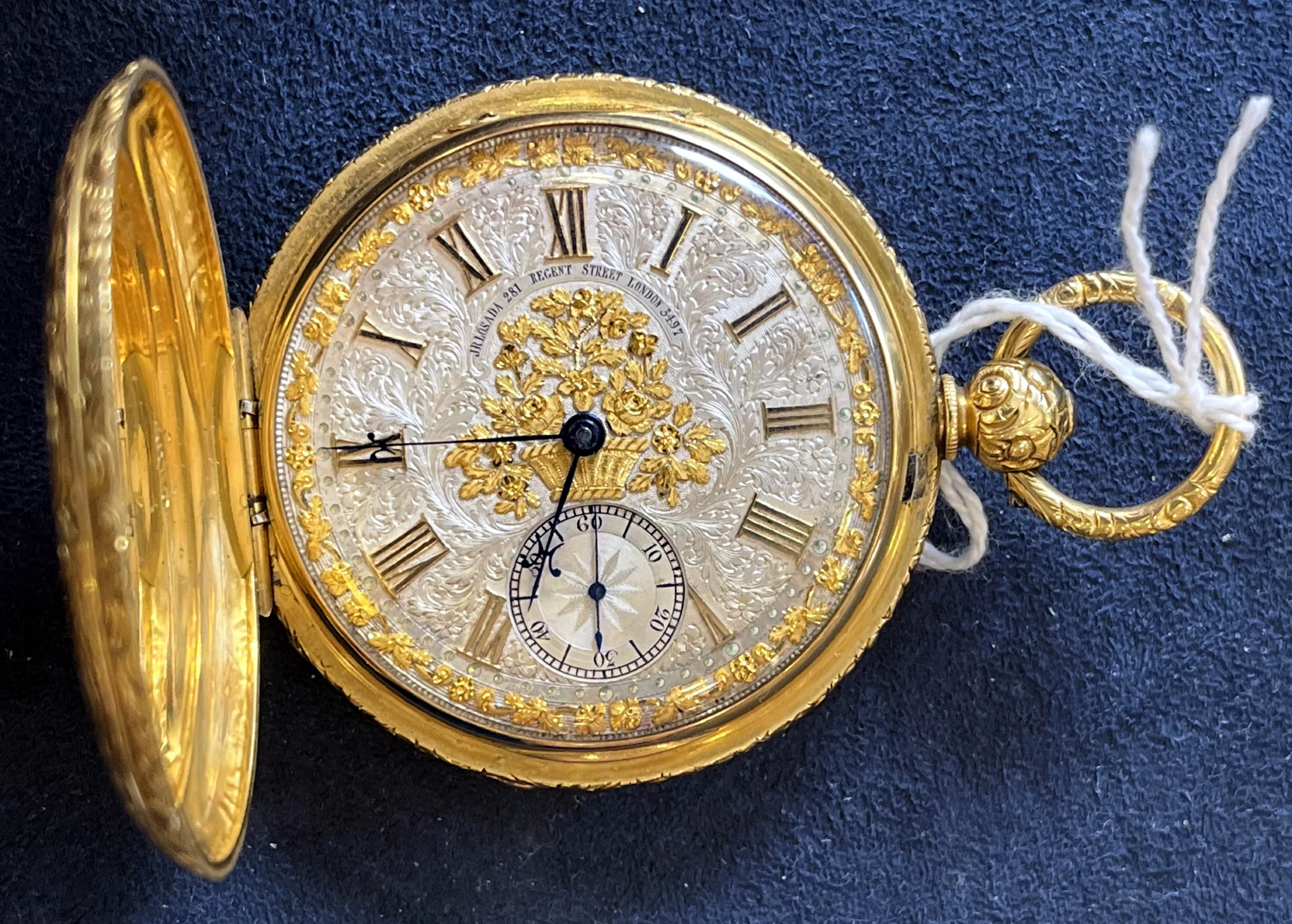
No. 3497 – 1855. One of José Rodríguez de Losada's most representative creations: his pocket watches, featuring Victorian dials decorated with gilded micro-relief inlays, the hallmark of his most characteristic production. (Courtesy of Subastas Segre, Madrid, Spain).

Specific objectives include:

  • Historical: Reconstruct the trajectory of Swiss watchmaking in Spain bearing this aesthetic by identifying the key figures and milestones that enabled the importation, adaptation, and dissemination of high-grade pocket watches, as well as the way in which the renown of the Losada brand served as a benchmark for the Spanish market.

  • Technical: Analyze the mechanical characteristics of Lardet pocket watches and those from other involved manufacturers—paying close attention to their jewels, escapements, hairsprings, jewels in chatons, and calibres—and examine how these elements integrated with the Victorian aesthetic to consolidate an esteemed and recognized style.

  • Commercial: Examine commercialization and distribution channels, taking into account the role of commission agents, wholesalers, and representatives, as well as how the presence of Swiss pocket watches in Spain was organized to maintain aesthetic uniformity alongside technical diversity.

  • Analytical: Formulate hypotheses on the Swiss industrial coordination that enabled the uniformity of dials and styling, considering the possibility that the entire industry functioned in an interconnected manner under the supervision of one or more production hubs, following the successful model established by Losada in London.

  • Cultural and Social: Explore the impact of these pieces on the Spanish market, the prestige associated with their ownership, and how watchmaking became a vehicle for social and economic status, consolidating the Victorian dial as a symbol of sophistication and confidence in Swiss quality.

In summary, this study aims to reveal the Victorian dial as the unifying thread of technique, commerce, and prestige—placing Swiss pocket watches in Spain within a broader framework of innovation, influence, and industrial coordination, while leaving open those questions that historical and documentary research has yet to clarify.

1.2 Temporal and Geographical Scope

1.3 Methodology and Hypothesis: Charles Édouard Lardet and His Influence

1.3.1 Biography and Diplomatic Career Charles Édouard Lardet was born in Fleurier (1832), Switzerland, and settled in Madrid during the mid-19th century. Appointed Swiss Vice-Consul in 1875 and Consul General in 1877, Lardet played a pivotal role in promoting and coordinating high-grade Swiss pocket watches for Spain and Portugal. His dual status as a diplomat, tariff negotiator, watchmaker, and commission agent enabled him to act as a privileged intermediary, managing customs, shipments, and commercial relationships with an authority unmatched by other watchmakers or representatives.

1.3.2 Lardet as Commission Agent and Founder Period documentation—such as the 1887 Annuaire du Commerce—confirms his dual role as consul and commission agent for mechanics at Calle Victoria 2, Madrid. This position allowed him to supervise the importation and distribution of high-grade Swiss pocket watches, control sales channels to major Spanish retailers, and ensure visual and technical consistency, notably concerning the Victorian dial.

His activity consisted of coordinating workshops and orders in Switzerland to meet the demands of the Spanish market, following the pathway forged by the popularity of Losada in London.

(Addendum: Lardet’s success as Swiss Consul in Spain materialized in a commercial treaty under which gold watch housings paid a tariff of only one peseta per piece [approximately 30 pesetas per kilogram], whereas raw gold was typically taxed at around 250 pesetas per kilogram—nearly a tenfold difference. This tariff disparity created a direct incentive to import complete Swiss pocket watches, boosting their competitiveness against English and other foreign products. By drastically reducing the fiscal duty on finished pocket watches, this measure facilitated their distribution across Spain and stimulated demand within a growing market, while high bullion duties deterred the export of raw precious metals. This mechanism illustrates how consular policy and bilateral treaties decisively shaped market dynamics between watchmaking nations.)

At the 1900 Paris Universal Exposition, Charles Édouard Lardet presented a series of high-grade pieces specially created for the Spanish market, including a 20-ligne gold hunter pocket watch decorated with an elaborately chased dragon motif.


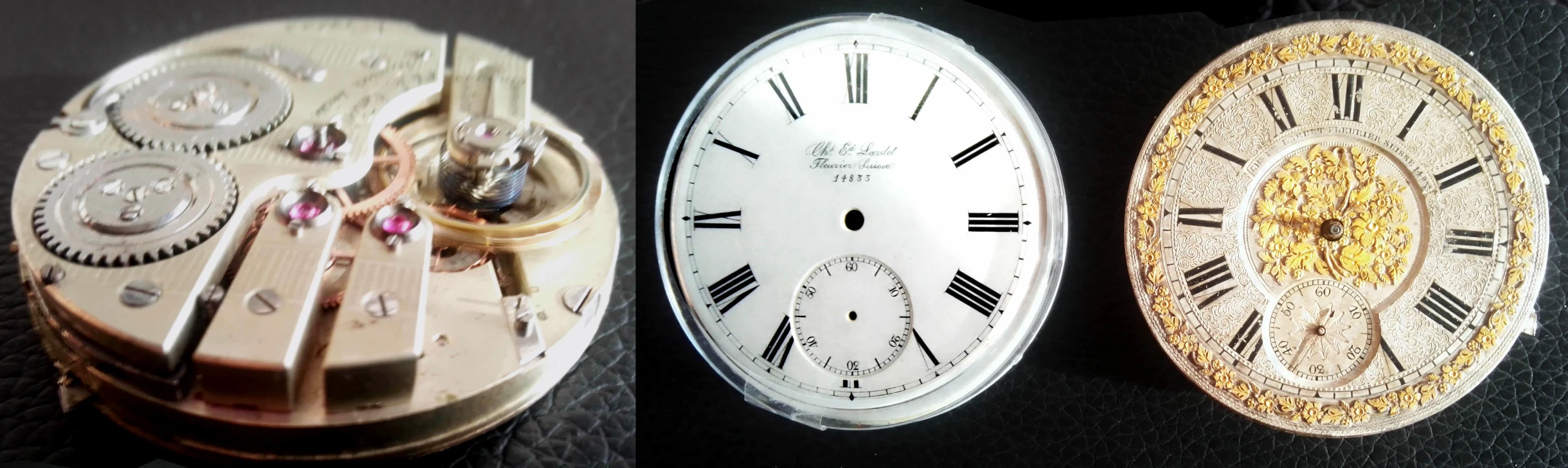
No. 14833 – Charles Édouard (Bovet) Lardet. Madrid and Fleurier, c. 1885. Chronometer featuring jewels in chatons, vivid rose-cut ruby endstones on the balance arbor, bimetallic balance, cylindrical hairspring, and Earnshaw-type detent escapement. Presented in a luxurious ebony presentation box with a velvet-lined interior, complete with a spare crystal and a plain white spare dial designed for more understated tastes, reflecting a restrained aesthetic compared to the ornamental richness of the Victorian period. The original gold case has not survived.

Lardet opened a primary workshop in Madrid and maintained a branch in Fleurier managed by his brothers Alfred (1) (who continued the business with his niece Luisa after C.-H.’s death) and Louis-Gustave Lardet (who resigned in 1898), ensuring direct contact with Swiss manufacturers and controlling the production of dials and calibres. Ferdinand Hodler’s (1853–1918) painting depicting Lardet’s Madrid workshop illustrates the workspace, organization, and social prominence of the watchmaker in the Spanish capital, reinforcing the image of a prestigious workshop catering to a demanding clientele.

(1) Alfred Lardet was a watchmaker of such prestige that in 1897 he was selected as a member of the Neuchâtel State Council commission charged with reforming chronometry competition regulations at the cantonal observatory. By being chosen to represent the town of Fleurier within this exclusive group—sharing the table with figures of the stature of Tissot, Nardin, and Ditisheim—his appointment confirmed his technical authority in high chronometry. This responsibility placed him at the core of decisions aimed at elevating Swiss precision standards and unifying technical criteria with the Geneva Observatory.

Lardet periodically sent reports from Spain to the Swiss industry detailing market acceptance, pricing, and local preferences. Coordination was maintained with agents and établisseurs in Fleurier and La Chaux-de-Fonds, adjusting the production of calibres, ebauches, and dials to Spanish taste, ensuring the uniformity of the Victorian dial and consolidating a recognized style in Spain. Surviving correspondence in Archives Portal Europe (J1.2#1000/1310#130*, E2200.38-04#1000/483#774) substantiates his role as the central node of the Swiss commercial network on the Iberian Peninsula.

1.3.3 Lardet’s Impact on the Commercialization of High-Precision Pocket Watches in Spain

Lardet did not merely promote the introduction of mid-grade pocket watches; he also manufactured pieces featuring Earnshaw detent escapements, cylindrical hairsprings, and chaton-set jewels, combining precision and prestige in the pure style of Losada.

The movement No. 18833 by Charles Édouard Lardet, dating to around 1875—and similar to watch No. 1625 produced in 1851 at José Rodríguez de Losada’s establishment—features a classic plain white enamel dial option, an Earnshaw detent escapement, a silver dial decorated with a perimetric garland and a central gilded micro-relief floral composition, a cylindrical hairspring, and a rose-cut jewel set in a chaton on the balance arbor.

The popularity of these models consolidated the Victorian dial as a symbol of distinction and confidence in Swiss quality, replicating and expanding upon the market acceptance achieved decades earlier by pocket watches signed by José Rodríguez de Losada.

Circular black-and-white seal featuring the name Ramón Campos, researcher of 19th-century Swiss watchmaking and early fountain pens.